
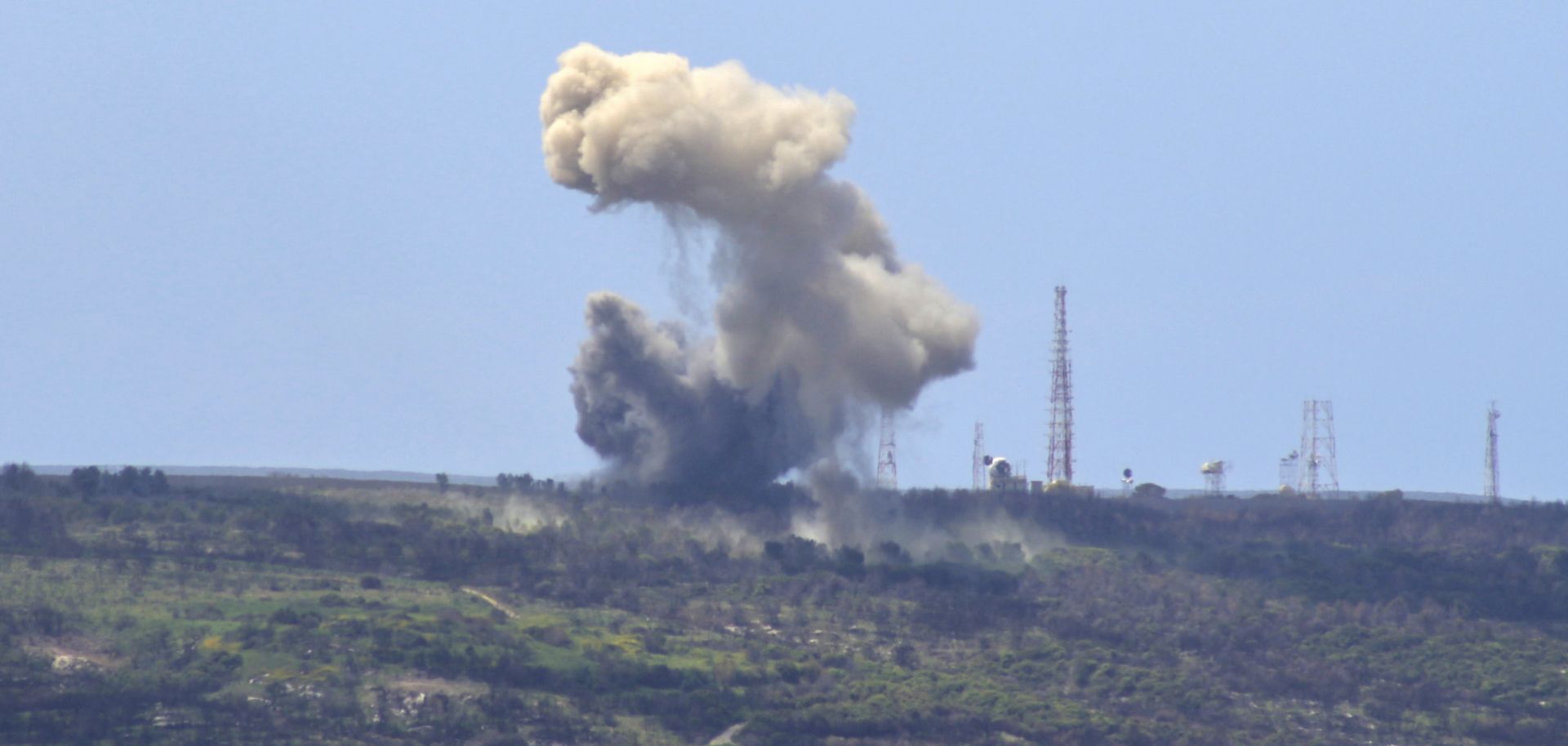
Despite elevated risks of a wider war and expanded tit-for-tat military exchanges, Israel and Hezbollah will likely opt to eventually resolve the border crisis diplomatically as the conflict in Gaza winds down, potentially resulting in a security zone on their shared borders. In a bid to signal openness to a diplomatic solution, and to keep diplomatic initiatives afloat, the Lebanese government submitted a written answer to France's concrete plan for a truce between the Lebanese militant group Hezbollah and Israel, Reuters reported on March 15. Lebanon said that the plan is a significant step toward achieving a truce on the Lebanese-Israeli border, without discussing the details of the proposal. However, both Hezbollah and Israel are unlikely to accept the proposal in its current form until the war in Gaza ends. Amid expanding cross-border skirmishes between Hezbollah and Israel and increasing saber rattling, France submitted the first concrete de-escalation proposal on Feb. 12 for the cessation of hostilities between Hezbollah and Israel. The French proposal would see Hezbollah dismantling its facilities and outposts close to the border and withdrawing its forces — including Hezbollah's elite Radwan brigade fighters and military capabilities, such as anti-tank systems — at least 10 kilometers (roughly 6.2 miles) north of the frontier, enabling northern Israelis who have been displaced by the border violence to return home. Within ten days of Hezbollah's withdrawal, the Lebanese and Israeli governments would resume negotiations to delimit 13 disputed border points, while Israel would also stop its air and artillery strikes against Lebanon.
- Since the current war began on Oct. 7, Hezbollah has exchanged fire with Israel in support of Hamas in Gaza. While these strikes have not resulted in a full-scale confrontation between the two opponents, Israeli strikes and Hezbollah responses have expanded in both intensity and geographic scope, heightening the risks of a miscalculation that could result in a wider war.
- The administration of U.S. President Joe Biden has sent Amos Hochstein, the U.S. envoy who led the negotiations that culminated in the 2022 Maritime Border Deal between Lebanon and Israel, to both countries several times since the start of the latest Gaza war, in a bid to advance diplomatic efforts aimed at ending the cross-border hostilities.
- On March 28, White House National Security spokesman John Kirby reaffirmed that the United States does not support a war in Lebanon, noting that ''restoring calm along [the Lebanese-Israeli] border remains a top priority for President Biden and from the administration, and it has to be of the utmost importance, we believe as well, for both Lebanon and Israel.''
- Several other Western leaders, including Italy's prime minister and France's foreign minister, have also visited Beirut several times in an effort to keep diplomatic initiatives afloat amid the ongoing border clashes, knowing that Hezbollah is conditioning any diplomatic settlement with Israel ending its war in Gaza.
In the near term, Hezbollah will likely continue to adopt ''strategic patience'' and calculate its every attack against Israel in a bid to support the Palestinians, as well as maintain the status quo and what the group describes as the ''Balance of Fear'' vis-a-vis Israel. Throughout the conflict, Hezbollah has tried to maintain the pre-existing rules of engagement with Israel, attacking Israeli border towns whenever Israeli attacks targeted civilians in Lebanon, while striking military assets whenever significant Hezbollah operatives were killed. As long as Israeli strikes remain under the threshold of a war, Hezbollah will try to maintain the current level of exchanges. In recent weeks, Israeli attacks have expanded in Lebanon, with the Israeli Air Force (IAF) striking deep in the Bekaa in northeast Lebanon several times. In response, Hezbollah has expanded its targeting of Israeli military assets, albeit by launching barrages of inaccurate Katyusha rockets, minimizing the risks of casualties and potential reprisal attacks by Israel that could compel the group into more significant attacks that would risk triggering a wider war. Hezbollah's calculus is that by maintaining pressure on Israel, and by trying to absorb losses without being provoked while simultaneously retaliating, the group will be able to secure more concessions from Israel in the long term. Hezbollah also believes that maintaining the current rules of engagement with Israel is in its favor, and will also deter Israel from any potential war with Lebanon. Despite knowing that a miscalculation can provoke an unwanted war, Hezbollah will keep betting on this calculus in the hopes that in the end, it will declare victory if the status quo is maintained and Israel fails to achieve most of its objectives.
- Through its Secretary General Hassan Nasrallah, Hezbollah has repeatedly stated that while the group prefers to avoid war, it is nevertheless prepared for one.
- Since the onset of the current Israel-Hamas war, Hezbollah has attacked Israeli border towns mostly with anti-tank guided missiles (ATGM). In response to Israel's expansion, the group has also started attacking Israeli army command bases, including ones in Safed and the Golan Heights, with barrages of Katyusha rockets. Through this strategy, Hezbollah is signaling that while the group prefers to avoid war, they can expand their targeting of Israeli military assets at any time.
Israel will likely continue to expand its strikes against Hezbollah, aiming to extract maximum concessions from the group ahead of a potential diplomatic settlement. Despite being domestically strained and missing U.S. support for an unprovoked war with Hezbollah, Israel is trying to change the unwritten rules of engagement with the Lebanese militant group to its advantage, trying to normalize deeper and more significant strikes that would result in more significant Hezbollah losses. In doing so, Israel has likely assessed that Hezbollah's choice of strategic patience and its unwillingness to go to war will enable Israel to continue pushing the boundaries of the gray zone conflict. This means Israel will likely keep conducting greater strikes against the group's assets in both Lebanon and the wider region, in the hopes of pushing Hezbollah into either caving or retaliating to the extent of provoking a larger Israeli reaction that would compel the United States to support Israel. By continuing down this path, Israel is also likely hoping to gain leverage in any potential diplomatic settlement that could enable it to extract more concessions from the group, like the establishment of a buffer zone on the Israeli-Lebanese border, which would force Hezbollah's elite units to retreat farther north. However, despite escalating its targeting of Hezbollah assets and commanders geographically, Israel's attacks have not yet crossed the threshold that would risk triggering a wider war with the group, which would involve targeting Hezbollah officials in Beirut, incurring massive civilian losses, and/or targeting vital infrastructure. While Hezbollah's strategy focuses on the long term, Israel on the other hand is looking for quick, tactical victories amid its stalling war in Gaza and inability to achieve full deterrence with these groups. While Israel, like Hezbollah, prefers a diplomatic solution, its expanding strikes nonetheless risk resulting in a miscalculation by either side that could provoke an unwanted war.
- Israel needs a buffer zone of at least 10 kilometers to prevent Hezbollah's elite Radwan forces from operating near its border towns, and to launch ATGM attacks against them. Hezbollah's attacks have emptied most Israeli border towns, and northern Israeli citizens are increasingly pressuring their government to act by removing Hezbollah from the Israeli border so they can return home.
- In recent months, Israel has engaged in an escalatory political posture, with its leaders — including Prime Minister Benjamin Netanyahu and Defense Minister Yoav Gallant — threatening Hezbollah with war while also holding the Lebanese government accountable. Israel has also conducted numerous drills in its north and transferred more troops and equipment toward the Lebanese border.
Once Israel ends its military operations in Gaza, the French plan could become a starting point for potential negotiations between Hezbollah, Lebanon and Israel. With the prospect of French and other international aid on the table in exchange for de-escalation, the French offer could become part of the general sentiment designed to prevent another Lebanese-Israeli war. Given Lebanon's deep economic crisis, international aid offers are highly attractive for all Lebanese political actors, including Hezbollah. In addition, Hezbollah has no clear victory path for a conflict with Israel that doesn't involve more economic destruction for Lebanon, an outcome that might weaken Hezbollah's domestic political status even if it's able to fend off an Israeli military assault. A final diplomatic settlement may include a variety of border solutions, including the return of U.N. peacekeepers and Lebanese soldiers to the region, a partial Hezbollah withdrawal, or a full Hezbollah pullback from a limited buffer space. And in exchange, Israel may agree to negotiate a withdrawal from several contested border towns, as well as negotiate the final status of 13 locations on the border that remain in dispute. Such a plan, however, would likely need U.S. backing. It would also probably be similar to the Lebanese-Israeli maritime agreement, in which both sides demarcated the border in order to extract economic benefits but did not delve deeper into the bigger drivers of their conflict or begin a comprehensive peace process.
- France and other international donors like Saudi Arabia and the United Arab Emirates have tied further aid to Lebanon to structural economic reform, which Lebanon's paralyzed government has failed to accomplish. But these foreign donors have recently signaled they might soften such demands for reform if Hezbollah de-escalates with Israel.
- In late 2022, Hezbollah did not block a Lebanese-Israeli maritime agreement over the disputed Karish gas fields in the eastern Mediterranean — partially because the group hoped to benefit from investment and possible energy revenue in the future, and partially because Hezbollah was fending off domestic political criticism at home that it was intentionally blocking reform and, in turn, crucial international aid for Lebanon.
- The United States has also put forward a plan to cease hostilities between Hezbollah and Israel, which proposes establishing a mechanism for implementing U.N. Security Council Resolution 1701, which ended the two sides' 2006 war.
