
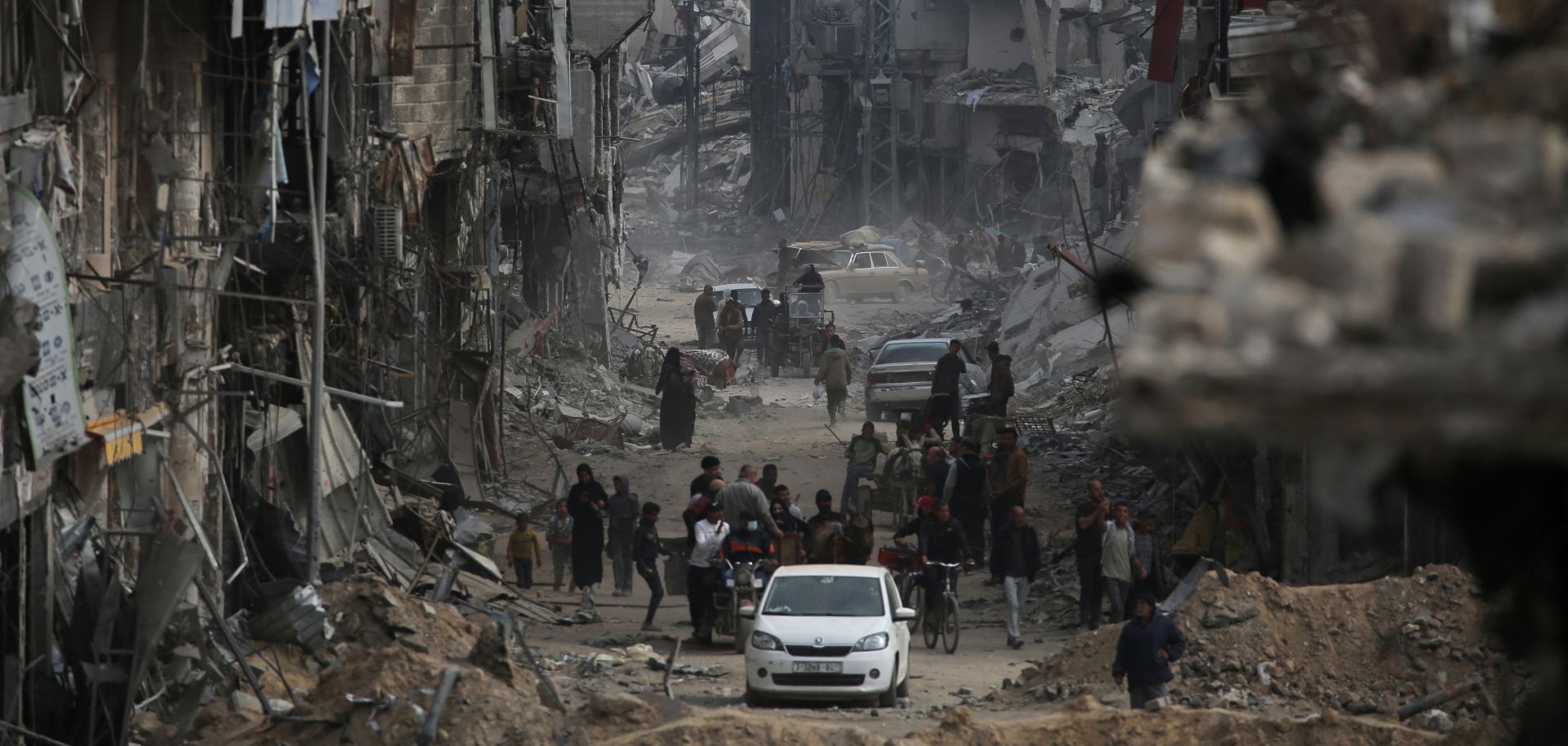
Israel's military strategy in the Gaza Strip is more overtly shifting to targeted operations instead of large-scale operations, but Israel's apparent lack of a sustainable governing strategy for Gaza will enable Hamas to maintain influence on the ground. On April 7, the Israel Defense Forces (IDF) withdrew all but one brigade from Gaza. The same day, Defense Minister Yoav Gallant said that the Palestinian militant group had been degraded to the point where it no longer ''poses a risk to the citizens of the State of Israel.'' The withdrawal of IDF forces triggered a backlash from the country's right wing, with National Security Minister Itamar Ben Gvir threatening to collapse the government if there was no offensive on Rafah. In an effort to push back against the right-wing opposition, Prime Minister Benjamin Netanyahu said on April 8 that ''there is a date'' to attack Rafah and that ''it will happen.'' Nonetheless, there remains doubt as intense diplomatic and internal political pressure mounts on Israel's government to halt preparations for a mass offensive on Rafah and instead agree to a temporary cease-fire with Hamas.
- At the height of the current war, Israel deployed 30-40,000 troops of its frontline combat units to Gaza, with significant fighting destroying large swathes of the strip.
- Israeli officials said that 18 of Hamas' 24 battalions had been dismantled, with four still in Rafah and two in central Gaza, but none able to carry out large-scale operations against Israel as they had before the current conflict began on Oct. 7.
With Israeli forces still positioned in and around Gaza, the IDF will be able to focus on a more targeted raid approach to degrade remaining Hamas forces as negotiations continue for a diplomatic breakthrough to end the war. In recent weeks, it has become more apparent on the Gazan battlefield that the IDF is increasingly focusing on targeted raids rather than major offensives to dismantle Hamas throughout an urban area, like the ones that took place in Khans Younis and Gaza City. For example, in a recent major battle at Shifa Hospital — well in Gaza's north, which the IDF nominally secured in late 2023 — Hamas and the IDF fought an extended battle that lasted two weeks and resulted in hundreds of deaths. The shift in IDF tactical operations suggests that Israel may consider a more targeted approach to operations in Rafah rather than a large-scale invasion. Israel is under intense international pressure not to attack Rafah in a mass assault, with President Joe Biden suggesting that U.S. policy — such as arms sales — might change should Israel do so over American objections. In recent weeks, a growing number of Israelis have also taken to the streets to demand that their government focus on releasing the remaining hostages still being held in Gaza, instead of defeating Hamas immediately. Negotiations to secure a partial or complete cease-fire that would halt fighting in exchange for the release of Israeli hostages remain ongoing.
- There are nearly 1 million Palestinian refugees around Rafah and there is no clear safe zone for them to move to. This has increased international pressure on Israel to refrain from another major invasion of the area akin to those the IDF conducted elsewhere in Gaza. The battles of Khan Younis and Gaza City caused widespread destruction and saw most of the civilian population flee those areas, many to Rafah.
- Israel claimed it killed up to 200 militants and captured 900 more, including top Hamas and Palestinian Islamic Jihad commanders, during the March battle at Shifa. In addition, in contrast to the November assault on the hospital, Israel endured comparatively little international condemnation for the raid, despite what media reported was the more significant damage to the complex than the first battle in November.
The IDF's withdrawal of troops from southern Gaza and increased focus on targeted operations will prevent Israel from being able to completely suppress Hamas and other militant groups. Though there is no firm number as to how many troops are needed to suppress an insurgency, a single brigade — or around 2,000-5,000 soldiers — is enough to control the Gaza Strip's estimated 2.1 million population. As demonstrated by recurrent battles in northern Gaza, Hamas and other militants will likely be able to reorganize and recruit new fighters for fresh operations in the absence of clear Israeli control. While Israeli raids will be able to break up the formation of large Hamas battalions, militants will likely be able to operate as underground cells and small unit formations and return to some of their roles in civil administration and police functions. Unless a full-scale cease-fire is reached, these formations will be able to attack Israeli forces, even occasionally firing rockets into Israel using preexisting stores and/or underground rocket factories. However, the number of rocket attacks on Israel is unlikely to reach previous highs due to constant Israeli bombardment and targeted operations that focus on Hamas' rocket production and logistics.
- Israel has attempted to find local civilian partners in northern Gaza to help distribute aid, a plan that has so far failed to yield a sustainable governing framework to supplant Hamas. Hamas police have reportedly returned to the streets in locations that the Israeli military has withdrawn from in the north.
- Israeli-Hamas peace talks have foundered on Hamas' demands for a full-scale Israeli withdrawal from Gaza and a permanent halt to the fighting, while Israel has pushed for a temporary cease-fire and a release of hostages before starting talks to end fighting entirely. According to Egyptian media, the most recent round of negotiations, which was held on April 7 in Cairo, apparently made some progress, but it was unclear if these substantial gaps had narrowed.
With Israel and Hamas potentially remaining in extended combat for months to come, a political solution to the conflict will remain elusive, hindering reconstruction and further deepening international pressure on Israel to shift its strategy toward focusing on the governance and rebuilding of Gaza. Given the lack of progress in cease-fire talks, Israel and Hamas will continue to fight small-scale battles, while Israel will utilize raids on Rafah to steadily degrade Hamas' remaining organized battalions. Israel may still conduct a major assault on Rafah if it can secure U.S. backing, but it will still prefer raids designed to pressure Hamas into a diplomatic deal in Israel's favor. However, within this environment, reconstruction will be impossible, with international aid focusing on everyday necessities instead. This will leave the humanitarian situation difficult for civilians, which will in turn spur Israeli allies like the United States to shift their attention from solely preventing Israel from causing more civilian casualties toward establishing policies that allow reconstruction to begin. As a result, in the long run, Israel will consider imposing a West Bank-style solution on Gaza that sees Israel assume many civil responsibilities for the strip.
- The United Nations now estimates that it could take decades to rebuild Gaza. The World Bank put the current reconstruction cost at $18 billion, but warned the total cost will increase once a full assessment can be made.
