
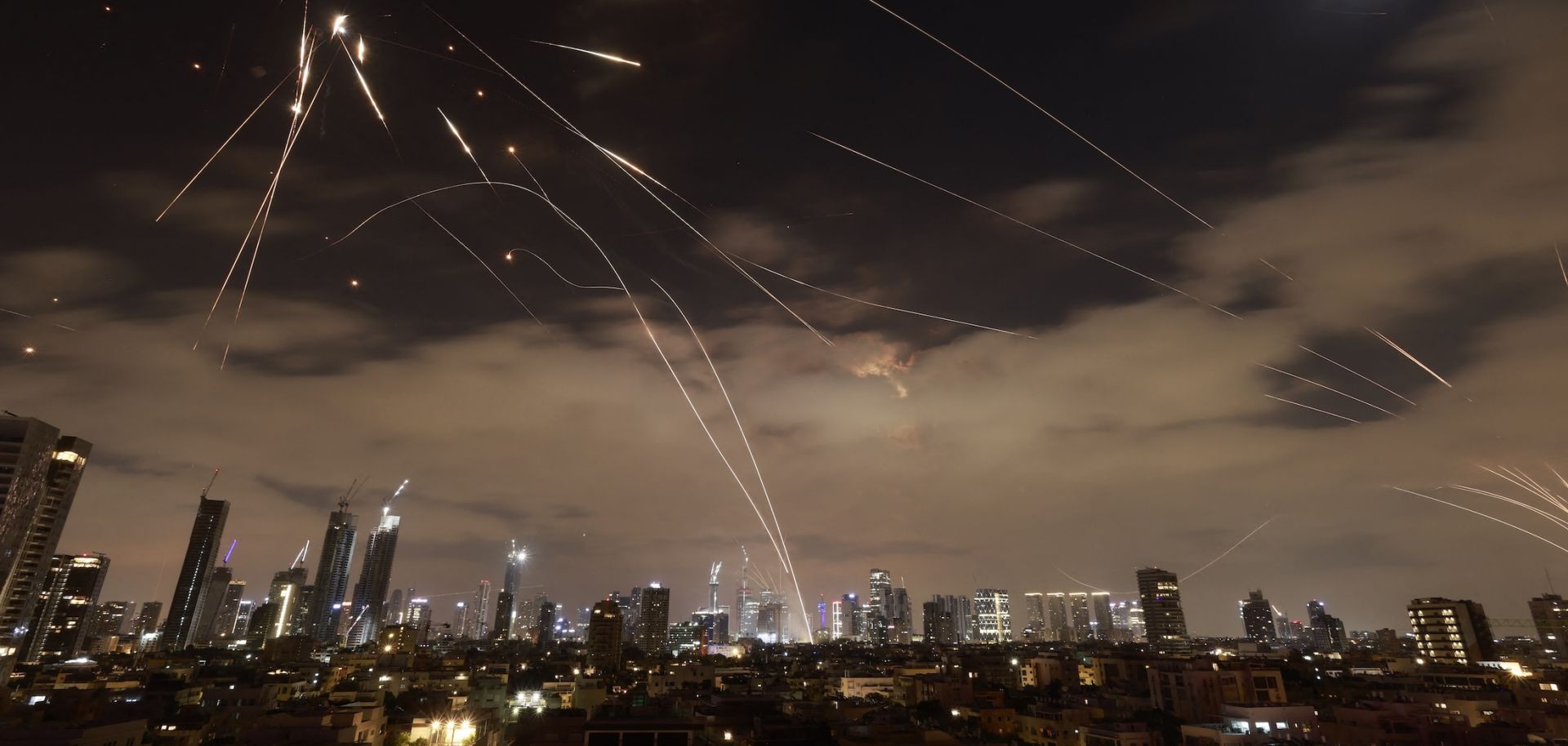
With both sides seemingly unwilling to negotiate, the Iran-Israel conflict is escalating into a high-intensity but limited war that increases the risk of regional spillover and/or Iran's withdrawal from the nuclear nonproliferation treaty, elevating the risk of U.S. military involvement. Iran launched dozens of ballistic missiles toward central and northern Israel early on June 16, while Israel continued its widespread attacks on Iran, including against its capital, Tehran. Since June 13, Israeli attacks in Iran have killed at least 224 people, according to the Iranian government, while Iranian attacks in Israel have killed at least 23 people and injured more than 400 others, according to the Israeli government. Iran's June 16 ballistic missile attack impacted several locations in Israel, including Haifa, Petah Tikva and Tel Aviv, where an Iranian missile slightly damaged the U.S. Consulate. Meanwhile, Israel reported that it hit more than 80 targets in Tehran on June 15, killing top commanders and scientists and hitting oil and government sites. Israel struck two fuel depots in Tehran and Ahvaz in the oil-rich southern province of Khuzestan. Israel also killed Mohammed Kazemi, the intelligence chief of Iran's Islamic Revolutionary Guard Corps, or IRGC, as well as his deputy.
- Israel claimed that since June 13, it has assassinated at least 14 scientists working on Iran's nuclear program, including via car bombs that exploded in Tehran on June 14.
- Iran did not attend the sixth round of nuclear negotiations with the United States that were scheduled for June 15, with Iranian Foreign Minister Abbas Araghchi calling them "meaningless" while Israel continues to attack Iran. He reaffirmed that Iran would be ready to return to the negotiating table only once Israel halts its attacks and Iran completes its retaliation.
After establishing air supremacy over Iran, Israel has focused on degrading Iran's ballistic missiles and nuclear program, alongside attacks on civilian infrastructure. In addition to striking Iranian nuclear facilities like Natanz and Isfahan, Israel's initial attacks focused on taking out Iran's air defenses, missile factories, chain of command and positioned launchers. Four days into the conflict, Israel claimed that it had achieved air supremacy over Iran, which would enable it to focus more not only on Iran's nuclear program, but also on its ballistic missile program that Israel sees as Iran's last conventional deterrent. Against this backdrop, June 15 and 16 saw Israel shift focus toward civilian and military infrastructure, notably manufacturing plants related to Iran's missile program, including electronic companies, and ready-to-launch ballistic missiles and launchers. Meanwhile, Iran has responded to Israel's attacks with waves of dozens of ballistic missiles against Israeli civilian and military infrastructure, including a power plant in Haifa, the Weizmann Institute of Science in Rehovot and the Ministry of Defense in Tel Aviv. In addition, Iran claimed it has yet to use its most advanced ballistic and hypersonic missiles in attacks against Israel, reserving them for future attacks in the event of further escalation. This prompted Israeli officials like Defense Minister Israel Katz and Prime Minister Benjamin Netanyahu to announce that the military's next steps would involve the degradation of Iran's offensive capabilities and ballistic missiles program.
The confrontation between Israel and Iran is increasingly veering toward a high-intensity but relatively short war of attrition. Israel's goal of degrading Iran's ballistic missile capabilities and nuclear program, as well as Iran's refusal to enter negotiations while under attack, suggests the conflict is moving toward a high-intensity limited war in the coming days and potentially weeks. Israel will likely expand the frequency and geographic reach of its strikes on Iran's missile infrastructure, nuclear facilities and key civilian sectors in the coming days to impose heavy economic and psychological costs on Iran's population and dismantle Iran's final military deterrents. Israel calculates that these impacts would increase the possibility of a regime change in Iran. In response, Iran will likely continue launching missile barrages toward Israeli territory in an effort to raise both the military and political costs of Israel's campaign without risking broader regional fallout — potentially making it politically unsustainable for Israel to continue. A high-intensity but short-term attritional campaign is more likely than an extended tit-for-tat campaign, due to constraints on Iran's missile stocks and Israel's defensive capacity. The Israeli military claimed it destroyed one-third of Iran's ballistic missiles, which were estimated to number 3,000 before the war. Additionally, there are reports that Israel may run out of ammunition for its air defenses, which would risk more Iranian missile impacts.
With neither side willing to de-escalate in the short term, the risk of regional spillover, asymmetric escalation and a broader international crisis is increasing. If Israeli strikes significantly degrade Iran's ability to inflict meaningful damage on Israel, Tehran may resort to asymmetric escalation, such as partially blocking the Strait of Hormuz, targeting Gulf energy infrastructure or activating proxies in Iraq to strike U.S. assets. However, such moves could provoke a U.S. military response, which would pose a severe threat to Iran's nuclear facilities, such as Fordow, which is built into a mountain. Politically, Iran will likely also begin to take calculated steps to raise uncertainty about its nuclear activities and intentions, such as by withdrawing from the Treaty on the Non-Proliferation of Nuclear Weapons, which would end international inspections and drive Iran's nuclear activities further underground. Withdrawal would further obscure Iran's nuclear intentions, heightening ambiguity around whether it plans to pursue a nuclear weapon and thereby complicating international efforts to contain the crisis.
- Though a complete blockade of the Strait of Hormuz would be impossible, Iran's navy could harass and launch drones toward oil tankers, which would further strain the global economy and drive oil prices higher.
- There is also a small but growing risk that the United States joins the war effort against Iran, seeing Israeli tactical successes as a way to end Iran's nuclear program. In response, Iran would use asymmetric tactics that expand the war throughout the region, including attacks on U.S. assets in neighboring countries via Iran's remaining proxies.
- Iranian officials, including the foreign minister and president, have already said the United States is partially complicit in Israel's attacks on Iran.
- According to Israeli National Security Adviser Tzachi Hanegbi, Israel assesses that Iran still has thousands of missiles left, despite Israel's attacks against several Iranian missile manufacturing and storage sites around the country.
