
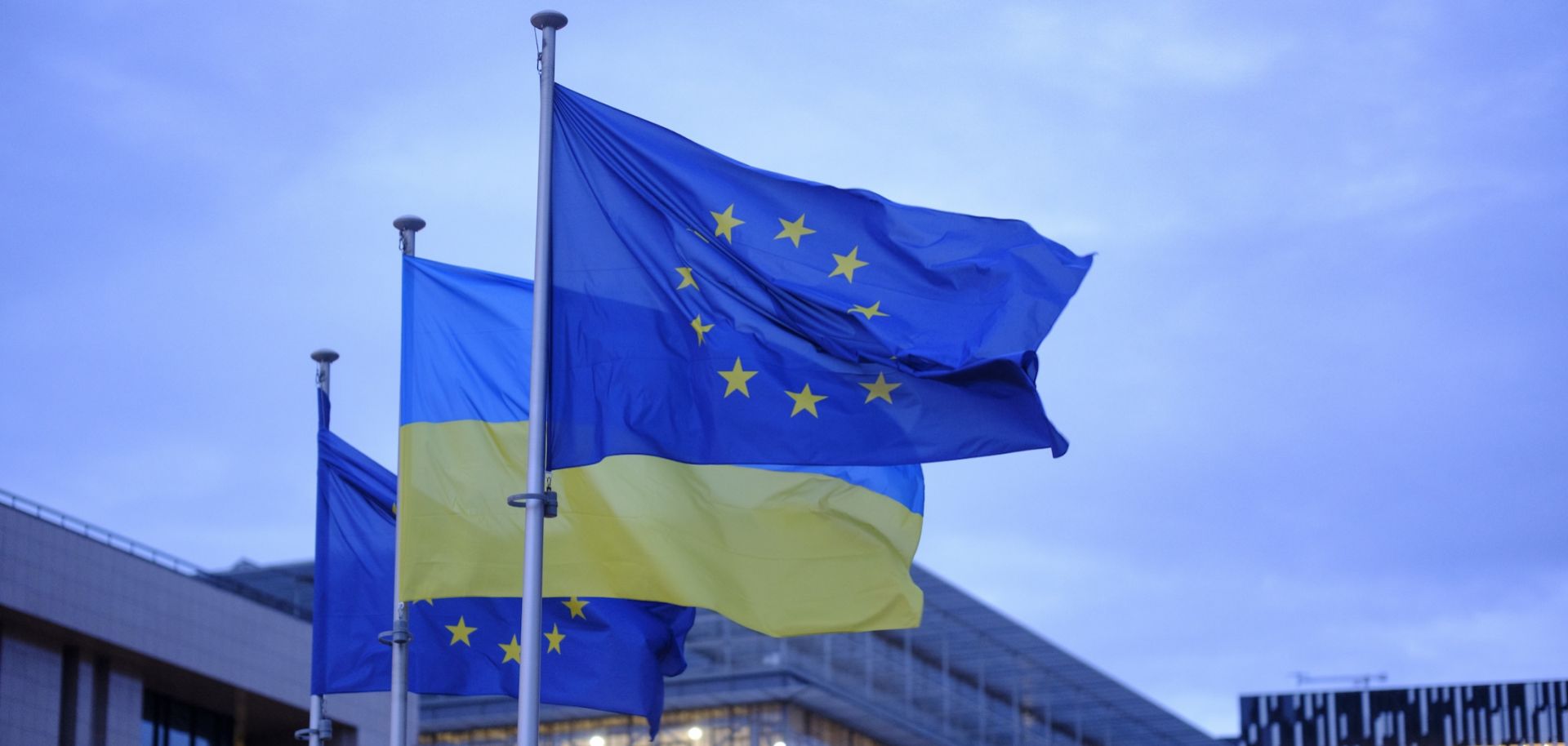
Ukrainian flags are flown alongside EU flags outside the European Commission headquarters in Brussels, Belgium, on Feb. 24, 2025, for the third anniversary of Russia'’s large-scale invasion.
(Thierry Monasse/Getty Images)
Ukrainian flags are flown alongside EU flags outside the European Commission headquarters in Brussels, Belgium, on Feb. 24, 2025, for the third anniversary of Russia’s large-scale invasion.

As European leaders consider military deployment options in Ukraine to prevent a settlement that destabilizes both the country and Europe's broader security architecture, the Franco-British proposal for a limited but strategically positioned European force presents the most feasible and effective solution. However, significant political, logistical and financial constraints persist, particularly without U.S. backing, while Russia could exploit weak enforcement mechanisms to undermine any ceasefire. The first step toward establishing a peace process for Ukraine began in Saudi Arabia on Feb. 18 as the United States and Russia held their first high-level meeting since the war began in February 2022 — notably excluding both Ukraine and European countries. The Trump administration of U.S. President Donald Trump has made it clear that it would fall on Europe to provide Ukraine with ''robust security guarantees'' post-conflict, ruling out any deployment of U.S. forces to the country after the war. The White House has also specified that any eventual peacekeeping troops sent to Ukraine would need to operate under a non-NATO mandate without Article 5 protections. In response to this shift in U.S. strategy, European leaders are seeking to reassert their role in the conflict and prevent a settlement that could leave Ukraine vulnerable to further Russian aggression and further destabilize European security architecture. Against this backdrop, the idea of a European deployment of troops in Ukraine is gaining traction, though the details remain under discussion. While France and the United Kingdom have signaled openness to deploying troops as part of an international peacekeeping mission, other European countries have been more hesitant. Following a White House meeting with French President Emmanuel Macron, Trump suggested Putin might accept the presence of European troops as part of a ceasefire agreement, but the Kremlin has so far ruled out this possibility. 

  • The leaders of France, Germany, Italy, Denmark, Poland, Spain, the Netherlands and the United Kingdom, alongside the heads of NATO and EU institutions, held an emergency summit in Paris on Feb. 17 following the initial formal contacts between the Trump administration and the Kremlin. The gathering underscored the urgency for European countries of securing a spot at the negotiating table, but failed to produce concrete action due to lingering divisions over whether a European deployment should even be considered and, if so, what it would look like in terms of size, mandate and level of U.S. backing. While Macron and U.K. Prime Minister Keir Starmer expressed support for a deployment (contingent on U.S. backing), Poland, Germany, Spain and Italy ruled out participation.
  • France and the United Kingdom have since been leading efforts to establish a European ''reassurance force'' to support a potential U.S.-brokered peace deal in Ukraine and deter future Russian aggression, with media reports leaking details of a Franco-British plan. The proposed force would potentially be led by the Franco-British Combined Joint Expeditionary Force and comprise fewer than 30,000 troops. The force would prioritize air and maritime defense with only limited ground deployments to protect key Ukrainian cities, ports and infrastructure, avoiding any frontline presence of European troops. Macron and Starmer visited Washington, separately, on Feb. 24 and Feb. 27 to present their plan to the Trump administration. Starmer also presented the Franco-British proposal to European leaders during a closed door summit in London on March 2, after which he said ''a number of countries'' had signed up to be part of the ''coalition of the willing'' in Ukraine, reiterating the need for it to receive U.S. backing in order to work. EU leaders will then meet in Brussels on March 6 to discuss European involvement in providing security guarantees to Ukraine, as well as plans for increased defense funding.
  • On Feb. 26, Trump said peacekeepers would need to be deployed on Ukrainian territory, but in a form that is acceptable to all parties (including Russia). He also said that Europe would be responsible for providing assistance to Ukraine. Trump then added that the United States would ''not give any large security guarantees, Europe will do this, because they are their neighbors'' and emphasized support for the Franco-British plan to send peacekeepers in Ukraine.
  • On Feb. 26, Russian Foreign Minister Sergey Lavrov denied that Moscow would support a European troop deployment to Ukraine, arguing this would only ''further fuel the conflict and to stop any attempts to calm it down.'' But Lavrov fell short of entirely ruling out the option, instead emphasizing that any force would need Russia's consent. On Feb. 20, Kremlin spokesman Dmitry Peskov had reaffirmed Russia's opposition to deploying European troops in Ukraine as part of a peacekeeping mission, calling the Franco-British proposal ''unacceptable.'' 

Since NATO membership remains off the table, Ukraine wants guarantees that a ceasefire will prevent a Russian re-invasion, potentially through the deployment of foreign forces. Given the complexity of the situation in Ukraine, a ceasefire will likely precede any formal peace plan, serving as an interim measure to allow time for negotiating a broader settlement. The Trump administration is actively urging Moscow to agree to a ceasefire as soon as possible. Such a deal would likely freeze battle lines, with the lands that Russia occupied by force remaining unrecognized until a formal settlement is reached. Ukraine would survive as an independent country and retain sovereignty to conclude security agreements, but NATO accession talks would remain indefinitely on hold, aligning with Russia's demand for non-membership status. In the absence of NATO's Article 5 protections, Ukraine's post-conflict security assurances would generally require a robust territorial defense system supported by continued Western military assistance and at least some form of deterrence against renewed Russian aggression. A key component of ensuring the ceasefire holds would be the deployment of foreign troops or personnel to Ukraine, acting as a deterrent and monitoring mechanism against violations. This presence could take different or multiple forms, ranging from simple monitoring missions to more robust peacekeeping forces (which could be neutral or not). However, Russia will remain wary of agreeing to any foreign military presence in Ukraine, as preventing forces from NATO-state militaries from entering and protecting Ukraine was one of the Kremlin's most explicit goals when it first launched its invasion in 2022. Securing Russian acceptance of such a plan would thus be a major hurdle in ceasefire negotiations, and would likely require significant concessions regarding the deployment's scope and objectives that could ultimately impede its effectiveness. 

  • In an interview with Le Figaro just ahead of the March 2 summit in London, Macron said that France and the United Kingdom intended to propose a one-month truce between Russia and Ukraine to be implemented in two stages, first applying to aerial and naval operations as well as energy infrastructure and then, if this initial ceasefire was upheld, to ground combat. Macron presented this as a pre-condition for a broader ceasefire and to discuss the deployment of a European ''assurance'' force in Ukraine. However, Starmer distanced himself from Macron's remarks, clarifying that no agreement had been reached on a one-month truce. Nonetheless, he expressed the U.K. government's commitment to advancing the peace plan ''with momentum.''

Potential Deployment Options

There are several options for the deployment of foreign troops in Ukraine, each varying in effectiveness, feasibility, constraints and the degree of Russian reaction they might provoke. The success and credibility of any such deployment would largely hinge on the level of U.S. logistical and political support, without which the feasibility of any European-led efforts would be significantly weakened.

It is important to note that these scenarios are not necessarily mutually exclusive; for instance, a limited European presence far from the frontlines could complement a broader U.N.-style peacekeeping force stationed at the line of contact. It also remains possible that no foreign force is deployed to Ukraine.

Scenario #1: A large combat-ready European force (10% likelihood)

The deployment of a large, combat-ready European force to Ukraine could deter Russian aggression and integrate Ukraine into Europe's security framework, but political and material constraints make this unlikely. A robust Western military presence in Ukraine — even if smaller than Kyiv's request for a 100,000-150,000 strong deployment — would provide a significant deterrent against future Russian aggression. The force would consist of at least 50,000 combat-ready troops stationed on Ukrainian soil within striking range of Russia, supported by air, naval and space assets to secure key air and maritime corridors. This force would also have a clear political mandate of intervening on the side of the Ukrainians should Russia attempt another offensive. Additionally, the force would act as a credible tripwire to deter further aggression and conduct training missions to enhance Ukraine's military self-sufficiency. Likely participants would include France, the United Kingdom, Nordic and Baltic countries, Poland and potentially non-European countries like Turkey, all operating under a mutual defense clause outside of the NATO framework. This mission would be the most effective solution to deter future Russian aggression against Ukraine in the long run, ensuring the stability of the country for post-war reconstruction and preserving the Ukrainian military as a conventional shield for the rest of NATO on its eastern frontier. However, this scenario remains highly unlikely due to several major constraints. For one, Russia would strongly oppose the permanent presence of European combat-ready forces in Ukraine, viewing it as a direct provocation and a red line that could derail ceasefire negotiations. Militarily, at least in the short term, European forces also remain underprepared for large-scale deployments without significant U.S. logistical and intelligence support; and while France and the United Kingdom are nuclear powers, they lack the conventional force projection needed to deter Russia alone. Politically, there are disagreements among key European powers — namely France, Germany, the United Kingdom and Poland — on how to proceed and what to prioritize, while public opinion across most European countries remains mostly opposed to direct military involvement. And financially, European countries' rising fiscal pressures and domestic spending priorities make large-scale, long-term military commitments difficult.

Scenario #2: A symbolic and/or U.N.-style peacekeeping mission (40% likelihood)

A symbolic presence of foreign troops in Ukraine — such as a small European tripwire force with a weak mandate or a broader international deployment with limited authority — would be more politically and logistically feasible, but it would fail to provide any meaningful guarantee to Ukraine or deterrent against Russia. A largely symbolic European deployment in Ukraine — made up of a few thousand military observers, rather than an active conventional deterrent force — would be more palatable to both Russia and the European public, and would also be easier and less expensive to implement. However, it would leave Ukraine highly vulnerable to future Russian aggression. A symbolic deployment could also take the form of a broader, U.N.-backed international peacekeeping force, which could not be European (as Moscow would not trust European countries to serve as neutral arbiters) and would instead need to include personnel from non-Western countries such as China or India. But while this would force Russia to consider the reputational risks of violating an agreement supported by key non-Western partners, a limited force stationed along the line of contact would do little to prevent renewed hostilities or Russian influence operations in Ukraine, given Russia's track record of disregarding international agreements when it suits its strategic interests, such as the post-2014 Minsk accords. Russian troops would avoid any direct attack against international peacekeepers, but past multilateral peacekeeping missions suggest that, in the event of hostilities, these forces would likely adopt a passive stance and fail to prevent a resurgence of conflict. In the case of clashes or even casualties, international responses would likely be contained to avoid escalation. For Ukraine to avoid severe instability in the absence of credible Western security guarantees, a weak peacekeeping mission would need to be paired with a robust strategy of deterrence through military strength from the part of Ukraine's own armed forces. This would require significant and sustained foreign military aid — likely in the tens of billions annually — to support a comprehensive security strategy aimed at building a self-reliant Ukrainian defense, including a fortified perimeter, rapid-response forces, critical infrastructure protection, advanced air and missile defense systems, electronic warfare capabilities, cyber defense measures and a vast reserve force capable of prolonged asymmetric resistance. Yet, without U.S. assistance, this burden would largely fall on Europe, potentially making it even more financially costly than directly putting European boots on the ground in Ukraine. Furthermore, without a credible enforcement and monitoring mechanism for the ceasefire, Ukraine would likely still struggle to deter future Russian aggression. Ultimately, this scenario — while more feasible than a large-scale European deployment — remains relatively unlikely, as it would still leave Ukraine vulnerable.

Scenario #3: A strategic but limited European deployment (50% likelihood)

A limited but strategically positioned European military presence in and around Ukraine, in line with the Franco-British plan, could function both as a backup and tripwire force. But without U.S. backing, the plan may be ineffective against Russian hybrid tactics and still somewhat constrained by Europe's political and logistical challenges. Instead of large-scale troop deployments, this plan would leverage Western air superiority, with European air forces — potentially supported by U.S. intelligence and airpower — stationed in Romania and Poland. Black Sea patrols and border surveillance would also enhance regional security, seeking to create a deterrent against Russia while providing Ukraine with the reassurance of a rapid military intervention in case of future Russian aggression. On the ground, fewer than 30,000 troops would largely focus on protecting Ukraine's critical infrastructure, including ports, nuclear power plants and energy infrastructure, as securing the country's airspace and maritime trade routes as well as the stability of its energy supply would be essential for post-conflict reconstruction and long-term economic stability. These ground forces would remain far from the frontline, which would continue to be guarded by Ukraine's own troops. The deployment of European troops in Ukraine's western neighbourhood would also serve the purpose of bolstering Europe's own defenses as questions emerge over U.S. commitments to the Continent's security. However, the success of such a plan would still largely depend on some form of U.S. backing as a security guarantor, even if the mission operates outside the NATO framework; otherwise, the mission would risk being perceived as largely symbolic, failing to deter Moscow or reassure Kyiv. Russia could test the unity of European forces through constant, low-intensity harassment, including via hybrid tactics and small-scale ceasefire violations. As European countries would likely seek to avoid any escalatory response, this would weaken the credibility of the mission and void the deterrent, potentially leading to larger ceasefire violations in the future. Moreover, material constraints remain even for a more limited deployment. The United Kingdom, for instance, faces significant manpower limitations, while French public opinion remains largely opposed to any deployments in Ukraine. Additionally, the European countries that have yet to explicitly back the Franco-British proposal or any similar plan for deployment and/or express any interest in participating in it, including Germany, would face significant political constraints toward committing troops for a peacekeeping force in Ukraine. Meanwhile, other countries that may be more willing to participate, such as the Baltic and Nordic states or Poland, also feel directly exposed to potential Russian aggression and, as they prioritize rebuilding their own military capabilities, their ability to provide substantial support to Ukraine remains limited. With European military forces stretched thin and defense budgets under pressure, sustaining even a moderate deployment would remain a challenge.

RANE
SUBSCRIBERS ONLY

Expert analysis when it matters most.

Get access to RANE's decision-grade geopolitical intelligence.