
Editor's Note: This article is the 10th installment in an ongoing RANE series on the shifting patterns of global trade. The first installment provided a broad overview of the geopolitical and economic implications of these shifts. Other installments have examined trade patterns in the Americas, the Strait of Hormuz, Japan and South Korea, India, Turkey, ASEAN countries, the digital landscape and Mercosur.
Countries' reliance on maritime chokepoints is increasingly rendering the availability of goods and energy supplies vulnerable to a range of threats, including geopolitical tensions, conflict, militancy, piracy and severe weather events. The growth of global trade since the advent of containerization in the shipping industry in the 1950s has led countries to increasingly rely on oceans to ship goods and energy products, particularly due to the lower cost and higher capacity of maritime shipping compared with air transport. Over 80% of global trade volume is carried by sea, with anywhere from 4,950 to 258,000 metric tons of cargo funneling daily between the world's least trafficked and most trafficked waterways. While these waterways have helped improve the reliability of supply chains and fostered global economic growth, their ever-rising traffic and often limited capacity have also gradually transformed them into chokepoints. These bottlenecks are vulnerable to geopolitical crises and conflict, physical security risks from threats like piracy and militancy, and environmental risks from severe weather events and natural disasters, threatening disproportionately severe disruptions to global commerce. The International Monetary Fund lists 24 chokepoints essential for international commerce, of which the Strait of Malacca, the Strait of Hormuz, the Bab el-Mandeb strait, the Suez Canal, the Danish and Turkish straits, and the Panama Canal are particularly important based on the number of goods and commodities transiting them. The geographic diversity of these chokepoints also highlights threats distinct to each waterway's location and exposure to geopolitical developments, alongside more common risks shared among several of these vital waterways.
The Strait of Malacca is responsible for facilitating the transit of more barrels of oil than any other waterway, rendering both risks and opportunities for China in particular, though alternatives to the strait exist. As the shortest route through which ships can transit between East Asia and Europe, the Middle East, and Africa, the Strait of Malacca enabled the transit of an estimated 23.7 million barrels of oil per day in 2023, as well as cars comprising 26% of global seaborne trade volume and containers comprising 19% of global seaborne trade volume. One of the long-standing threats to shipping around the strait stems from piracy. While increased multilateral cooperation on maritime security and more robust ship security protocols have reduced the global threat of piracy from its peak in the 2010s, and have in recent years helped stabilize the number of piracy incidents, such incidents continue to be reported. In 2024, the International Chamber of Commerce's International Maritime Bureau recorded 72 piracy incidents in East and Southeast Asia, particularly around the Strait of Malacca and, more specifically, the Singapore Strait, eclipsing the combined 44 piracy incidents it recorded that year in other regions. Meanwhile, alongside the nearby South and East China seas, the Strait of Malacca is exposed to rising geopolitical tensions between China, regional countries and the West. As the Strait of Malacca has supported China's years-long economic growth, it has also made Beijing reliant on the waterway. This consequent vulnerability has driven China to pursue alternative routes and infrastructure, focus on developing its maritime capabilities and adopt a more assertive posture in the South China Sea to gain greater strategic flexibility. However, these efforts remain ongoing and are currently insufficient to insulate China or the global economy from disruptions to the Strait of Malacca. In addition, China's assertiveness has fueled regional tensions, as neighboring countries have responded by ramping up their resistance to Beijing and making their own territorial and maritime claims. Tensions have risen further amid Western countries' rivalry with China, which has driven them to increase their involvement in regional maritime disputes and freedom of navigation operations.
- Despite the Strait of Malacca's importance, the Lombok and Sunda straits remain viable alternatives. The Lombok Strait is a particularly attractive option given its significant average depth of around 250 meters (compared with the depth of the Strait of Malacca, which ranges from 25 to 200 meters) and its ability to handle more traffic than the Sunda Strait. However, these straits would require longer transits, increasing trip times and fueling costs, while their far less robust infrastructure (like ports and navigational aids) also makes them less ideal than the Strait of Malacca.
- In recent years, Thailand has proposed another alternative route to the Strait of Malacca, comprising two seaports connected via a highway and railway in the country's south. Such a route could shave days off shipping times, reduce costs and offer an attractive option in case passage through the waterway is disrupted. The economic and geostrategic value of the proposed passage has enabled Thailand to seek funding and support from a wide range of countries, including Saudi Arabia, India, Japan and China. Beijing has appeared especially interested, given its desire to diversify the routes and sources through which it obtains energy supplies.
The Strait of Malacca will remain threatened by piracy and, over time, will likely become increasingly vulnerable to tensions between China, regional countries and the West, opening the door to an incident that disrupts transit through the strait. Despite countries' and shippers' efforts to improve security and defend against piracy, such incidents will remain an underlying concern for vessels transiting the Strait of Malacca. In recent years, the ICC's International Maritime Bureau has noted pirates' rising use of firearms and knives, as well as pirates taking a growing number of crewmembers hostage or kidnapping them. Thus, vessels transiting the waterway will be vulnerable to elevated personal safety concerns and insurance premiums — even though the strait's economic and strategic importance, as well as its ever-growing traffic, mean piracy alone will almost certainly fail to meaningfully dampen use of the waterway. Over the longer term, the strait will also likely be increasingly threatened by tensions between China and other regional countries, as well as with the West; these tensions appear set to intensify over the coming years as Beijing grows more assertive in staking its claims in regional waters. While Beijing has a strong interest in keeping the strait open, its increasing maritime confrontations with the Philippines, which is a U.S. treaty ally, maintain the possibility of a more expansive or severe conflict in which one side's actions severely restrict maritime transit. Depending on the severity and duration of any clashes that erupt, such a conflict could drive severe spikes in oil prices, given the amount of oil that transits the strait. Clashes would also risk significant supply chain challenges, particularly for the West, given that the strait enables the transit of goods from Asian manufacturing hubs. Though these challenges may ease as regional countries develop alternate routes, these efforts probably will take years to complete, sustaining countries' reliance on (and consequent vulnerability to) the Strait of Malacca.
- Though the threat of piracy has waned since its peak in the 2010s, the ICC's International Maritime Bureau noted that pirates worldwide reportedly took 126 crewmembers hostage and kidnapped 12 crewmembers in 2024, representing an uptick from recent years. For instance, in 2023, 73 crewmembers were reportedly taken hostage and 14 were kidnapped, and in 2022, 41 crewmembers were reportedly taken hostage, and two were kidnapped.
- The United States has regularly reiterated that its mutual defense treaty with the Philippines would require it to defend the island country if a major clash between the Philippines and China emerges.
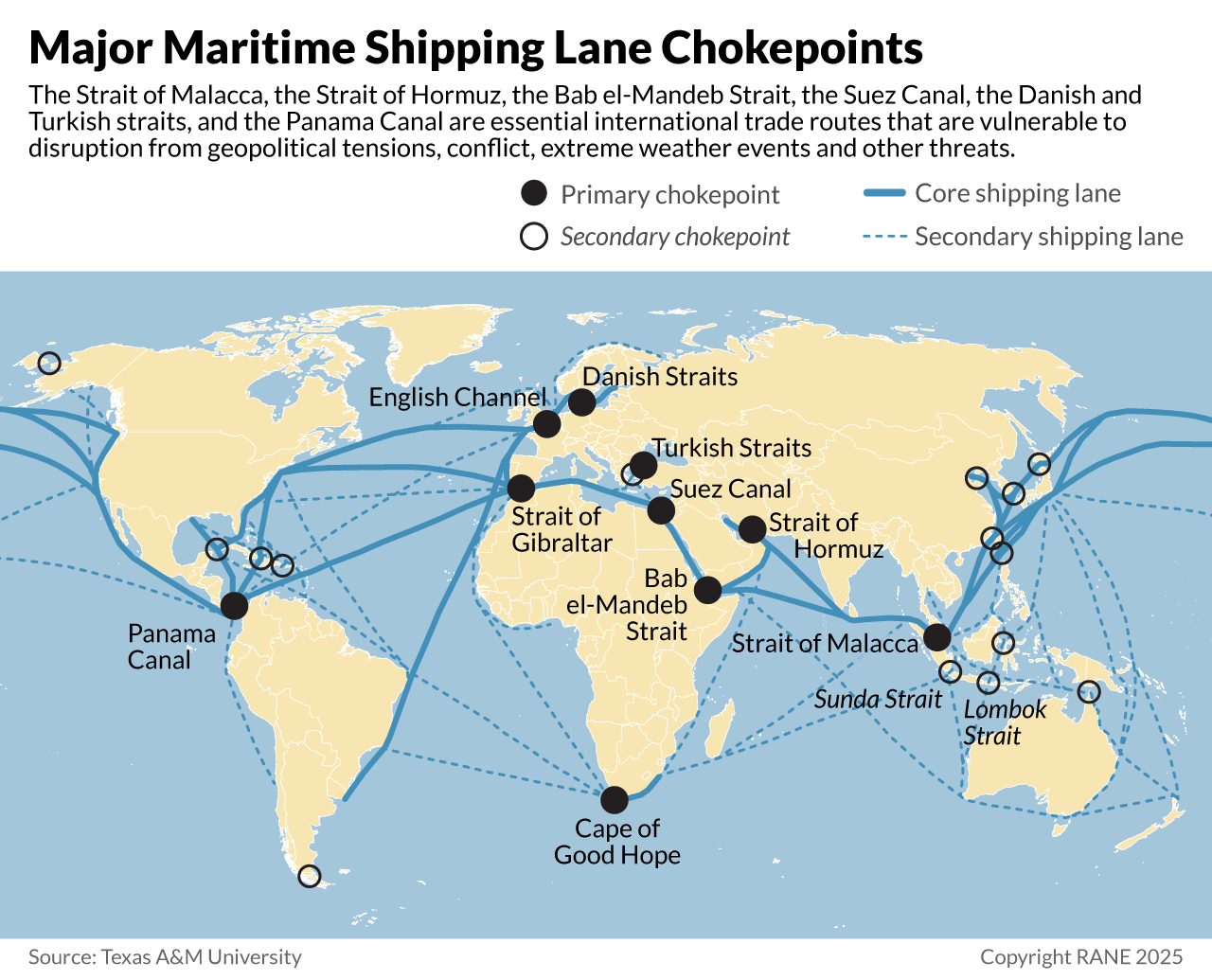
The Strait of Hormuz is another major chokepoint that is especially important for global energy, facilitating the transit of some 20% of global oil consumption, much of which is destined for Asia, and it has long been vulnerable to tensions and conflict in the Middle East, particularly given constraints on alternative routes. The Strait of Hormuz enables the movement of some 20 million barrels of oil per day, and its value is magnified by the fact that few alternatives to the strait exist. While regional Saudi and Emirati oil pipelines offer alternatives, they typically do not operate at full capacity and, regardless, are far more limited in the amount of oil they can transit. Given that around 84% of the crude oil and 83% of the liquefied natural gas that transits the Strait of Hormuz is destined for countries including China, India, Japan and South Korea, Asia is particularly reliant on the strait for energy. Europe and the United States are comparatively less reliant on the waterway — especially with the United States boosting domestic energy production in recent years — but they would still experience upticks in energy prices from any potential disruptions. The location of the Strait of Hormuz has rendered it particularly vulnerable to conflict in the Middle East, including the Israel-Hamas war that began in October 2023 and the June attacks between Iran, Israel and the United States.
Though tensions have eased since Israel and Iran's fragile ceasefire, the conflict may reemerge and even escalate if the deal falters, risking at least temporary oil price hikes and possibly even temporary disruptions to shipping through the Strait of Hormuz. As Israel and Iran's June 24 ceasefire remains tenuous and the underlying issues that sparked the conflict — such as the existence of Iran's nuclear and ballistic missile programs — remain unresolved, conflict could still reemerge. Should conflict resume, Iran and its militant partners' historical willingness to target major oil-producing countries and harass oil tankers transiting through the Strait of Hormuz would threaten to at least temporarily elevate oil prices. While price hikes would likely dissipate promptly in the event of a limited or short conflict, more severe or prolonged kinetic exchanges would threaten to sustain higher prices. Such sustained spikes would significantly risk slowing economies worldwide, particularly in developing countries, which tend to be less capable of adapting to external shocks. A particularly severe or prolonged conflict may even prompt Iran to consider attempting to close the Strait of Hormuz, which would threaten to spike oil prices over $100 per barrel. However, the significant costs associated with such action probably would limit the likelihood and duration of any closure. For one thing, closing the Strait of Hormuz would significantly disrupt the global economy, including Iran, its Gulf neighbors and key Iranian trading partners like China and India. These anticipated ramifications have dissuaded Iran from closing the strait during prior international crises, and were it to attempt such a closure, a range of countries would pressure Iran to quickly end the crisis. In addition, though Iran could disrupt shipping by laying sea mines, harassing ships and carrying out similar lower-level activities, Iranian forces probably would struggle to enforce a comprehensive closure of the strait for a prolonged period — especially as it would likely prompt the United States and potentially other countries to militarily reenable transit through the waterway. For these reasons, the risk of Tehran attempting to shutter the Strait of Hormuz will remain limited.
- The Strait of Hormuz facilitates some 3% of global container traffic, according to the U.S. Energy Information Administration. This means any closure or disruption caused by Iranian harassment of transiting vessels would also risk causing supply shortages and delaying the delivery of goods, though the implications for container traffic would be less severe than those for energy supplies.
