
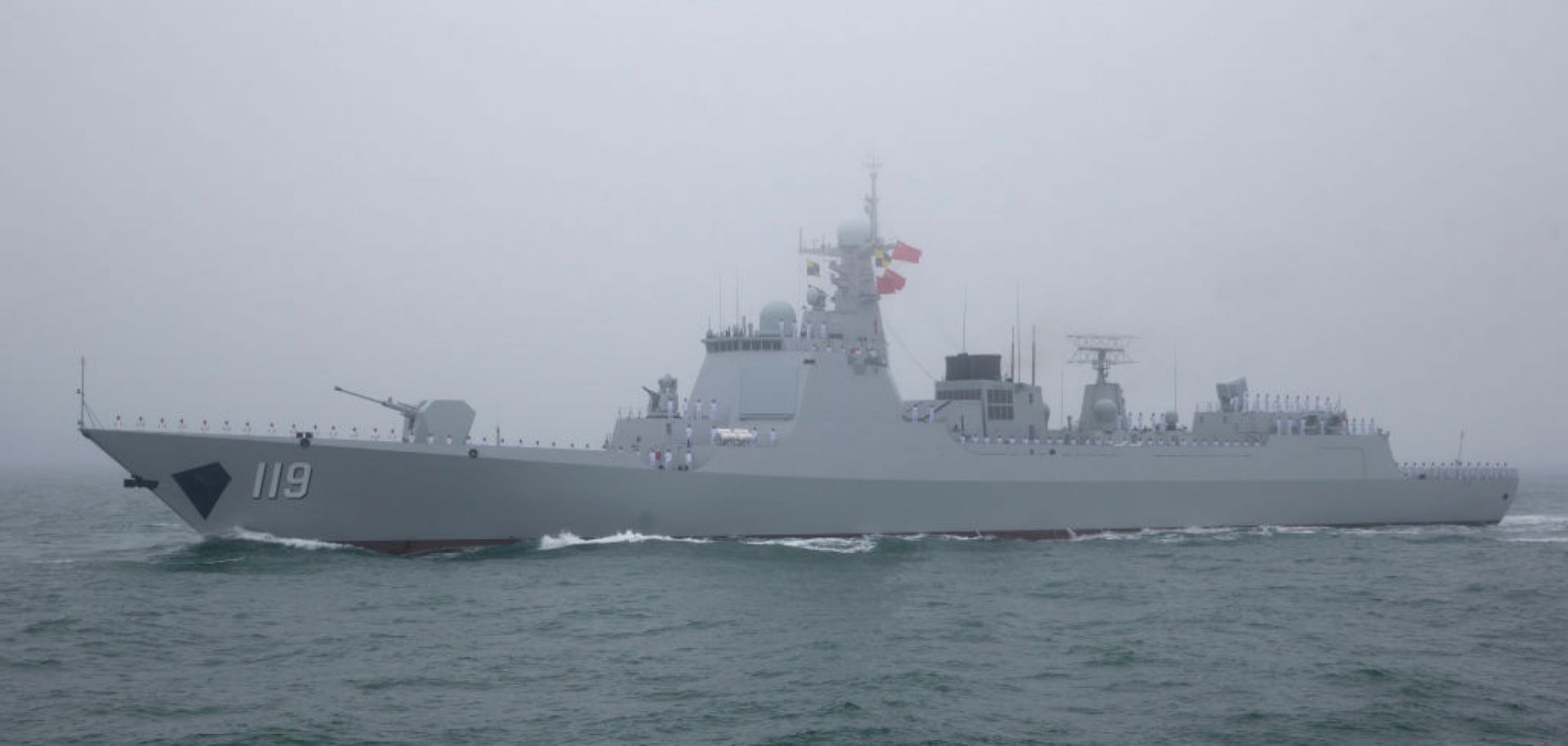
A shift from coastguard to naval confrontations between Chinese and Philippine forces in the South China Sea raises the likelihood of direct conflict that, though stopping far short of a larger war, would significantly worsen already high maritime tensions. An escalation in maritime tensions is unfolding in the hotly disputed South China Sea, marked by increasingly bold Chinese naval actions and a surge in Philippine countermeasures. On May 5, two Chinese naval frigates and a coastguard ship confronted the Philippine navy's BRP Emilio Jacinto just 11.8 nautical miles from the contested Scarborough Shoal, which China seized by force from the Philippines in 2012. One Chinese frigate crossed the ship's bow in a high-risk maneuver, prompting a sharp rebuke from Manila, which condemned the action as "reckless and threatening," while Beijing insisted it had lawfully expelled an intruding vessel from its territory. The confrontation followed several incidents that have ratcheted up tensions in recent weeks. On April 25 and 27, military personnel from the Philippines and China separately planted competing flags on Sandy Cay, a contested feature near Thitu Island. These incidents come after the Philippines on April 22 significantly loosened a 1987 ban on governmental and military contacts with Taiwan in what was a subtle but significant policy shift. On April 27, Manila then confirmed informal naval coordination with Taipei, citing the new rules, a move Beijing condemned.
- Thitu Island is the Philippines' largest and most strategically important outpost in the disputed Spratly Islands section of the South China Sea, hosting troops and infrastructure that serve as a forward base for asserting sovereignty and monitoring Chinese activity in nearby contested waters.
The Philippines is engaging in a calculated escalation in response to growing Chinese aggression, driven by political, security and strategic imperatives. The latest incidents come as the Philippines is preparing to hold midterm elections on May 12, which is pressuring President Ferdinand Marcos Jr. to show resolve amid widespread public anger over Chinese maritime aggression — particularly among Philippine fishers, many of whom have been displaced from traditional grounds, particularly near Scarborough Shoal. From a security and strategic standpoint, Manila also wants to reinforce its South China Sea claims and assert its role as a frontline state in U.S.-led regional security architecture. Together, these factors have driven the government to harden its maritime posture, reinforced by growing defense cooperation with the United States, as well as newly signed reciprocal access agreements and similar arrangements with other countries like Japan, to enhance joint training, interoperability and regional security in the South China Sea. Indeed, the latest confrontations with China occurred during the final days of the annual U.S.-Philippine Balikatan military exercise, which has been among the largest yet, with 16,000 troops simulating high-intensity maritime conflict, amphibious landings and gray zone defense. Moreover, by expanding informal military and political coordination with Taiwan, the Philippines is also carefully testing the limits of its "One China" policy without officially challenging Beijing's sovereignty claims, as the the loosening of its ban on Taiwan contacts retains limits on top national security officials like the president and defense minister communicating with their Taiwanese counterparts.
- The Philippines has significantly expanded its defense partnerships through reciprocal access and visiting forces agreements with Australia (2007), Japan (2024), New Zealand (2025), Canada (pending 2025) and France (negotiations ongoing), on top of its 1951 Mutual Defense Treaty with the United States. These agreements enable military cooperation ranging from joint exercises and disaster response to rotational deployments and facility construction, underscoring Manila's growing strategic alignment with regional partners.
- The Philippines has also acquired and been training on a bevy of new weapons systems, including India's BrahMos supersonic cruise missiles (2024-2025), Turkish T129 ATAK helicopters (May 2024) and U.S. systems, such as the Typhon mid-range missile launcher with Tomahawk and SM-6 interceptors (deployed April 2024), the NMESIS anti-ship system, MADIS counter-drone units and microwave weapons (newly tested in May).
This convergence of Philippine military drills and elections, along with Manila's deepening security ties with regional partners and increasingly assertive defense posture, is likely catalyzing China's increased coercive pressure. With the Scarborough Shoal, Second Thomas Shoal and now Sandy Cay all active flashpoints — and with Manila's engagements broadening to include Taiwan, Japan, Canada, Australia and New Zealand — the risk environment in the South China Sea has evolved. In response, China has launched a high-pressure, multi-vector campaign designed to expand its jurisdictional control, degrade Philippine confidence and test the resolve of third-party allies, especially the United States amid heightened uncertainty over the country's foreign policy direction under President Donald Trump. To this end, the May 5 incident — where Chinese frigates blocked a Philippine warship in Scarborough Shoal — occurred during the final days of the annual U.S.-Philippine Balikatan military drills, which China perceives as a thinly veiled rehearsal for conflict scenarios involving both the South China Sea and Taiwan. Notably, the Philippines' recent relaxation of its 1987 ban on communications with Taiwan also crossed a line for China because any official or military coordination with Taipei undermines Manila's official "One China" policy by implicitly treating Taiwan as a separate political and security actor. Additionally, the Scarborough clash occurred just a week before the Philippines' May 12 midterm elections, where the South China Sea is a key issue because President Marcos' handling of Chinese incursions shapes public perceptions of whether he is defending national sovereignty or recklessly endangering the country by provoking Beijing. The timing of the Scarborough incident thus appears to be a calculated effort by China to assert physical control and politically undermine the Philippine government ahead of elections, while also probing how far the U.S.-Philippines Mutual Defense Treaty extends without triggering direct U.S. intervention.
- Scarborough Shoal's proximity to the Philippines' exclusive economic zone, its symbolic role in past disputes, and its strategic location near major shipping lanes make it a low-cost, high-impact theater for China's coercive signaling.
- The Philippines has accused China of attempting to interfere in the country's May 12 midterm elections both via grayzone tactics in the South China Sea and via other means, like cyber and influence operations.
- The April 25-27 flag-planting episode in Sandy Cay prompted a rare third-party protest from Vietnam, which also claims the feature alongside China and fellow Association of Southeast Asian Nations (ASEAN) member, the Philippines. Such disunity among ASEAN — exemplified by Vietnam protesting both China and the Philippines' competing activities — also offers China an opportunity to splinter regional consensus while still appearing diplomatically engaged via code of conduct negotiations.
Recent events illustrate a shift from coastguard- and maritime militia-dominated gray zone tactics to higher-stakes naval signaling and brinkmanship, which raises the likelihood of miscalculation and an accidental brief conflict, even if a larger confrontation remains unlikely. While no shots have yet been fired, the scale, proximity and political timing of these latest maneuvers between China and the Philippines suggest that the next phase of confrontation could cross a new threshold. Incidents like the May 5 Scarborough clash illustrate how Beijing is increasingly using naval warships for coercive signaling and not just coastguard and maritime militia assets. While open warfare remains unlikely in the short term, the risk of a conflict breaking out between China and the Philippines, albeit short in time and limited in scope, is growing. This raises the stakes as accidental collisions, injuries or deaths could easily trigger a crisis, especially during future drills or resupply missions to Second Thomas Shoal. However, escalation to a U.S.-China war remains constrained by structural and doctrinal factors. For one, despite its mutual defense treaty with the Philippines, the United States is unlikely to respond to individual incidents in the South China Sea with direct military intervention, opting instead for presence operations, expanded training and diplomatic signaling. This aligns with Washington's historical reluctance to intervene kinetically in the South China Sea dispute. China, for its part, is calibrating its actions to test the United States' resolve while avoiding provocation thresholds that would compel U.S. intervention or unified pushback from the ASEAN, though Beijing's risk aversion also means it is unlikely to actually cross these thresholds. The Philippines thus faces a bind as it is emboldened by its alliance with the United States and growing regional support, but is limited by its own military capacity and dependence on U.S. strategic ambiguity. At the same time, Manila's deepening informal naval communication with Taiwan adds a new dimension to South China Sea tensions by further tying this geography and the Taiwan Strait into a singular strategic space that is more thoroughly linked to the first island chain. Therefore, any decision by the Philippines to build permanent structures at Scarborough Shoal, Second Thomas Shoal or Sandy Cay — or any move by the United States to provide direct support for resupply missions — would mark escalatory steps that China could counter with mass deployment of maritime militia vessels or de facto coercive exclusion zones. Such Chinese tactics would avoid outright war but heighten the risk of unintended escalation. Wildcard scenarios, such as unsanctioned belligerent actions by Chinese maritime militia or Philippine civilians in contested waters, could also trigger unplanned crises.
- A short, sharp conflict would likely entail a localized, days-long exchange involving ship collisions, limited missile or gunfire near contested features like Second Thomas Shoal, the disabling or detention of vessels or personnel, and the rapid mobilization of air and naval forces — stopping short of full-scale war but triggering immediate diplomatic and military responses.
- In June 2024, Chinese coastguard personnel injured a Philippine sailor during a violent interdiction near Second Thomas Shoal, underlining the increasing risk of close-contact escalation.
- The first island chain is a string of U.S.-aligned territories stretching from Japan through Taiwan and the Philippines to Borneo. The islands form a strategic maritime barrier against Chinese naval expansion, which makes Philippine-Taiwanese cooperation increasingly important for surveillance, deterrence and control over key chokepoints like the Bashi Channel and Luzon Strait.
