
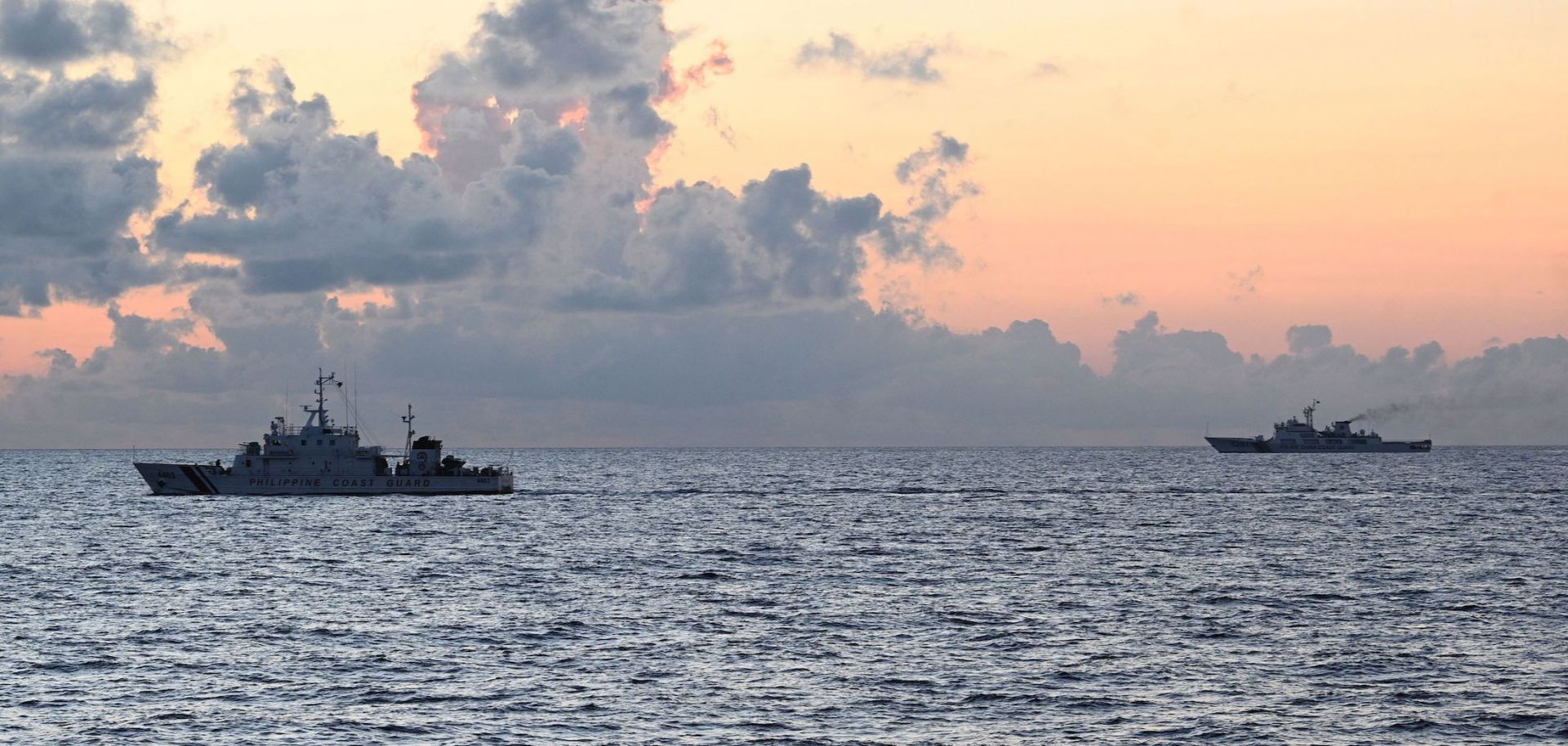
A Chinese coast guard ship (R) shadows the Philippine coast guard vessel BRP Malapascua (L) while on patrol at the Second Thomas Shoal in the Spratly Islands in the disputed South China Sea on April 23, 2023.
Clarified defense commitments from the United States will bolster the Philippines' maritime security, but also raise the risk of a direct military confrontation with China. The U.S. Department of Defense issued a six-page document on May 4 outlining its defense commitments under the U.S.-Philippines Mutual Defense Treaty, the first effort to clarify the U.S. position since the treaty was signed in 1951. The department clarified four criteria: the geographic scope of the treaty, Philippine entities the United States is committed to defending, intelligence sharing protocols, and ways Washington plans to counter Chinese gray zone capacities in the region (actions that fall between war and cooperation). Broadly, the document expands U.S. commitments to defend the Philippines if it is attacked "anywhere in the South China Sea" and not only in the so-called West Philippine Sea, the area of the disputed waters claimed by the Philippines within its exclusive economic zone (EEZ). The U.S. guidelines also for the first time specifically mention the Philippine coast guard, which often faces threats from Chinese maritime forces in the disputed waters. Additionally, these clarified defense commitments move the United States and the Philippines closer to real-time intelligence sharing and direct efforts to counter Chinese gray zone activities. The guidelines do not, however, clarify the threshold of what constitutes an "armed attack" that would trigger Articles IV and V of the Mutual Defense Treaty and bring U.S. military intervention.
- The Pentagon released the guidelines during Philippine President Ferdinand Marcos Jr.'s state visit to Washington, D.C., from April 30 to May 4. Marcos and U.S. President Joe Biden agreed to these provisions during their meeting on May 3.
- On May 1, the United States and the Philippines released a similarly intentioned joint statement that said an armed attack on Philippine armed forces, public vessels or aircraft in the Pacific ("including the South China Sea") will invoke Article IV of the Mutual Defense Treaty, thereby triggering U.S. military intervention. However, this statement also does not clarify the "armed attack" threshold.
The revised treaty guidelines come after a near-collision between Philippine and Chinese coast guard vessels in the disputed South China Sea and the offer of more direct assistance to Philippine efforts from the U.S. Navy. A Chinese coast guard vessel and a Philippine coast guard vessel experienced a near collision on April 23 — coming within 50 yards (46 meters) of each other — as the Chinese vessel maneuvered directly into the path of the Philippine vessel while the latter was on a resupply mission to a Philippine military base at the Second Thomas Shoal in the Spratly Islands. China claimed that the Philippine vessel encroached on Chinese territory under its claim to almost all of the South China Sea. In response, the U.S. Navy offered direct assistance to Philippine resupply missions to the Second Thomas Shoal, likely in the form of accompanying Philippine sailors and providing real-time intelligence. The United States already provides intelligence to the Philippines for these missions, including locations of Chinese vessels (which maintain a near-constant presence around the shoal), but does not do so in real time. On April 29, the United States called on China to stop "provocative and unsafe conduct" in the South China Sea and warned that an armed attack would trigger U.S. defense commitments under the Mutual Defense Treaty, a position further clarified as a result of Marcos' visit.
- Three journalists invited by the Philippine coast guard were aboard the Philippine vessel involved in the April 23 incident and witnessed and reported on the near collision. This is part of a new Philippine policy to loudly broadcast instances of Chinese military coercion to garner sympathy from the international community. China accused the Philippines of setting up the incident in order to generate bad press against it.
- The April 23 incident took place during a visit to Manila by Chinese Foreign Minister Qin Gang, highlighting how the bilateral relationship continues to deteriorate.
- Recurring missions to resupply the Philippine contingent at the Second Thomas Shoal are fraught with danger as China wants to cut the base off from the Philippine mainland to force a retreat that would enable China to take the shoal. Beijing previously deployed water cannons (Nov. 16, 2021) and military-grade lasers (Feb. 6, 2023) to chase off both Philippine civilian and military craft along this resupply route.
The recent U.S.-Philippines meetings and announcements continue the Marcos administration's efforts to reinvigorate defense ties with the United States. The Philippines has been reversing its prior shift toward China by engaging more intentionally with Washington, a trend that Marcos has intensely accelerated since his inauguration in June 2022, primarily by strengthening cooperation regarding defense in the South China Sea. Most recently, the Philippines and the United States finished their April 11-28 Balikatan (''shoulder-to-shoulder'') war games, which were the largest-ever joint drills between the two countries, involving nearly 18,000 troops. Moreover, on April 11, top U.S. and Philippine officials committed to completing a 10-year roadmap for delivering U.S. military equipment to the Philippines. These developments came after Marcos revived the previously stalled 2014 U.S.-Philippines Enhanced Defense Cooperation Agreement (EDCA) in November 2022, which allows U.S. troops and assets rotational access to Philippine bases, and expanded it in February 2023 by adding four more bases under the agreement strategically positioned to face the South China Sea and Taiwan Strait hotspots.
- Since reviving and expanding the EDCA, Marcos has continued to insist that the United States cannot use the Philippines as a "staging post" for military operations, but Philippine military personnel have acknowledged that a U.S. military presence puts the Philippines in danger of a Chinese attack on the country in the event of a conflict over Taiwan.
- These developments come after former Philippine President Rodrigo Duterte stymied the EDCA during his tenure, turning more toward China amid what he considered an unacceptable level of ambiguity regarding U.S. defense commitments.
The deteriorating security situation in the South China Sea is driving the United States to clarify a previously ambiguous defense strategy, increasing the likelihood of a direct confrontation with Chinese maritime forces. With China pressing its territorial claims and the United States prioritizing freedom of navigation and defense of the Philippines' EEZ, neither side is likely to back down. Washington's position will ensure the Philippines’ reliability as a U.S. ally, but it also subjects the United States to additional risk since it will be increasingly liable for Philippine behavior. If increased U.S. support for the Philippines leads U.S. naval vessels to accompany Philippine ships on resupply missions to the Second Thomas Shoal, the likelihood of a direct confrontation between Chinese and U.S. ships will increase. This explains why the United States has been wary of clarifying the threshold of what would trigger defense commitments under the Mutual Defense Treaty, relying on the technical and legal term "armed attack" while leaving the exact conditions ambiguous (as, for example, previous attacks involving Chinese use of water canons and military-grade lasers against Philippine sailors did not cross the threshold). Washington likely perceives that drawing a clear red line would encourage both Manila and Beijing to test it and thus further increase the likelihood of a confrontation or miscalculation. For Beijing's part, it will still look to foster positive relations with Manila through economic cooperation (China is the Philippines' biggest trade partner) in the hopes of alienating it from the United States, but its chances of warming relations with the Marcos administration while assertively pressing its claims in the South China Sea are slim.
- Efforts to implement a hotline between China and the Philippines to manage dangerous incidents at sea, to which the countries' leaders agreed in January, have not come to fruition, with the Philippines accusing China of dragging its feet on the issue, driving it to seek more security cooperation with the United States.
