
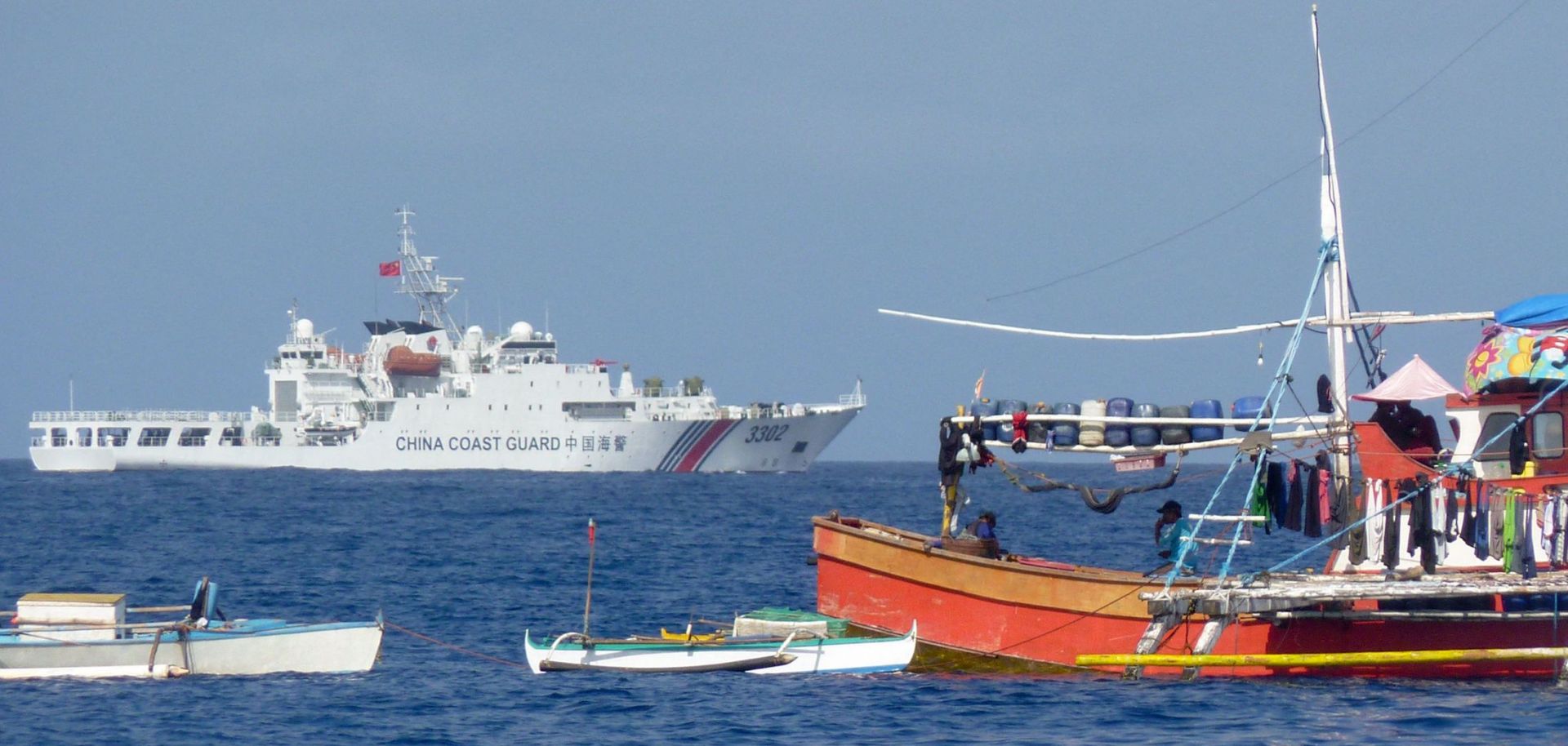
A Chinese coast guard ship sails past anchored Philippine fishing boats in the Scarborough Shoal, in the disputed South China Sea, on Feb. 3, 2023.
Despite the resumption of talks between the Association of Southeast Asian Nations (ASEAN) and China over the still-unrealized South China Sea code of conduct, fundamental differences suggest the long-standing deadlock will persist, driving claimants to accelerate regional militarization. On March 10, China and ASEAN concluded the latest round of negotiations to produce the long-sought-after code of conduct governing claimant states' behavior in disputed territories of the South China Sea. As expected, the meeting did not yield much progress. The main result, which was primarily symbolic, was an agreement to "attempt" to establish a security hotline between ASEAN and China at some point in 2023 — a measure agreed upon in 2016 but never implemented — to reduce the likelihood of escalation in the event of maritime standoffs or accidental collisions. Most consequentially, China and ASEAN did not discuss whether the code of conduct will be legally binding (which ASEAN insists on and China resists).
- The latest talks were held in Jakarta, Indonesia, which currently chairs ASEAN. The country's top ASEAN official told reporters on March 10 that "we avoid binding words [regarding the code of conduct] for now."
- On March 13, Japan established a security hotline with ASEAN, becoming the first non-member state to do so and accomplishing it before China. This development underscores that Southeast Asia is fast becoming a realm of geopolitical competition between China and Japan, and it highlights the sluggish pace of discussions on the code of conduct.
- China established bilateral hotlines with claimants Vietnam in 2021 and the Philippines in January 2023, illustrating Beijing's preference for negotiating with individual states (over which China can exercise asymmetric advantages) rather than with ASEAN as a bloc.
- A legally binding code of conduct would be based on the U.N. Convention on the Law of the Sea. The International Court of Justice would then have jurisdiction to adjudicate disputes.
The parties resumed negotiations following a three-year COVID-19-induced hiatus, but simmering regional tensions and diplomatic posturing, rather than a genuine push to produce a code of conduct, primarily drove the meeting. In recent months, tensions in the South China Sea have increased, particularly between China and the Philippines, contributing to claimants' desire to renew negotiations. Moreover, as ASEAN chair, Indonesia has vowed to utilize its greater power relative to other Southeast Asian countries to actively push China to conclude the code of conduct. However, as gleaned from the negotiations, the two sides remain so far apart that the negotiators opted to discuss minor issues, such as the hotline, while actively avoiding the major issue of legal force. Even so, holding the meeting still served other interests. For example, by bringing China back to the negotiating table, Indonesia is able to boost its credibility as a regional leader and emerging diplomatic player. China, for its part, needs to maintain dialogue with ASEAN counter-claimants or risk these countries falling under greater Western influence, even if it has no intention of pursuing the code of conduct along more actionable lines.
- ASEAN has sought a binding agreement on the South China Sea since 1996. The bloc produced a draft code of conduct and provided it to China for consultation in 1999.
- After years of negotiations, the parties agreed to the non-binding declaration of conduct in 2002, wherein claimants agreed to peacefully settle differences and exercise self-restraint, but the document does not provide any mechanism to fulfill its commitments. At the time, the declaration of conduct was hailed as a milestone toward eventual resolution. Yet since its signing, the declaration's non-binding nature has failed to meaningfully constrain claimant states' behavior, which has only grown more aggressive over time. Subsequent non-binding documents intended to regulate behavior have had similarly little impact.
China's core strategic interests mean it is unlikely to make concessions on the South China Sea, and ASEAN lacks the leverage needed to compel a compromise. China's strong and heavily militarized position in the South China Sea, which it was largely able to cultivate while the United States was distracted from the region in prior decades, serves to help secure vital sea lines of communication and critical maritime chokepoints. Moreover, China is motivated to maintain its claims and de facto freedom of movement due to a desire for trade routes and maritime resources such as oil, gas and fisheries to satisfy growing domestic demand, especially since China has depleted its domestic fish stocks. Additionally, the South China Sea is a potential key battleground in the fight over Taiwan; if China can effectively surveil and prevent the United States and its allies from sending supplies, vessels and aircraft through the waters, it can more effectively cut off Taiwan from outside assistance. In the long term, this would further enable China to establish control over a wider area, not just its own coasts, to become the dominant military in the Western Pacific. Relatedly, control of wide swaths of the maritime region also enables China to control subsea internet cable installation and repair projects in the South China Sea, which prevents the installation of surveillance systems by adversaries and gives Beijing de facto control over much of the maritime region's internet connections. All of these interests mean that China is highly unlikely to allow a code of conduct to curb its substantial strategic advantages. This has proven to be a major sticking point, as Chinese interests are often directly at odds with those of ASEAN counter-claimants.
- Around $3.4 trillion of global trade moves through the South China Sea annually.
- China occupies 20 outposts in the Paracel Islands and seven in the Spratly Islands after creating around 3,200 acres (1,295 hectares) of new land since 2013.
- The South China Sea's subsea cables provide telecommunications and internet connections from the region to the rest of the world. Two cables currently under construction, Apricot (connecting Japan to Singapore) and Echo (connecting Indonesia to the United States), are being built to circumvent the South China Sea.
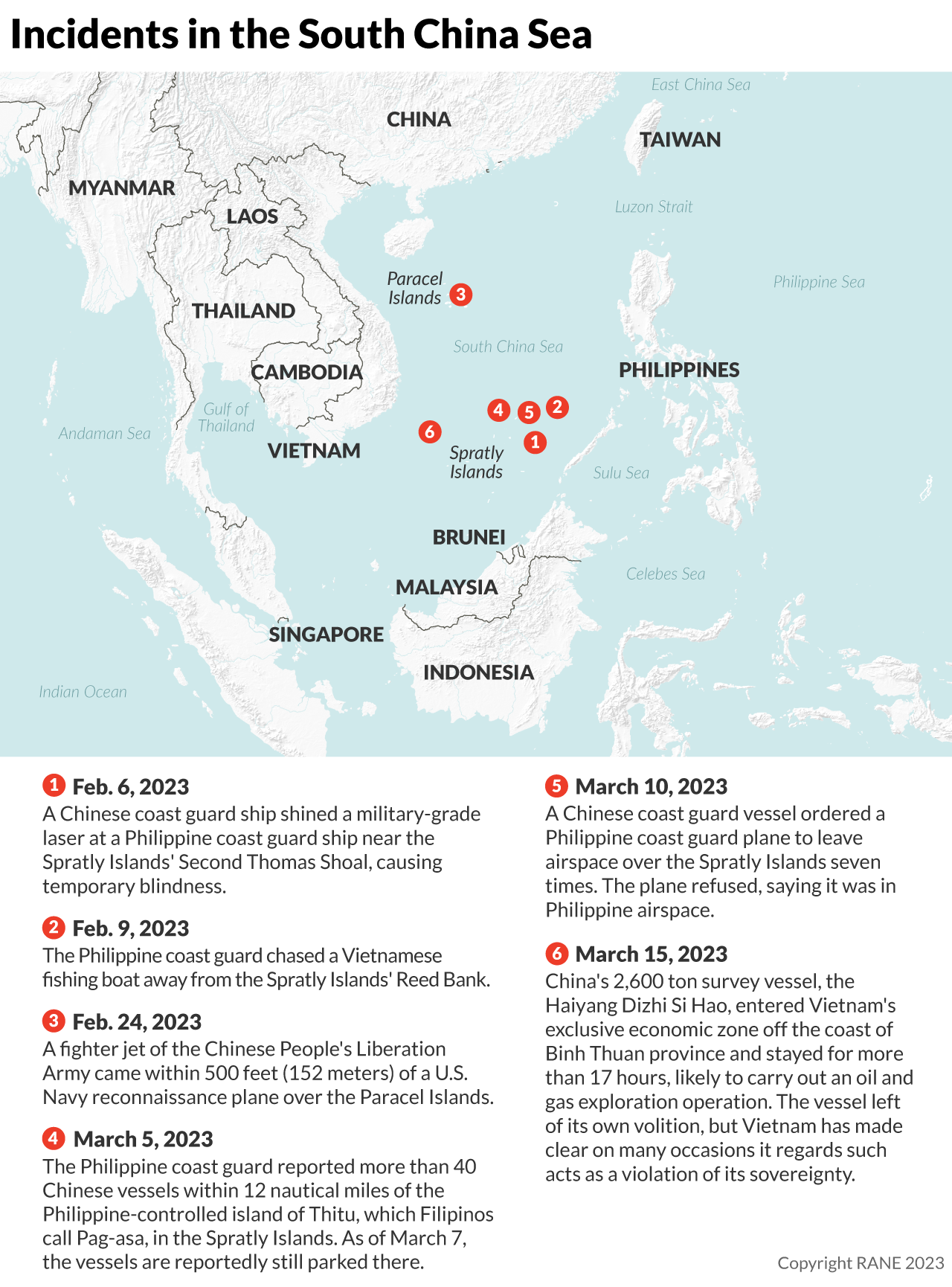
The poor prospects for a binding code of conduct amid increasing regional tensions suggest that claimants will continue expanding their militaries to secure their interests, which will result in more dangerous incidents at sea. Though China may be amenable to a code of conduct that allows it to formalize its control of occupied features, Beijing remains unlikely to entertain a legally binding agreement that would constrain its military options. And because ASEAN states are unlikely to agree to a non-binding document that would leave member states' claims in the region unaddressed and unprotected, enabling China to maintain control over disputed territories while using its vast maritime capacities to outmuscle the competition, it remains unlikely that an agreement will come to fruition. This means that the currently elevated level of military activity is set to persist, especially from China, the Philippines and Vietnam — the three most aggressive maritime powers in the region. As China continues to build out military facilities on its occupied features, the Philippines is breathing new life into its alliance with the United States by allowing U.S. forces to build out and staff nine military sites in the country. Manila is also adopting more bellicose rhetoric regarding Chinese encroachment and seeking deeper defense partnerships with China's adversaries, such as Australia and Japan. Vietnam, for its part, is substantially intensifying its land reclamation efforts in the South China Sea and prioritizing its ability to both expand and protect areas already under its de facto control. These activities suggest that ASEAN claimant states do not anticipate signing a legally-binding code of conduct soon. Without a mechanism governing claimant states' behavior, growing militarization portends a rockier status quo going forward, which will result in more incidents at sea, intrusions into counter-claimants' exclusive economic zones, harassment of counter-claimants' fishermen, and disputes over oil and gas exploration. This also implies that inter-state conflict is slowly becoming more likely, although ASEAN states’ characteristically cautious approach would likely drive major efforts to de-escalate the situation should this prospect reach a genuine crisis point.
- On March 8, ASEAN announced that it will elevate ties with Japan to a "comprehensive strategic partnership" in 2023, suggesting that the bloc will court other powers to balance against China.
- The United States will begin cycling military assets and personnel in 2023 into the Philippines under the 2014 Enhanced Defense Cooperation Agreement, which Philippine President Ferdinand Marcos Jr. revitalized in November 2022 and expanded in February 2023.
- Other claimants Malaysia and Brunei are also shoring up security collaboration with each other and Indonesia. The Philippines and Malaysia likewise boosted defense cooperation in March.
- According to the U.S. think tank Center for Strategic and International Studies, Vietnam created approximately 420 acres (170 hectares) of new land in 2022 compared with 540 acres (219 hectares) in the entire preceding decade — an 80% increase in just one year. Vietnam has also vastly expanded its anti-access and area denial capabilities to prevent adversaries from deploying forces to the areas under its control while inhibiting the movement of enemy forces that are already in-theater.
- On Feb. 6, the Chinese coast guard shined a military-grade laser at Philippine sailors, causing temporary blindness. President Marcos subsequently issued a formal complaint and instituted a policy to widely broadcast the occurrence of future Chinese incursions in an effort to sway popular opinion.
