
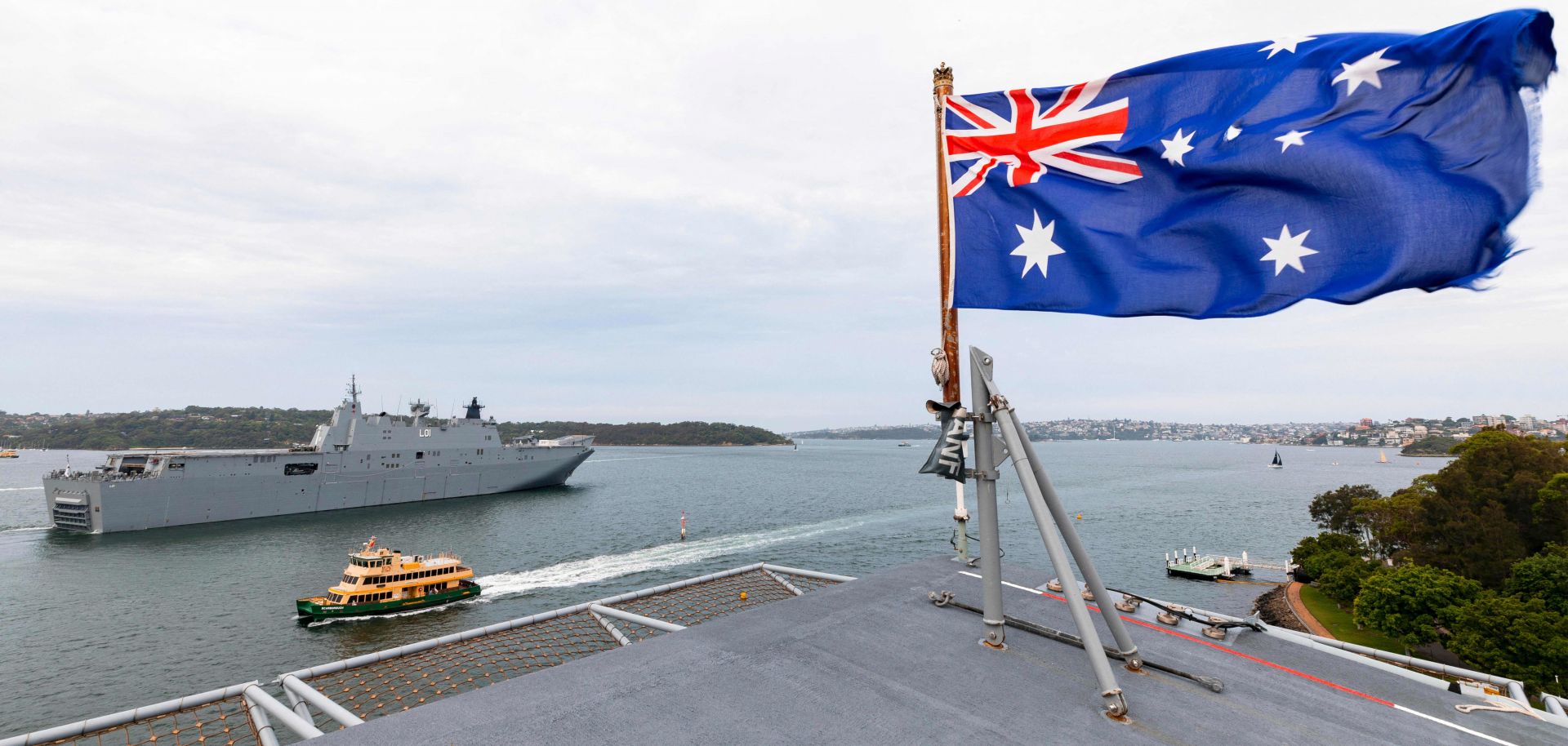
An Australian flag waves as a ship transits a waterway in the background.
Australia is accelerating its military development in response to China's growing presence in the Indo-Pacific. But Canberra's focus on mitigating the more direct threats posed by Chinese encroachment could ultimately enable Beijing to make further inroads in the region by leaving Pacific Island nations' other security concerns unmet. On April 19, China and the Solomon Islands ratified a security agreement that allows Chinese naval vessels to dock in the island nation to refit and repair. The deal also allows Chinese military forces to conduct security operations on the Solomon Islands, and for Chinese police to train local police forces. This base access is a grave security concern for Australia, as the Solomon Islands sits just off its northeast coast. The island nation can provide a strategic location for China to monitor regional maritime traffic and can also serve as a staging point for Chinese naval forces to threaten Australian waters. This is a major step for China as it seeks to expand its naval deployments into the greater Indo-Pacific.
- On Feb. 22, Australia demanded a full investigation after a Chinese vessel in the waters between Australia and Papua New Guinea pointed a military-grade laser at an Australian military aircraft in flight over Australia's northern airspace border.
- In recent years, Australia has adopted a more confrontational stance on Beijing's regional rise and involvement in the COVID-19 pandemic. In retaliation, China banned imports of Australian goods like beef and wine in 2020. Supported by the Chinese navy, Chinese fishing fleets also stepped up operations in Australian waters in 2020, aiming to disrupt Australian fishing activities and potentially deplete some of the fishing stock in the area.
Australia is seeking to quickly develop new military capabilities to reassert its presence in the region and, in turn, mitigate current and future Chinese threats. On April 5, the Australian government announced it had moved up its self-imposed deadline for rearming the country's fleet of fighter jets and warships with long-range strike missiles from 2027 to 2024. The following day, Prime Minister Scott Morrison also said Canberra would boost Australia's defense troops by roughly 30% to 80,000 personnel by 2040. This push to quickly ramp up the military's missile capabilities and manpower indicates that Australia is anticipating a need for a larger conventional defense force in the near future. And even if the May 21 general election unseats Morrison's ruling Liberal-National Coalition, Canberra remains highly unlikely to reverse course on these policies, as Australia's main opposition Labor Party also recognizes the need to rapidly develop domestic military capabilities.
- In September, Australia announced plans to acquire nuclear-powered submarines from the United States and the United Kingdom as part of the three countries' new AUKUS trilateral security arrangement. The move caused an uproar in France by undercutting a deal Canberra had made with Paris to purchase conventional French-made diesel submarines. The AUKUS arrangement, however, aligns much closer with Australia's strategic goals, as nuclear-powered submarines have greater range and arms capacity than diesel-powered submarines. The new trilateral defense pact is also primarily focused on securing the Indo-Pacific region and, in addition to the more advanced submarines, grants Australia access to new intelligence sharing, support and coordination with the United States and the United Kingdom.
- On March 30, the Australian government announced a $9.9 billion budget over ten years to combat external cyber threats, develop artificial intelligence, and build up a robust cyber intelligence network to combat current and future Chinese cyber threats.
As it adopts a more assertive stance against Chinese encroachment, Australia's narrow focus on securing the waters of the Indo-Pacific risks overlooking its island neighbors' other, less conventional concerns (like climate change), which could create another avenue for Beijing to gain influence in the region. Australia is likely to utilize its new capabilities and personnel to address traditional security threats of interest to the West, including protecting commercial shipping, freedom of movement on the seas, and maritime territorial security. However, many Pacific Island nations place greater weight on non-traditional security concerns, such as climate change and rising sea levels, illegal fishing and piracy. Canberra's military plans can address some of these concerns simultaneously, such as illegal fishing or piracy. But others, like climate change, require different solutions that Australia is not prioritizing with its focus on traditional maritime security. If Canberra neglects these interests, it leaves an opportunity for China to step in, particularly if Beijing can present itself as a more capable leader in combating climate change, which many island countries see as an existential threat. China's recent unveiling of its new Cooperation Center for China and Pacific Island Countries on Climate Change, which aims to coordinate climate action between China and Pacific Island nations, could support this strategy.
- On April 6, Morrison issued a joint statement with his U.S. and U.K. counterparts announcing that the three countries would work together to pursue hypersonic missiles and ''counter-hypersonics'' in an effort to keep pace with China's development of such weapons.
- Australia has pledged to invest $500 million from 2020 to 2025 into on regional efforts focused on transitioning to renewable energy, combatting climate change, and disaster resilience in the region. But the investment per annum is small and is not enough to cover the many projects needed to harden the region's communication lines and other critical infrastructure against the impacts of climate change, such as rising sea levels and more extreme weather events.
- In 2019, the president of Kiribati — the island nation in the central Pacific Ocean — justified recognizing Beijing instead of Taiwan by referencing the former's pledge to help Pacific Island nations mitigate the effects of climate change.
