
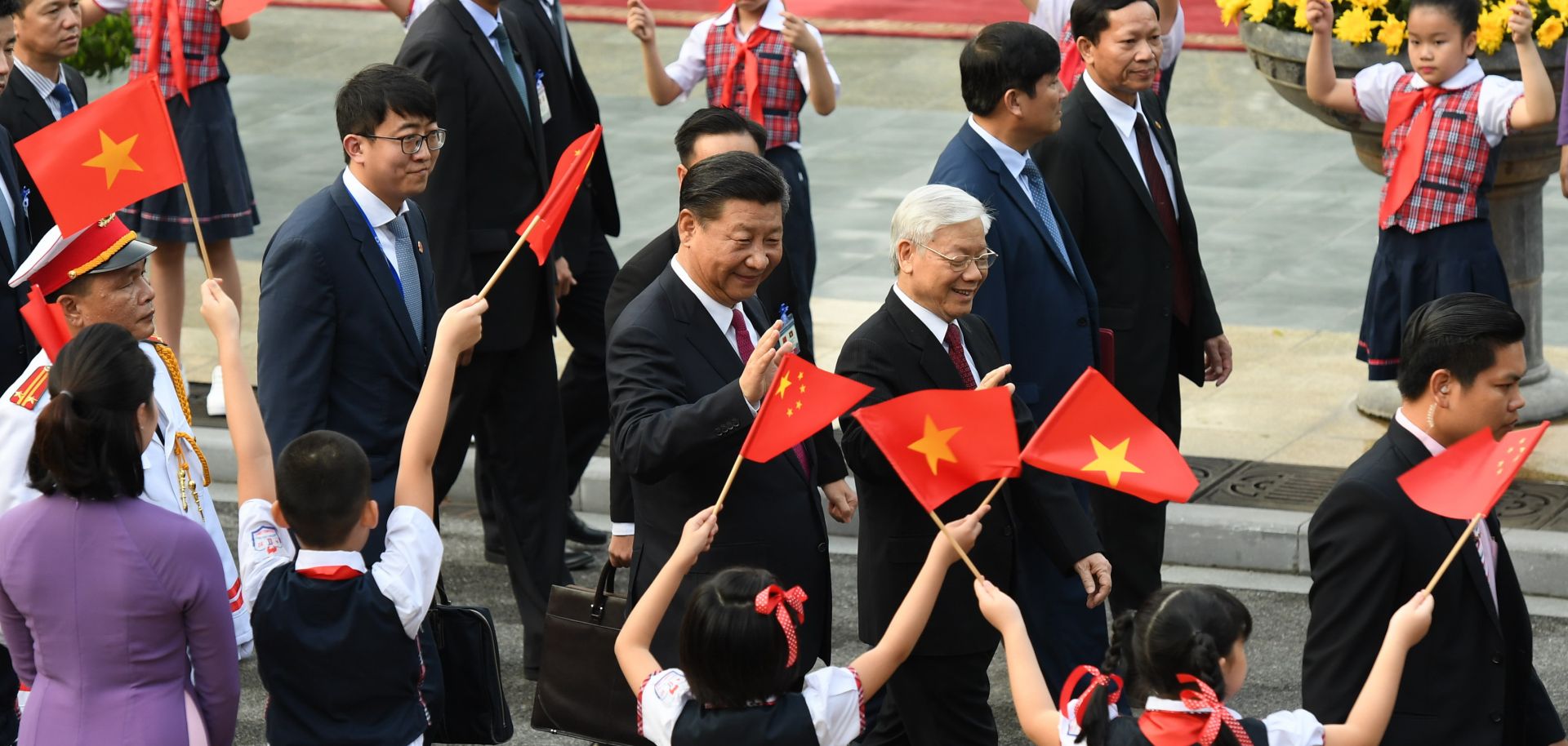
Chinese President Xi Jinping (center) and Vietnam's Communist Party Secretary General Nguyen Phu Trong (right) wave during a welcoming ceremony at the presidential palace in Hanoi, Vietnam, on Nov. 12, 2017.
A recent meeting between party leaders of Vietnam and China suggests a possibility of improved relations between the two countries after years of tensions, but Beijing's political overtures and economic promises will not be enough to substantially alter Hanoi's multivector foreign policy. From Oct. 30 to Nov. 1, Vietnamese Communist Party Chairman Nguyen Phu Trong visited Chinese President Xi Jinping and other high-level officials. Trong was the first foreign leader to meet with Xi since the Chinese leader secured his historic third term, highlighting the special importance Beijing ascribes to its relationship with Hanoi. The delegation accompanying Trong was also unusually large and dominated by national security officials, including the defense and national security ministers. The two sides agreed to increase bilateral trade, maintain supply chain stability, strengthen strategic connectivity and manage differences under the rubric of the two countries' comprehensive strategic partnership. The meetings produced 13 documents to boost cooperation in politics, law (including extradition), trade, customs, the environment and tourism.
- Both countries' state-run media apparatuses, playing to domestic audiences who harbor deep-seated mutual distrust, hailed the visit as the opening of a new era in relations. The event featured an unusually high level of grandeur and symbolism demonstrating prime national importance. Trong was greeted in Beijing with a rare 21-gun salute and awarded the Friendship Medal of the People's Republic of China, last awarded in November 2020.
- China-Vietnam relations are severely constrained by overlapping territorial claims in the South China Sea, in addition to perpetual mistrust over the many wars the two countries have fought. But the Vietnamese Communist Party (VCP) maintains a strong fraternal relationship with the Chinese Communist Party (CCP), which provides room for political cooperation between Beijing and Hanoi. China's choice to invite Trong instead of Vietnam's head of state highlights Beijing's need to pursue dialogue via a friendlier channel.
- The visit took place as China is renewing its international diplomatic push in a so-called “new era” ushered in by Xi's third term. Xi took his first post-COVID trip abroad in September, with visits to Kazakhstan and Uzbekistan. For almost three years, Xi avoided foreign delegations and travel abroad for fear of contracting the virus. During his visit to Uzbekistan, he attended the Shanghai Cooperation Organization but skipped many of the events out of COVID-19 concerns, limiting the impact of his presence. But Xi was notably maskless when he greeted Trong upon his arrival in Beijing on Oct. 30. Despite still being extremely cautious about COVID-19, Xi also shook Trong's hand and hugged for photo ops — further showcasing the importance Xi gave to the meeting.
For Vietnam, retaining close ties with China is key to maintaining Hanoi's larger balancing act between the world's top powers. Vietnam’s foreign policy philosophy, which eschews formal alliances and joining coalitions, enables it to fluidly pivot between China, the United States and Russia as dynamic external circumstances dictate the need for change while never fully ensconcing itself in a geopolitical camp. In managing security threats in the South China Sea, Vietnam has often relied on its limited security partnership with the United States — capitalizing on Washington's core national interest in defending Freedom of Navigation in the disputed waterway (without needing to be vocal or directly conformational with respect to its claims), while also maintaining robust economic and political ties with China. Erosion of this delicate balance would destabilize the region and limit Hanoi’s ability for independence of action — possibly forcing hard, point-of-no-return security choices. To avoid that outcome, Vietnam will continue to nurture its political and economic relationship with China — maintaining an outwardly deferential demeanor (which was on full display during Trong's recent visit to Beijing). Vietnam also has a close relationship with Russia, which is its longest-sustained and top traditional partner. But Russia’s deteriorating status on the world stage, largely due to the ongoing war in Ukraine, as well as its deepening dependence on China, is forcing Hanoi to recalibrate its foreign policy needs and become less reliant on Moscow. Given Vietnam's limits to further increasing cooperation with the United States, maintaining predictability with China is made all the more necessary.
China, for its part, is seeking to prevent Vietnam from using its emerging international influence unfavorably, as well as keep other countries from establishing a strong foothold in the strategic neighboring state. The joint statement that China and Vietnam released after Trong's visit highlighted Vietnam's heightened global prominence and international standing. Vietnam's newfound geopolitical importance is undergirded by its transformation into a global manufacturing hub and membership in 63 international organizations — most notably the Association of Southeast Asian Nations, which China seeks to broadly influence as the organization has become a front in competition with the United States. Vietnam also participates in six U.N. bodies — including the Human Rights Council, which in September published an unflattering report detailing China's human rights abuses in Xinjiang.
China is also hoping to gain greater access to and influence over Vietnam's fast-developing economy while more efficiently streamlining its own firms’ operations in the country. During his meeting with Trong, Xi offered to assist Vietnam with key infrastructure projects — an area in which Vietnam is sorely lacking — under Beijing's signature Belt and Road Initiative. This underscores a renewed desire to bolster economic cooperation with Hanoi, especially given that many Chinese firms have relocated or expanded to Vietnam in recent years. China wants to encourage tech companies to invest in Vietnam and open up targeted imports to boost strategic sectors. Easing cross-border transactions is thus in its own interest as Chinese companies now find it difficult to bring products back into the country. In addition, Beijing wants to boost supply chain capacity and increase economic interconnectedness with Vietnam to lower China's trade reliance on the West. Such an easing of cross-border trade processes would, in turn, help China mitigate external risks to its economy in the medium-to-long term. To Vietnam's benefit, China will also seek to increase agriculture, forestry and fishery imports to help alleviate the $45.5 billion trade imbalance. But restrictions related to China's “zero-COVID” policy will ultimately continue to limit the scope of bilateral trade.
In addition, China is seeking to contain Vietnam as a potential threat as Hanoi's security relationship with Washington evolves with an indeterminate trajectory. Vietnam is the only Asian country that remains outside the formal U.S. regional security architecture that could plausibly challenge China. China and Vietnam also share a long land border that has been the center of numerous wars. If Vietnam were to fully embrace an anti-China policy, it could potentially challenge Chinese preeminence in neighboring Laos and Cambodia (where Vietnam has historical influence) and resume oil excavation in contested parts of the South China Sea, which it has de facto ceded to China after backing down from threats.
However, while Vietnam ultimately seeks an even-keeled and predictable relationship with China to prevent hostilities, Hanoi's foreign policy doctrine and unwillingness to enter fully into China's orbit will still limit medium to long-term collaboration. Vietnam touches more than 2,100 miles of coastline along the South China Sea. Despite recent increases in military spending, Vietnam's five naval bases also remain insufficient to protect the extensive adjacent Exclusive Economic Zone. The country thus remains intrinsically vulnerable to threats from its far wealthier and more powerful northern neighbor. Intensified Chinese pushes into Laos and Cambodia have further rendered Vietnam militarily encircled. While Hanoi remains deeply concerned about Beijing's expansionism in the South China Sea (which drove Vietnam to modernize its air and naval capabilities and seek security accommodation with the United States), Vietnam will not vocally support Western-led security initiatives as part of its careful balancing act under China's shadow. Beijing, with no intention of withdrawing from the South China Sea, likely sees the need to seize the opportunity afforded to it by Vietnam's reluctance for direct confrontation to undercut incentives for more outward security cooperation with Beijing's adversaries and incentivize Vietnam to act more cautiously in responding to potential Chinese threats. However, as China is not willing to budge on the maritime dispute, incentives remain limited to economic considerations and appeal to ideological solidarity.
Without meaningful security guarantees, Vietnam will continue to keep China at arm's length. The recent high-level meeting portends a slight improvement in bilateral relations, particularly in trade and interconnectivity. But from a security perspective, Vietnam and China have demonstrated severe aversion to direct discussion on the South China Sea, making a bilateral diplomatic solution unlikely. This will, in turn, see Vietnam continue to pursue a multilateral solution to that issue and lean on the United States for security and limit the scope of renewed cooperation with China.
