
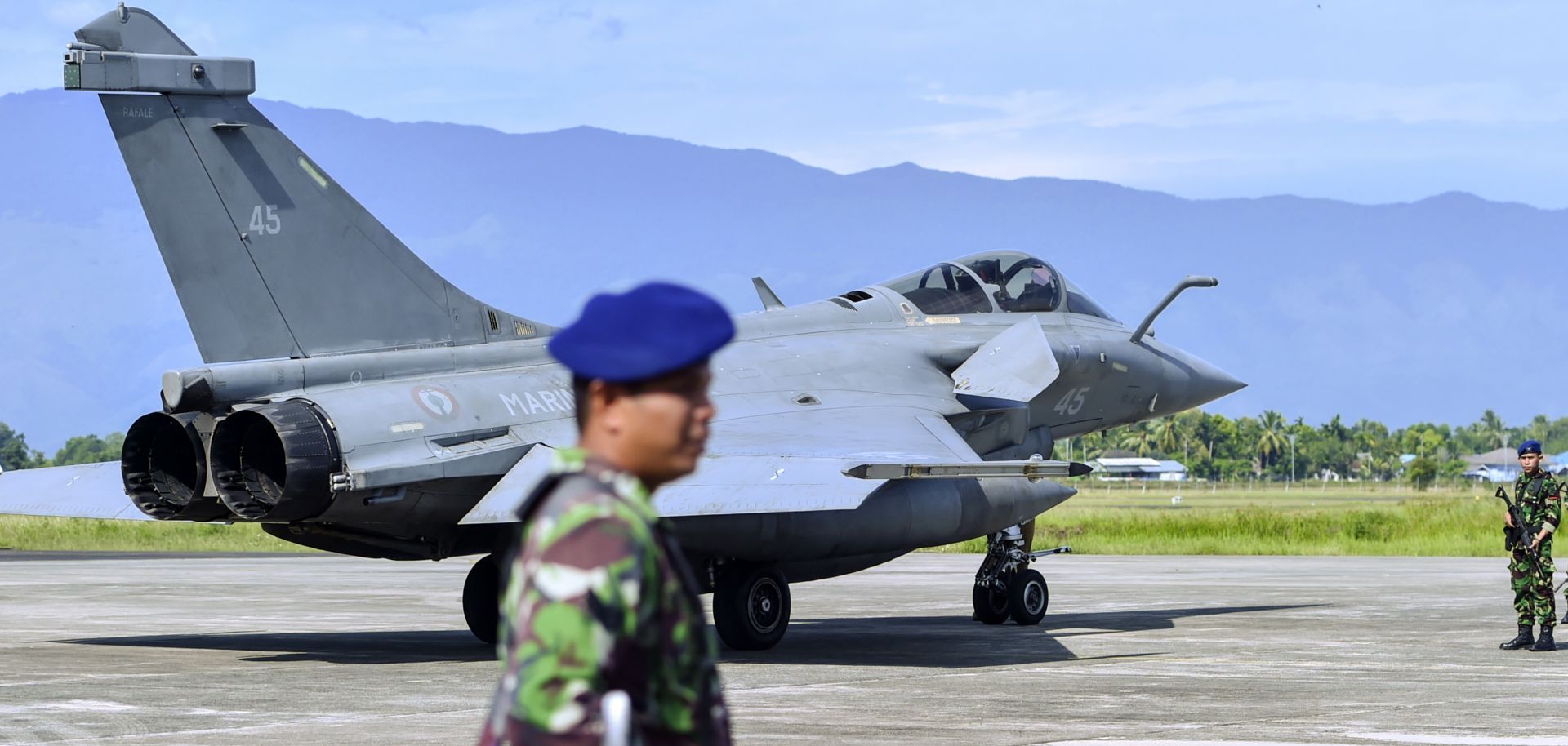
Indonesian soldiers stand guard near a French Rafale fighter jet at a military base in Blang Bintang, Indonesia, on May 19, 2019.
Indonesia's military development will escalate tensions with China in disputed waters north of the Natuna Islands, forcing Jakarta to accept the potential economic cost of Chinese retaliation. Both Indonesia and China claim control over the territory in the South China Sea that borders Indonesia's Natuna Islands, which have an estimated 1.9 trillion cubic feet of natural gas reserves, crucial fishing stocks, and access to key shipping lanes that go from the Strait of Malacca to East Asia. Indonesia is attempting to balance its military modernization and territorial defense against Beijing's competing claims just north of the islands, as well as Indonesia's economic reliance on China (with 26% of Indonesian exports going to China). In recent months, Jakarta has been in talks with major arms-dealing countries to upgrade and modernize its navy and airforce, shoring up holes in its defense.
- In February, Indonesia purchased 42 French-made Rafale fighter jets for $8 billion, with talks of purchasing French submarines. That same month, Jakarta also signed a $14 billion deal to buy U.S.-made advanced fighter jets.
- In mid-November, the Chinese navy used water cannons to prevent Philippine navy vessels from resupplying sailors on the Second Thomas Shoal. The incident showed Beijing's willingness to press its territorial claims in the South China Sea, which raises the possibility of similar clashes with Indonesia.
Indonesia's military buildup could dent the country's economic growth by harming its trade relationship with China. China's retaliation to Indonesia's military buildup is likely to include targeted tariffs and import controls on key Indonesian goods. As an export-oriented nation, Indonesia is very susceptible to a sudden increase in tariffs, and China has used targeted tariffs as economic retaliation in the past against rival countries. Though trade with China has risen in recent years, Indonesia has also reached trade deals with other nations that would mitigate the impact of Chinese economic retaliation.
- Indonesia exported roughly $231 billion worth of goods in 2021. About $60 billion of those goods went to China last year, which included mostly iron, coal, natural gas, and palm oil shipments.
- In September, China banned Australian wine, barely, lobster, coal and timber exports. For China, banning such consumer goods minimizes blowback on the Chinese economy while still having the desired strategic political and economic impact on the targeted country.
- In late 2021 and early 2022, Indonesia signed trade deals with South Korea and Australia to export urea, a diesel fuel additive that reduces pollution, after China banned exports of the product.
Indonesia, however, is unlikely to sacrifice national security and territorial integrity for economic continuity. Fishing rights and natural resource extraction are key strategic interests in the region. The maritime territory around the Natuna Islands also includes key strategic defense locations, making them even more important from the Indonesian standpoint. If China were to control these islands or the territory around them, it would undermine Indonesia's security position by giving Chinese forces a close staging ground to launch attacks against Indonesia. The close proximity of the islands to Indonesia presents a significant security risk for Indonesian national defense and enables the military to monitor trade routes through the region. Indonesia's push to harden its defensive capabilities may not necessarily see increased cooperation with the United States, as Jakarta is likely to prefer working with regional actors on defense and security instead of working directly with China's main rival.
- In early December, a letter surfaced from China demanding that Indonesia stop drilling for oil and gas in Indonesia's exclusive economic zone northeast of the Natuna Islands, claiming the drilling was taking place in Chinese territory. Indonesia refused, referring to the 2016 Hague ruling against China's sweeping claims to the so-called nine-dash line in the South China Sea.
- Also in December, Indonesia invited five other nations (Brunei, Malaysia, the Philippines, Singapore, and Vietnam) to meet to discuss coordinated action against territorial aggression in the South China Seas. While they did not name China specifically, this meeting would indicate that Indonesia is likely to prioritize security over investment.
