
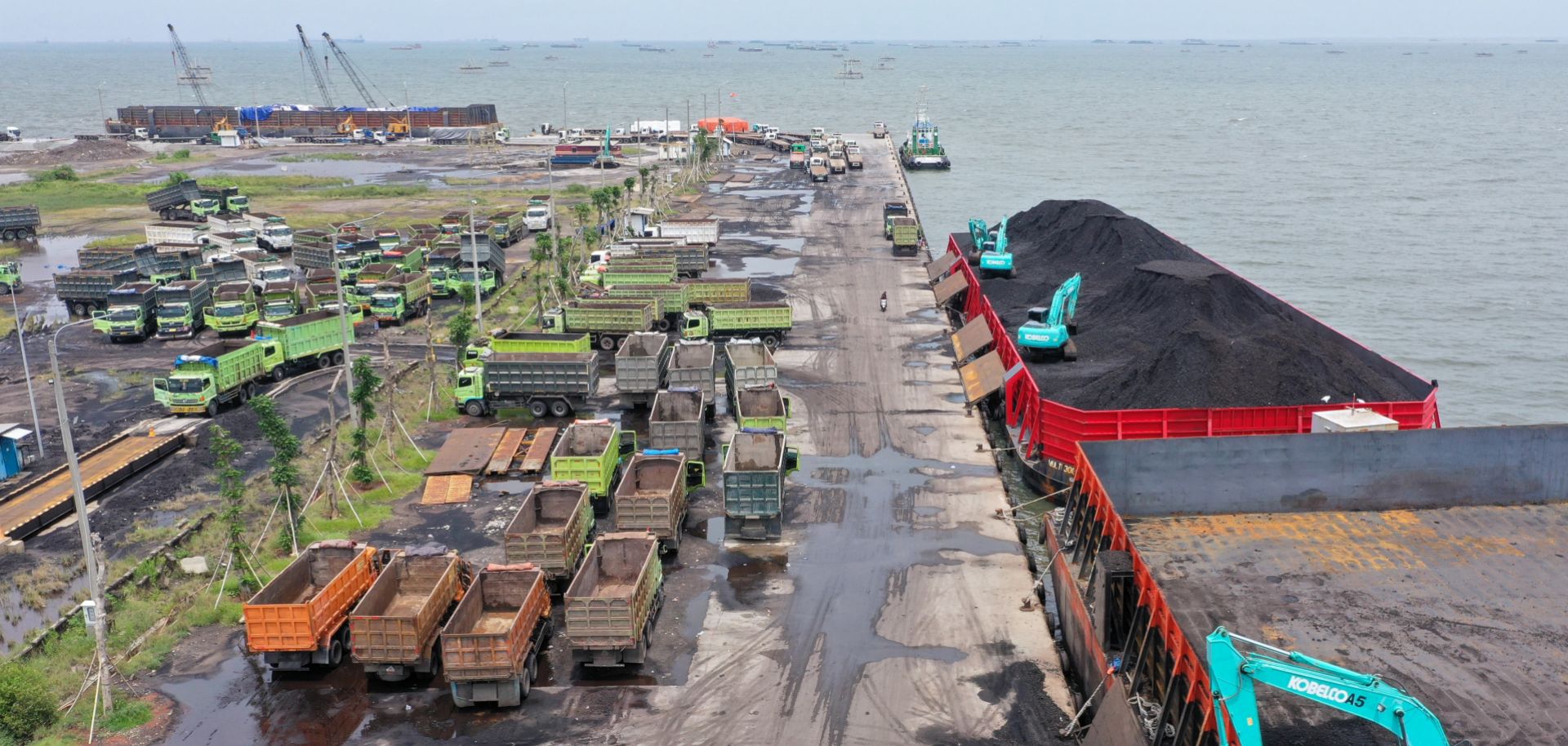
Machinery is used to load coal onto trucks at a port in Jakarta, Indonesia, on Jan. 17, 2022.
Indonesia’s trade surplus will enable its government to restructure the economy and attract investment, but Jakarta will ultimately struggle to reduce its reliance on energy exports. The recent surge in global energy prices and demand has been a boon for Indonesia, which saw its energy exports grow by 35.4% between 2020 and 2021. The country now has a $35.34 billion trade surplus, which its government will use to diversify the economy away from energy exports to avoid over-relying on an industry heavily influenced by global demands. The first step of this push will include reforming Indonesia’s state-owned enterprise (SOE) sector by permanently closing poor-performing SOEs while preparing others for initial public offerings (IPOs). The oil and gas company Pertamina and electrical utility company Perusahaan Listrik are among the largest SOEs in Indonesia in terms of assets and revenue, and both are planning to go public later this year. The revenue generated from these IPOs and others could bring in much-needed revenue and investment that Jakarta can then use to fund the development of other economic sectors.
- Buoyed by supply chain issues and increased demand during 2020 and 2021, global energy prices are currently up 76% since 2020.
- Energy exports (including coal, oil and gas) have accounted for roughly 17% of Indonesia’s GDP since 2019.
- Dayamitra Telekomunikasi (Miratel), a telecommunications subsidiary of Telekomunikasi Indonesia, raised $1.28 billion after going public in November.
As part of the economic restructuring, Indonesia will use the new funds from the SOE reforms and related IPOs, as well as foreign investment, to increase development across more industries and islands. The majority of investments and infrastructure is currently centered around the country’s capital of Jakarta and the surrounding island of Java, as well as the country’s energy and palm oil industries. But in January 2022, the Indonesian government announced that the capital to a soon-to-be-constructed city named “Nusantara” on the neighboring island of Borneo in an effort to drive more development to the country’s other islets. Effects from the recent ore ban have encouraged investors to invest in infrastructure and projects on islands outside of Java as well, which not only benefits other local economies but aligns with Jakarta’s push to develop higher-value exports than raw ore. The Indonesian government has also taken a renewed interest in developing the country’s tourism sector, which has lagged behind that of its neighbors like Thailand in attracting international tourists.
- Chinese companies have $30 billion in nickel supply chain projects in Indonesia’s industrial parks, including those on the islands of Sulawesi and Maluku. This investment is almost equal to the $32 billion in overall trade between the two nations in 2021.
- Prior to the onset of the COVID-19 pandemic in early 2020, tourism revenue accounted for roughly 5% (or $34 billion) of Indonesia’s GDP and 22% (or $120 billion) of nearby Thailand’s GDP.
The short window for making these changes, however, makes it unlikely the nation will fully shed its reliance on energy exports. President Joko “Jokowi” Widodo has been the main driver behind this economic reform push. But his term is up in 2024, and there is no guarantee his successor will continue these policies or reforms — including Jokowi’s championed raw ore bans, which have forced countries to further invest in Indonesia to gain refined ore exports since they came into effect in 2019. Additionally, high energy prices on the global market will eventually ease, putting a cap on any future trade surpluses from energy exports. This will put further pressure on the government to move swiftly on its restructuring efforts to avoid being caught when energy prices inevitably fall.
