
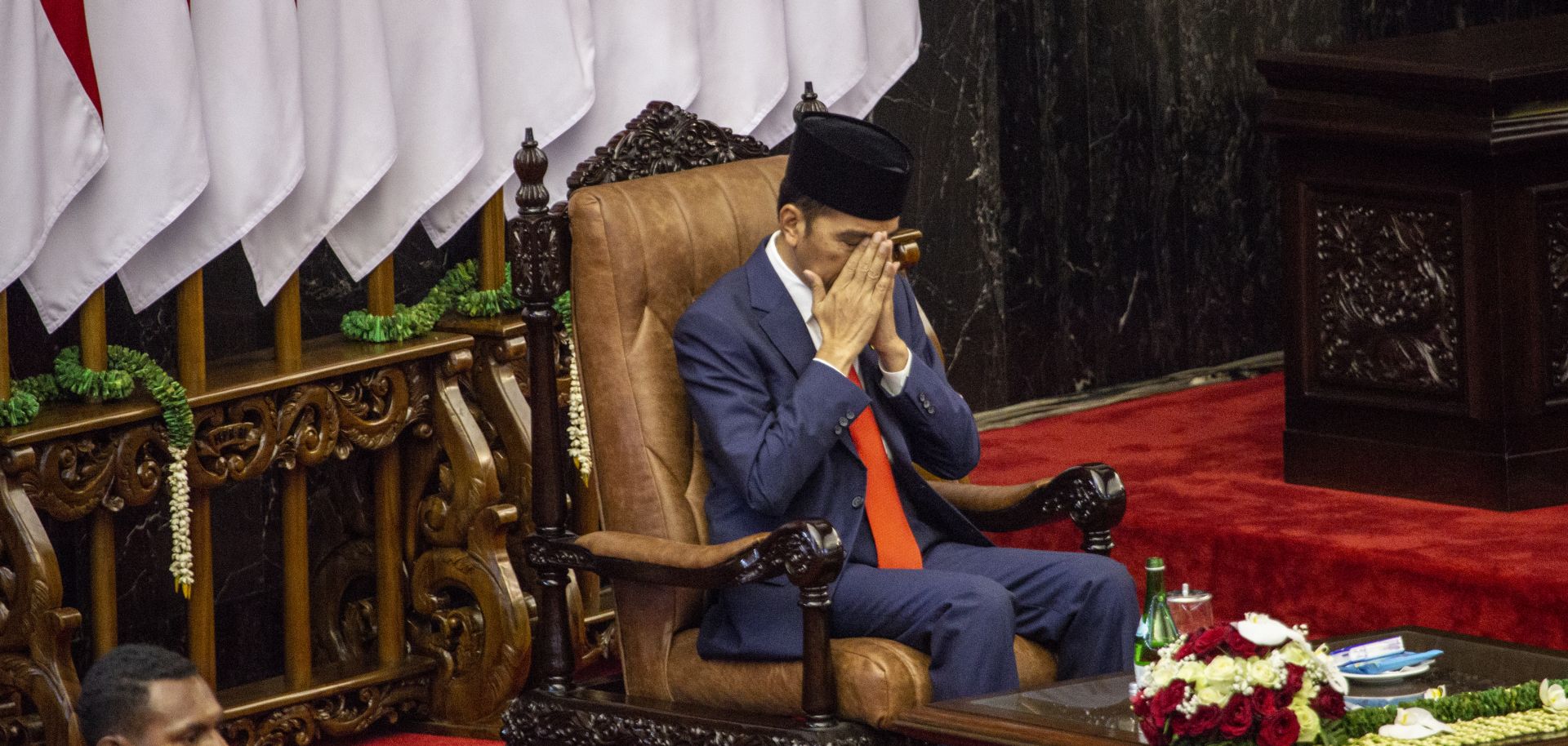
Indonesian President Joko "Jokowi" Widodo prays during his inauguration for his second term on Oct. 20, 2019, in Jakarta. His large governing coalition means he will likely have to compromise to enact his agenda.
As Indonesian President Joko "Jokowi" Widodo begins his second, and final, term in office, his focus has remained the same as in his first: spurring economic growth, development and investment. And, as in his first term, his pursuit of ambitious economic reform will be limited by the entrenched interests among his coalition partners and political allies that will force him to make compromises, making it more difficult to attract outside investment and spur growth.
Treading a Political Path
Although Jokowi walked away from April's election with a solid victory, he faces internal political difficulties. Jokowi's status as the first Indonesian president from outside the political and military elite means he lacks a firm support base in the top echelons of power. Without a powerful network outside entrenched power, he cannot advance reforms that go against the demands of his party, the Indonesian Democratic Party of Struggle, and its coalition allies. Because that coalition has expanded to include the major former opposition party Gerindra, Jokowi will find his second-term strategy even more limited, giving an even broader variety of stakeholders a say in which reforms move forward. As each pushes the interests of its own constituencies and power bases, it will slow the pace of implementing changes to investment restrictions, put other legislation ahead of reform, and lead to carveouts for certain economic sectors.
Given his first-term experience, Jokowi is no stranger to coalition politics. Near the end of that term, for instance, he was forced by political need to prioritize a raft of unpopular social law and corruption-authority related reforms instead of a more popular tax reform law. This sparked massive street protests that lasted nearly up to his inauguration. Jokowi also finds himself standing against a push for constitutional reforms that would, if successful, weaken the presidency by potentially ending direct elections and restoring parliamentary control of policy. On top of those constraints, Jokowi must contend with the fact that the Indonesian political establishment will soon begin maneuvering to line up his successor. That process will be difficult for him to direct as he tries to forge policy continuity.
Jokowi must work not only to rally his own coalition around him but also outmaneuver disruptive opposition forces, which helped fuel the messy street protests that marred the second half of his first term. To this end, Jokowi made a surprise move in forming his second-term government — bringing his main presidential election rival, Prabowo Subianto, and the opposition Gerindra party, into the government.
For the president, expanding the coalition was more about assuring legislative support for his agenda than a matter of ideology or unity. The second-term coalition he's built controls 74 percent of seats in parliament, up from the 61 percent of his first term. His wide base leaves the opposition as little more than a rump: Only three of Indonesia's nine major parties remain outside of the ruling coalition. By including the opposition, and specifically Prabowo, Jokowi hopes to avoid further intermittent protests that marked the five months between his electoral victory and inauguration, unrest that Prabowo was accused of influencing.
A More Complicated Political Atmosphere
While cooptation might help Jokowi blunt the messy protest politics of recent years, it also creates a host of new headaches for him. To keep a broader set of allies happy, he may now be compelled to compromise on his much-touted economic reforms. Prabowo, in particular, adds significant political firepower with deep roots in the country's powerful military institutions and connections among a broad swath of political elites. But the price of enlisting Prabowo's support by naming him defense minister gives his interest groups a greater say in policy direction. With this more inclusive second-term strategy, Jokowi risks the same pitfalls that hampered the reform efforts of his predecessor, Susilo Bambang Yudhoyono, who had built a similarly wide-ranging coalition in his second term.
As defense minister, Prabowo will have a powerful hand in allocating the military's budget and formulating the broader military strategy. As a strong Indonesian nationalist and opponent of what he condemns as overweening foreign influence, Prabowo has directed criticism toward Chinese investment and Jakarta's trade policy regarding Beijing — two key areas for Jokowi as he tries to overhaul the country's economy and infrastructure. China's largesse will be particularly critical for Jokowi's recently unveiled plan to move the Indonesian capital from Jakarta to a new location on the island of Borneo. The move, which is expected to cost $33 billion, combined with Indonesia's major infrastructure deficit, will likely require substantial Chinese investment through the Belt and Road Initiative, another thorny political topic. At the same time, Prabowo has criticized the funding levels of the country's military institutions as insufficient, setting the stage for spending increases that could sap funding from other pro-growth priorities. Although Prabowo will have to compete for resources with other powerful figures in related ministries, he will certainly have a strong say in steering both Indonesian policy and Jokowi's overall strategy.
The rest of Jokowi's 38-minister Cabinet is stocked with elite appointees from within his own motley political camp. But he has also included two high-profile political outsiders, the founder of the transportation app Gojek, Nadiem Makarim, and media tycoon Erick Thohir to lead the education and state-owned enterprises ministries in an effort to inculcate innovative, pro-business policies. However, Jokowi has given the key economic slots to party leads and political allies. While this does not in and of itself jeopardize economic reforms, it does suggest that ministers might seek to bend policies toward their own constituencies and pander to domestic business lobbies against the interests of opening up investment.
An Uphill Economic Climb
On the economy, Jokowi has his work cut out for him as the global trade outlook darkens. Moody's projects that the growth of Indonesia's economy, which reached 5.2 percent of gross domestic product in 2018, will slow to 4.9 percent in 2019 before further cooling to 4.7 percent in 2020. This is a far cry from the 7 percent growth that Jokowi touted at the start of his first term. And in spite of the success that neighbors such as Vietnam, Malaysia, Thailand and Cambodia have had in attracting manufacturing fleeing China because of its trade war with the United States, Indonesia has so far failed to reap substantial gains. This can be attributed to Indonesian restrictions on foreign investment, its tight labor laws and its less attractive incentives for foreign business.
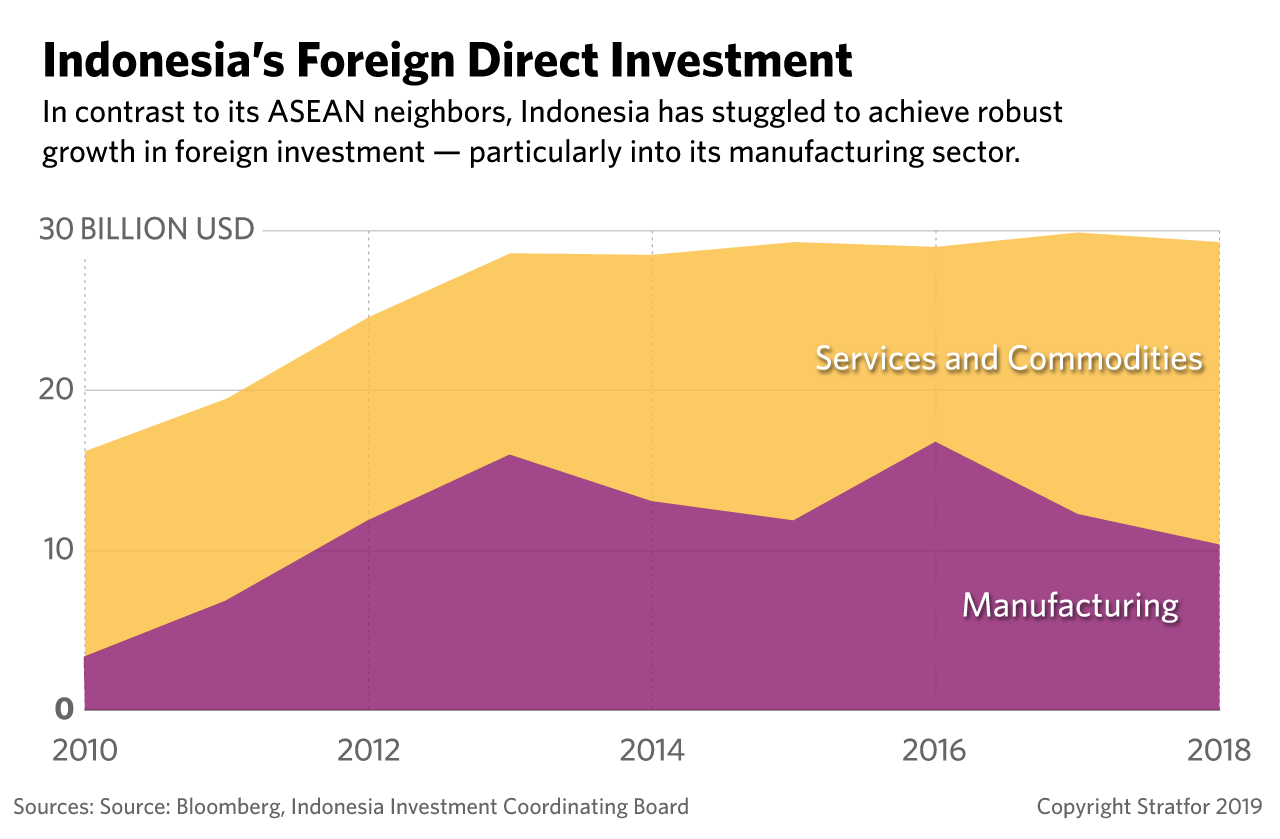
Jokowi's top priority remains improving the country's investment climate. Investor sentiment improved after his reelection, with a 6 percent year-on-year uptick in foreign direct investment over the second half of 2019 bringing in $7 billion in the third quarter. Among its closest peers in the Association of Southeast Asian Nations, Indonesia's ratio of foreign direct investment to GDP is the lowest — 2.1 percent.
Jokowi's economic reform plan focuses on overhauling laws that have made Indonesia less attractive than its neighbors for investment. Specifically, he has pledged to prioritize labor law reform to make hiring and firing workers easier, ease strict business licensing requirements, lower the corporate tax rate from 25 to 20 percent by 2023, remove several industries from the foreign investment negative list, which restricts or bars foreign investment in certain sectors, including those in the health care and education sectors, and create numerous special economic zones. In an effort to free up money to use for infrastructure and growth-oriented spending, Jokowi hopes to trim Indonesia's bloated bureaucracy, which accounts for nearly 34 percent of government spending, allowing the government to lay off tens of thousands, demote officials and close facilities.
But some of these reforms will be difficult to push through, as the changes would threaten the interests of key factions by opening up some sectors to foreign competition and prioritizing certain regions over others. This means Jokowi may need to adjust his priorities to placate key allies. Civil service reform, in particular, has proved particularly controversial given its effects on employment. Entrenched domestic business interests have opposed past efforts to trim the negative list, therefore increasing competition — 2018 investment liberalization plans, for instance, were reshaped to protect smaller industries. Substantial protests led by trade unions cropped up in early October to oppose labor reform efforts. To placate the labor groups, Jokowi altered his reform proposal to apply only to new workers — leaving in place restrictions and protections for the existing workforce. His second term will bring further struggles in implementing these policies, even if many go through.
Jokowi's own push to nationalize resources provides a case in point. The high-profile, unpredictable nature of the push risks dampening overall investor sentiment. In August, for instance, the government announced plans to advance a ban on raw nickel exports from 2022 to early 2020, roiling markets. In late October, the government followed with an announcement that the ban would instead go into effect immediately, before it reverted once again to the 2020 timeline. The strategy behind the ban was to promote domestic processing of the resource and develop Indonesia's far-flung regions — with hopes of eventually fostering electric vehicle production in Indonesia as well. The sudden policy shifts and announcements reflect the delicate balance the president is trying to maintain between the demands of his domestic political allies and fears of alienating foreign investors.
These factors are likely to surface again as economic reform efforts continue. Ultimately, just like his first term, the president will have to balance, recalibrate and dilute his reform proposals to make them more palatable to key interest groups. But this time, his coalition is all the more diverse, and his window of opportunity all the more limited.
