
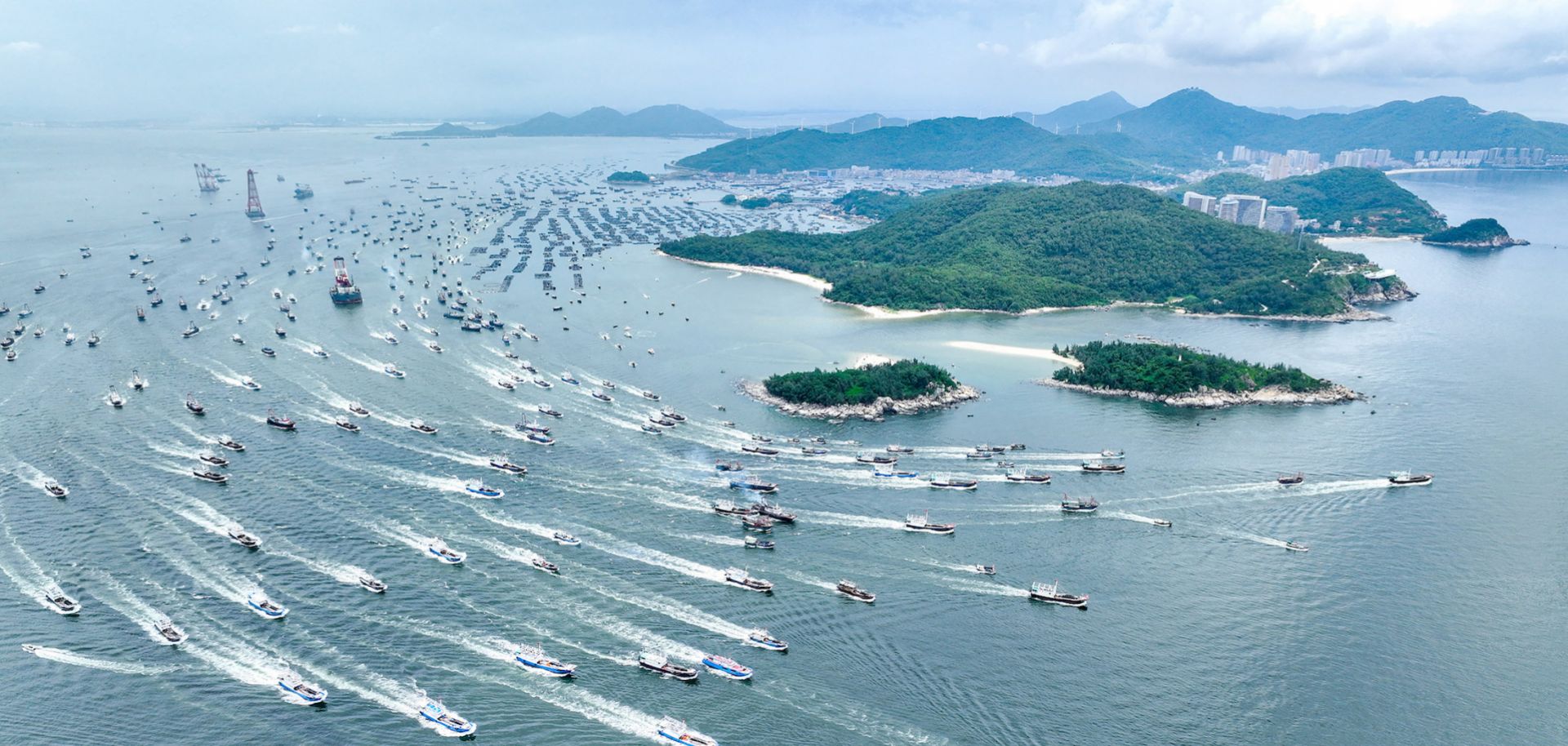
This aerial photo was taken on Aug. 16, 2022, and shows fishing boats heading out to sea on the first day of the fishing season in Yangjiang, in China's southern Guangdong province.
The United States implemented new sanctions over illegal Chinese fishing to disrupt Chinese maritime power projection in the Pacific Ocean and score a diplomatic victory against Beijing. However, coastal states' economic interests and lackluster enforcement mechanisms will constrain the sanctions' effectiveness. On Dec. 9, the U.S. Treasury Department imposed new sanctions on China's distant water fishing industry via the Global Magnitsky Act, which expands the use of economic sanctions triggered by human rights violations. The Treasury Department said it levied the sanctions over "serious human rights abuses" aboard Chinese vessels engaged in illegal, unreported and unregulated (IUU) fishing, as well as over the illegal transport of endangered species and the "exacerbat[ion of] the environmental and socioeconomic effects of climate change." The sanctions added two Chinese nationals, their companies Dalian Ocean Fishing and Pingtan Marine Enterprise, an attendant network of eight entities, and 157 China-flagged fishing vessels to the Specially Designated Nationals list, which blocks listed entities from accessing any U.S. assets and bars U.S. entities from engaging in business with them. China denied the allegations, and its foreign ministry declared that "The U.S. is in no position to impose unwarranted sanctions on other countries or act as a 'world policeman,'" adding that "China will act resolutely to safeguard its lawful rights and interests."
- The Treasury Department's press release alleges that crewmembers are treated harshly, physically abused, coerced into forced labor and debt bondage, spend more than a year consecutively at sea in extreme isolation, work 18-hour days, eat expired food and drink unsanitary water. When crewmember deaths occur — at least five between 2019 and 2020 — some are allegedly dumped at sea rather than repatriated.
- One of the targeted companies, Pingtan Marine Enterprise, is the first entity the United States has sanctioned that is listed on the Nasdaq Stock Market.
Washington's imposition of the sanctions on an emblematic day will bolster its broader campaign against IUU fishing. The announcement of these and other sanctions coincided with International Anti-Corruption Day on Dec. 9, International Human Rights Day on Dec. 10, and the end of the 20th International Anti-Corruption Conference, hosted in Washington and attended by representatives from 126 countries that did not include China. Washington may have used these international markers to maximize the symbolism of its action in an attempt to contrast itself with China. The sanctions on IUU fishing are in line with existing U.S. policy and strategy, stemming from the Biden administration's June 27 Memorandum on Combating Illegal, Unreported, and Unregulated Fishing and Associated Labor Abuses, as well as earlier counter-IUU fishing initiatives dating back to 2019. IUU fishing, banned under international law, is widely regarded as a global problem that threatens food security by exhausting otherwise sustainable fisheries and severely damaging ocean ecosystems. There is also a national and economic security component because IUU fishing typically involves foreign plunder of national resources, which puts domestic fishermen at an economic disadvantage. The United States has prioritized deterring IUU fishing in recent years via legislation, enforcement initiatives, data collection, port restrictions and coast guard patrols while elevating international cooperation to those ends.
- The United States also used International Anti-Corruption Day and International Human Rights Day to level other sanctions against individuals and entities from Russia, El Salvador, Guatemala, Guinea, Iran, Mali, North Korea and the Philippines, among others, for a variety of offenses.
- On Aug. 3, the U.S. Coast Guard conducted its first counter-IUU fishing operation in the eastern Pacific in line with its 2022-2026 strategic plan, which makes detecting and deterring IUU fishing activities a national security priority.
- The U.N. Law of the Sea, which stipulates countries' maritime rights and duties and which China signed, explicitly defines and outlaws IUU fishing. The United Nations estimates that 85% of global fisheries are fully fished or overfished.
Washington also hopes the sanctions will help win support from countries affected by Chinese IUU fishing, from Southeast Asia to the Americas, but several factors will limit these countries' potential moves toward the West. The U.S. sanctions specifically address some of the concerns expressed by coastal Pacific states, such as human rights abuses, climate change and illegal fishing's ability to put local fishermen out of work, in hopes of pushing more coastal countries toward the West and away from China. But these countries' lucrative trade and other economic arrangements with China (even cases of economic dependency) will limit their ability to express such support. Even if economic dependency were not an issue, many coastal Pacific countries lack the military wherewithal to confront China's extensive maritime capabilities, which means they will hesitate to oppose Beijing's maritime encroachment openly.
- Ecuador, Chile, Colombia and Peru issued a 2020 joint statement that aimed to combat IUU fishing, but it did not name an offender, despite China being the only known case in the region.
- China has the world's largest distant water fishing fleet. The Overseas Development Institute, a British think tank, estimated a total of 16,966 vessels in 2018, dwarfing China's official limit of 3,000. Chinese IUU fishing vessels have been frequently documented in all four oceans, and the IUU Fishing Index, a ranking maintained by a European corporate-nongovernmental organization partnership, ranks China as the worst offender out of 152 coastal states based on 40 metrics. A European Parliament report as far back as 2012 claimed Chinese deep water fishing vessels have encroached on the exclusive economic zones of 93 countries.
- In response to international backlash, on May 25 China's Ministry of Agriculture and Rural Affairs issued seasonal moratoriums on distant water fishing in the southwest Atlantic Ocean, the eastern Pacific Ocean and the northern Indian Ocean. But reprieves only coincide with periods of typically lower fish stocks and last only long enough to enable sealife to repopulate.
- Chinese IUU vessels avoid entering U.S., EU and other Western nations' territorial waters owing to those countries' naval capacities.
Despite U.S. efforts, China's distant water fishing will likely continue uninterrupted as a core component of its maritime territorial expansion and food security policy. Chinese fishing vessels drive broader geopolitical goals, particularly with respect to maritime reach and control of disputed waters, and often act as de facto paramilitary forces that enable the establishment of port networks outside Chinese waters. Control of fisheries, a rapidly diminishing food source, is in itself a geopolitical end not fundamentally different from competition for other resources. China's fishing industry is vital to the country's economic development and constitutes a core national interest, as it reportedly brings in tens of millions of metric tons of seafood a year. This supply is a key source of protein for the country's expanding middle class, and its absence would prompt food insecurity, as seafood in Chinese waters is now mostly depleted as a result of overfishing from the mid-1980s. For these strategic reasons, China is unlikely to cease distant water fishing, which the government heavily subsidizes. To that end, China will likely be able to largely maneuver around sanctions with time-tested strategies such as renaming entities, reflagging ships, eschewing the use of standardized tracking technology, and taking advantage of lax registration and licensing laws in local jurisdictions. The preponderance of unlicensed vessels that lack identification numbers needed for tracking further complicates enforcement, as does the fact that China's fishery institutions rarely disclose data. These factors mean China will likely be able to continue to expand its maritime reach, control over a vital resource and militarization of its fishing fleet despite U.S. commitment to a China containment strategy.
- Armed Chinese coast guard or People's Maritime Militia vessels often accompany fishing vessels, even in other countries' territorial waters. These initiatives also lead to the construction of militarized artificial islands.
- Since the late 1990s, the Philippines, Vietnam, Malaysia, Indonesia, Japan, Argentina and Ecuador, at least, have had armed confrontations with Chinese fishing vessels.
- The Treasury Department alleges that Dalian Ocean Fishing received $8 million in annual subsidies from 2019-2020 and that Pingtan Marine Enterprise received a single $19 million dollar subsidy in 2021 from the Chinese government.
