
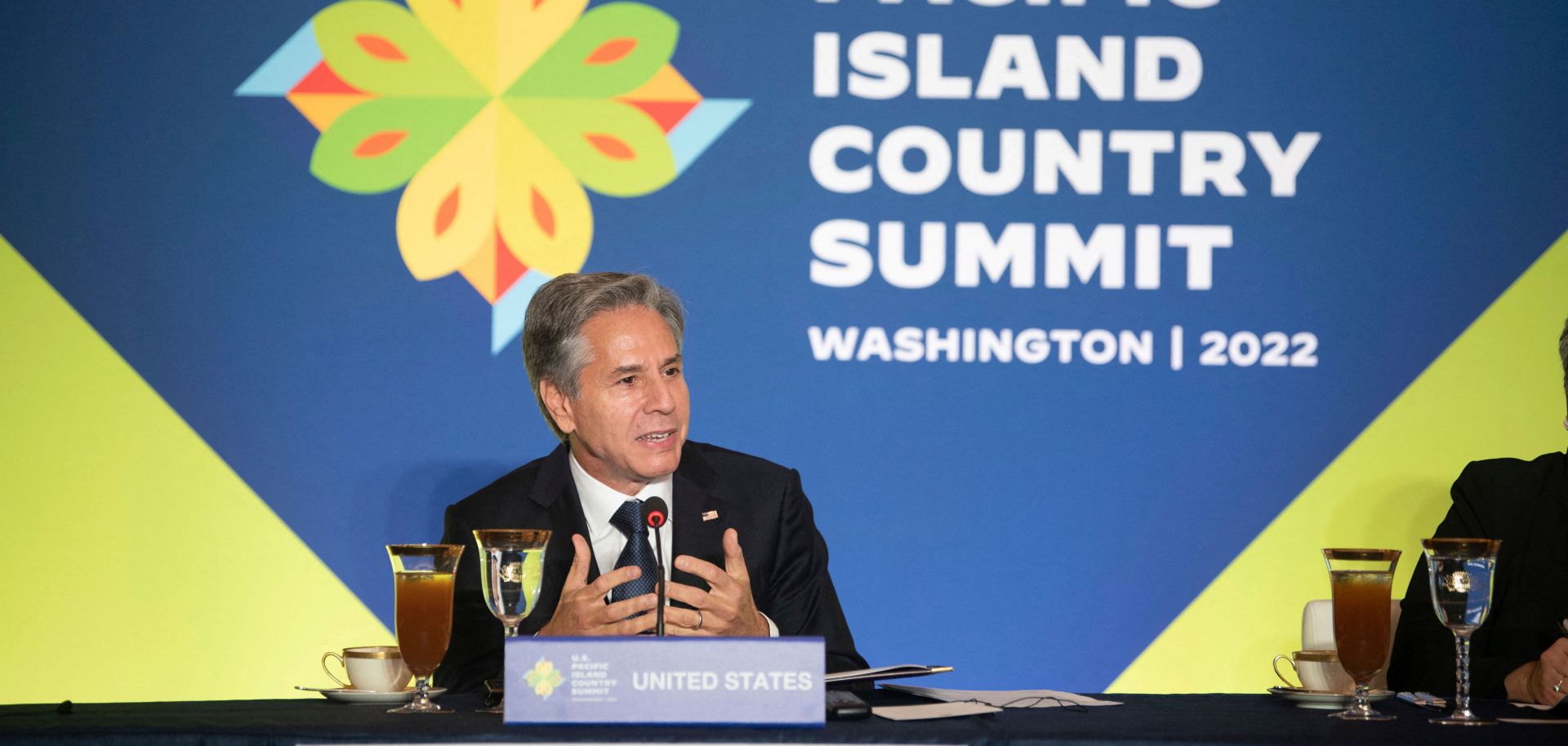
U.S. Secretary of State Antony Blinken hosts a working lunch with Pacific Island countries in Washington, D.C., on Sept. 28, 2022.
The historic U.S. Pacific Partner Strategy highlights the United States' desire to reassert its presence in the Pacific Islands region amid rising threats from China. But the success of such renewed cooperation will depend on whether Washington can meet island nations' needs more effectively than Beijing, without letting U.S. security imperatives or other diplomatic priorities get in the way. On Sept. 29 during an inaugural Pacific Island summit in Washington, the U.S. government unveiled its first-ever strategic document dedicated to the Pacific Islands region. The 16-page U.S. Pacific Partnership Strategy, along with the two accompanying fact sheets, contains several provisions for increased cooperation in a region long seen as neglected by the U.S. foreign policy establishment. Instead of China's regional influence and security competition, the document focuses on areas of primary concern for Pacific Island countries — namely, economic development and the regional impacts of climate change. In the document, the United States also demonstrates an interest in bolstering the Pacific Islands Forum, the region's main multilateral platform. All of the leaders from the 14 Pacific Island nations who attended the summit endorsed the document, despite previous trepidation and protest from the Solomon Islands and the Marshall Islands. The U.S.-Pacific Islands summit was attended by U.S. officials of the highest level (including President Joe Biden, House Speaker Nancy Pelosi and Secretary of State Anthony Blinken) — demonstrating a comprehensive effort on Washington's part to woo Pacific Islands nations.
- The strategic document outlines four main U.S. objectives: 1) a strong U.S.-Pacific Islands partnership; 2) a united region connected to the world; 3) a resilient region against climate change; and 4) a prosperous economic region. China is mentioned only once in the context of potential economic coercion.
- The United States will open three new embassies in the Solomon Islands, Kiribati and Tonga, bringing the total number of U.S. embassies in the region from six to nine. The U.S. government will also create a new ambassador's post to the Pacific Islands Forum.
- As part of the new strategy, the United States will invest more than $810 million in expanded programs to aid Pacific Islands on top of the $1.5 billion that has been provided over the past decade. Funds focus on infrastructure, education and combating climate change.
- The United States will also provide law enforcement training via the FBI and the U.S. State Department. China and Australia also have law enforcement training agreements in the region.
- As part of the new strategy, the United States said it will formally recognize the Cook Islands and Niue as sovereign states — playing catch up with China, which has maintained diplomatic relations with both island countries since 1997 and 2007, respectively.
The summit and release of the Pacific Partnership Strategy come as the United States and China are increasingly vying for influence in the region, with the former seeking to reclaim the upper hand as the latter tries to expand its access to key resources and forge a more advantageous security environment. In recent years, China has become increasingly active in the Pacific Islands. For China, the region offers a way to project power beyond the Second Island Chain, as well as gain access to valuable fishing sites and subsea mineral resources. Through its deepening ties with Pacific Island nations, China also hopes to build the capacity to disrupt long-range lines of communication between the United States and its Asian partners. China's ultimate goal in the region is to advance its key geopolitical interests, such as gaining the strategic room to unify Taiwan on Beijing's own timeline and securing critical shipping lanes in the South China Sea. China's growing influence in the Pacific Islands has caused concern in the United States, which has long maintained a strategy of keeping military confrontation far from its shores by influencing the far abroad before threats materialize close to home. More broadly, Washington's rising geopolitical competition with Beijing has also increased the overall strategic importance of the region, which enables the United States to project power into China's near seas. This has seen the U.S. government take a renewed interest in the Pacific Islands as it seeks to bolster its influence amid growing threats from China. The United States also hopes to boost its military and surveillance capacity in the Pacific, as well as secure its territory in Guam and Hawaii, and protect critical communication lines across the vast Pacific Ocean.
- The United States' involvement in the Pacific Islands is heavily tied to its own security needs. Washington took great interest in the region during and immediately after World War II, but once the immediate threat posed by Japan ebbed, so did U.S. intervention. Cold War realities then drove the United States to turn its attraction back toward the region in the 1980s, but after the collapse of the Soviet Union, the United States again shifted its focus to other regions, namely the Middle East. The latest surge in U.S. outreach to the Pacific Islands has again been driven by security imperatives — this time, its escalating rivalry with China — which has reinforced the perception among island nations that the United States only cares about the region when there's a direct threat to U.S. security.
- China has bilateral agreements with 11 Pacific Islands nations, mostly focused on economic measures via Beijing's Belt and Road Initiative.
This sudden uptick in regional attention from China and the United States has given Pacific Island nations newfound bargaining power on the issues they consider most strategically significant. For years, the Pacific Island nations have lobbied for the region to look inward for security arrangements and not rely on great powers. But they also know that without wealthy benefactors like the United States, China or Australia, their potential for economic development and capacity to combat the effects of climate change remain bleak. Until recently, this need for external economic aid had left Pacific Island nations with little bargaining power in their negotiations with foreign actors. But the region's recent emergence as the next theater for U.S.-China competition has started to shift this power dynamic by enabling island nations to be more selective in their external engagement and, in turn, maximize investments. This was acutely evidenced in May, when Pacific Island countries rejected a Chinese-proposed regional pact due to concerns that it was too heavily focused on granting Beijing security and military access, and did too little to address top local concerns — namely, the tourism-dependent region's economic recovery from the COVID-19 crisis, and bolstering island nations' resilience to rising sea levels and more severe weather events related to climate change. The United States has seemingly learned from the Chinese proposal's failure, as its new Pacific Partnership Strategy supports regional multilateral architecture, such as the Pacific Islands Forum (PIF), and deemphasizes Washington's own security objectives when dealing collectively with the bloc. Indeed, many of the provisions outlined in the document align with the PIF's 2050 Strategy for the Blue Pacific Continent, which highlights the U.S. need to appease its Pacific Islands partners rather than dictate terms. The United States is thereby looking to satisfy its perceived security needs through individually negotiated bilateral arrangements with regional countries.
The success of the partnership will depend on the United States' ability to follow through on its commitments and balance its own security objectives against the climate and economic priorities of Pacific Island countries. Pacific Island countries are aware that the United States has a security agenda, which immediately casts suspicion that could constrain trust and future efforts. By centering around Pacific Islands countries' collective concerns, the new U.S. strategic arrangement strikes a crucial cooperative tone that may invigorate collaboration. On the other hand, the United States has admitted that it has not paid enough attention to the Pacific Islands. A vow to do so is a start, but the United States does not have a strong track record of maintaining long-term relations with economically less significant regions like the Pacific Islands, except during times of strategic concerns — like those currently related to China's growing influence in the Pacific. The prospect of overpromising and under-delivering represents the greatest risk to a successful partnership. Years of neglect and underinvestment have left scars in U.S. relations with Pacific Island nations, and the ability of the United States to focus on the region is suspect given its many other priorities around the globe, including the ongoing Russia-Ukraine war, and proclivity to get distracted.
- The United States has ''Compacts of Free Association'' agreements with Palau, the Marshall Islands and Micronesia that allow the U.S. military access in the strategically important region in exchange for economic assistance. The agreements, which contain security measures favorable to the U.S. military that are absent from the new Pacific Partner Strategy, are set to begin expiring next September. The United States has recently ramped up negotiations to renew the bilateral pacts, but Washington's move to wait until the last minute to do so has only reinforced regional perceptions of the country's fickle foreign policy.
