
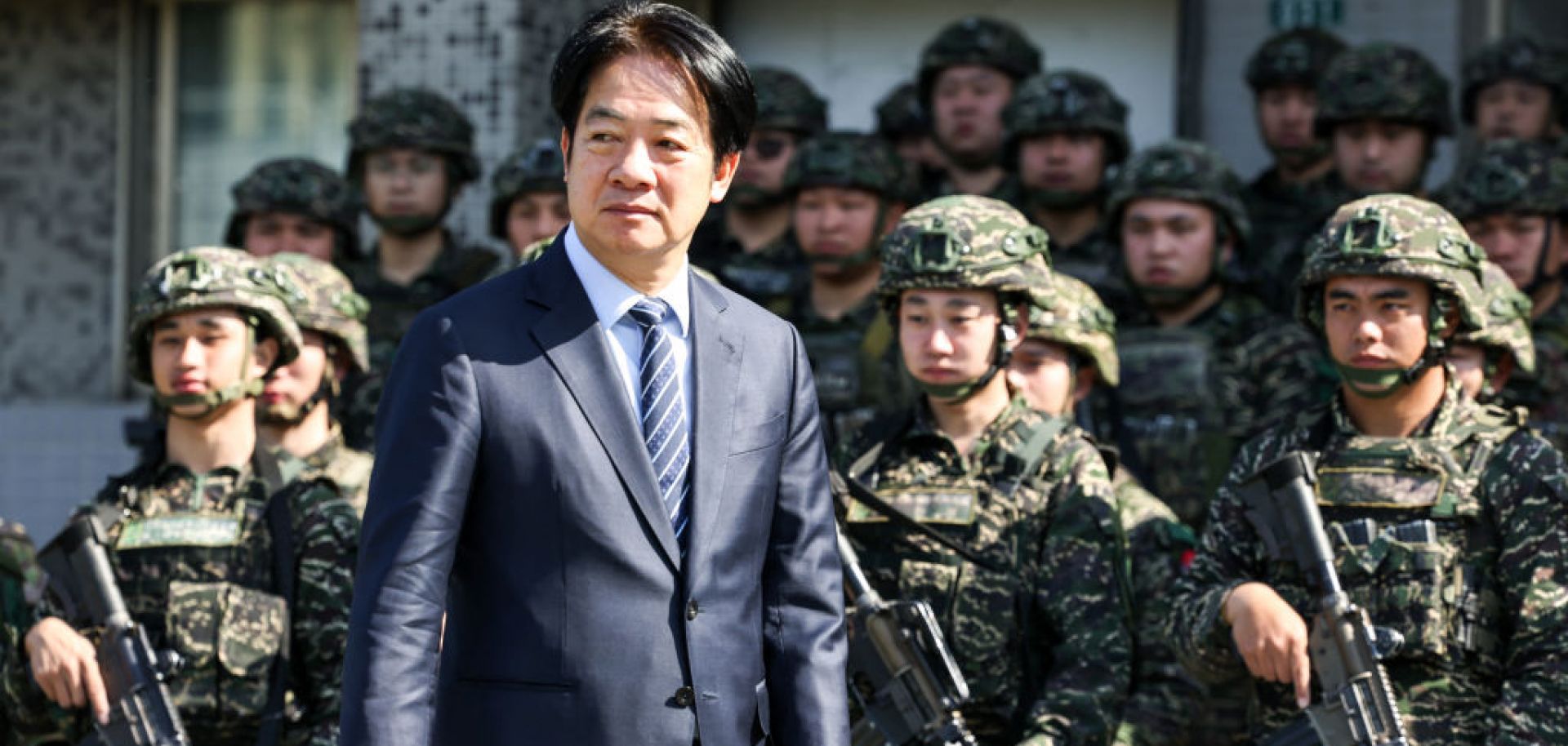
The Taiwanese president's latest policy efforts to safeguard sovereignty and root out Chinese influence will drive China to rely more on economic and military coercion, but these efforts do not make a Chinese invasion more likely. On April 1 and April 2, China conducted two rounds of military exercises around Taiwan, including live-fire drills 300 kilometers (approximately 185 miles) north of Taiwan and blockade drills around Taiwan's key ports and energy import terminals. A spokesperson for China's Taiwan Affairs Office (TAO) said the drills were in direct response to a press conference on March 13 by Taiwanese President William Lai in which he pledged to protect Taiwan's sovereignty from China by more closely scrutinizing cross-strait ties. Lai also asserted that China's actions against Taiwan qualify it as a "foreign hostile force" as defined in Taiwan's Anti-Infiltration Act, presaging more punitive action. That was the latest policy move taken by Lai's government in recent months aimed at protecting Taiwan's sovereignty and curbing Chinese government influence over Taiwan's government and society. Among other things, in January, the government published a list of Chinese ships that, if loitering in Taiwanese waters, would be intercepted by Taiwan's coast guard. The coast guard has already made good on this pledge, including by intercepting a freighter named the Hong Tai and detaining its Chinese crew of eight on Feb. 25 on suspicion of cutting an undersea cable. In his latest speeches, Lai has also pledged to crack down on current and former military officials as well as celebrities and social media influencers whose words or actions threaten Taiwan's sovereignty or "national dignity." Taipei has followed this up with at least three deportations of Chinese nationals.
- Taiwan deported Chinese influencer Liu Zhenya on March 25 for advocating for a Chinese invasion. This marks the first instance of Taiwan deporting a Chinese spouse of a Taiwanese citizen on national security grounds. Immigration authorities have ordered two other Chinese spouses of Taiwanese citizens, Zhao Zhan and En Qi (a nickname), to leave Taiwan by March 31. Taiwan's government data claims there are around 367,000 Taiwanese citizens (out of a population of 23 million) who have Chinese spouses.
- In 2024, Lai delivered a handful of speeches that appeared to push the bounds of Taiwan's sovereignty rhetoric. In his inaugural address on May 20, Lai referred to his country alternatively as Taiwan or the Republic of China and the PRC as China, as opposed to "two sides of the strait," and he asserted that neither entity was subordinate to the other. Additionally, in two speeches surrounding Taiwan's Oct. 10 National Day celebration, Lai noted the Republic of China was an older political entity than the PRC, and thus China could not be "the motherland," and added that China has no right to represent Taiwan.
- Taiwan's Anti-Infiltration Act of January 2020 outlines potential punishments for persons or entities working with the Chinese government or affiliated institutions or other entities de facto controlled by Beijing. For such entities, the following actions are punishable: making political donations, engaging in elections or recall processes, and lobbying (especially on matters of national security). It also raises penalties for pre-existing crimes if committed by such entities.
- In response to Lai's March 13 speech and Taiwan's deportations, China's TAO announced on March 26 that it was launching a tip-line for citizens to report people who undermine cross-strait unification. A TAO spokesman added that China had sentenced a Chinese national with residence in Taiwan to three years in prison for inciting secession over his ties to a Taiwanese publisher with anti-China views.
Lai is attempting to implement many of the pro-sovereignty views of the previous administration, including by using the Anti-Infiltration Act to target a broad scope of societal actors with perceived ties to China. These developments represent an effort by Lai's government to ground his Democratic Progressive Party's usual pro-sovereignty rhetoric in policy realities. This comes in contrast with his predecessor, Tsai Ing-wen, also from the DPP, who also took steps to defend Taiwan's sovereignty in specific cases where China threatened it (e.g., by extending the duration of conscription from four months to one year following China's large military drills in August 2022), however, in most instances, Tsai sought to avoid provocative language or actions in an effort to prevent further antagonizing China. In his March 13 press conference, Lai laid out other policy shifts to help defend Taiwan's sovereignty and root out sources of Chinese influence. These include: reviving military trials to hear cases against service members that threaten Taiwan's sovereignty; adjusting the military's criminal code to penalize expressions of loyalty to "the enemy"; revising regulations on military retirement benefits for service members and their families to "uphold military discipline"; introducing more national security considerations into naturalization processes for Chinese nationals; establishing guidance for the words and actions of Taiwanese celebrities that engage with China; requiring disclosure by all local officials and societal groups (including religious organizations) of their exchanges with China; and depoliticizing cultural, academic, educational and other people-to-people ties (a likely reference to cutting ties with Chinese government agencies engaged in these areas). Though Lai did not specify enforcement mechanisms for most of these policies, the Anti-Infiltration Act threatens fines and prison time for those who facilitate the actions of "foreign hostile forces," while more deportations and punitive action against institutions (e.g., revoking non-profit status for religious institutions) are also likely on the table.
Lai's policy shifts are driven by increasing public dismay with China, a U.S. administration less concerned about putting "guardrails" on competition with China and China's increasingly aggressive behavior toward Taiwan. Despite Beijing's narrative that Lai is and always has been a "die-hard separatist," there are more complex, multifold drivers for his actions. Though Lai did evince staunch pro-independence stances during early political campaigns in 2014 to distinguish himself from a crowded field of DPP candidates, he has long since softened his rhetoric and pledged to maintain the same stance as his predecessor Tsai, namely that Taiwan is already de facto sovereign and so does not need to declare independence. Still, Lai's moves to buttress this de facto sovereignty with policy shifts, whereas Tsai was mainly reactive to China's efforts to curb that sovereignty, stem from three geopolitical shifts in recent years. First, Taiwanese citizens increasingly identify as solely Taiwanese (and less Chinese), while support for unification with China is dropping, and support for the status quo or independence is rising, allowing Lai room for policy changes that reflect popular sentiment. Second, despite recent criticism from Trump administration officials of Taiwan's insufficient commitment to self-defense, Taipei likely believes it has more latitude than usual from Washington to alter its policies toward China. Whereas the United States has traditionally been just as concerned with Taiwanese independence advocates provoking war as with China doing so, the Trump administration is fully committed to containing China economically and militarily and is less focused on the "competition with guardrails" framework of the former Biden administration. To wit, a recently leaked Pentagon memo confirms this primary focus on countering China and on preventing a Chinese invasion of Taiwan, helping to alleviate Taiwanese concerns about the Trump administration not coming to its defense if necessary. Third — and on this point, he is similar to Tsai — Lai is partly reacting to China's increasingly frequent and operationally complex military drills around Taiwan and increasing threats from Beijing. For example, in June 2024, China published a set of 22 guidelines for punishing "Taiwan independence separatists," threatening sanctions and even the death penalty against Taiwanese citizens; this helps reduce public outrage in Taiwan when Lai targets Chinese citizens with various legal threats.
- The share of Taiwanese citizens who see themselves as only Taiwanese has grown from 58% to 63% between when Tsai came to office in 2016 and 2024, while the share of those who see themselves as Taiwanese and Chinese has dropped from 34% to 31%. In that same time frame, the share of Taiwanese who want unification with China dropped from 10% to 5%, while those who want independence rose from 23% to 27%, and those who would prefer to keep the status quo (de facto, but not de jure, independence) has grown from 59% to 61%.
- During his Senate confirmation hearing on March 4, Trump's pick for Under Secretary of Defense for Policy, Elbridge Colby, asserted that Taiwan did not spend enough on defense, saying it needed to raise defense spending from 2.5% to 10% of GDP. On the campaign trail in late 2024, Trump complained that Taiwan did not pay enough for U.S. arms, even though Taiwan uses its domestic budget to fund 90% of its U.S. arms purchases.
- Besides the April 1-2 drills, China's military has launched several other rounds of military drills around Taiwan since August 2022, including the Joint Sword 2024A and Joint Sword 2024B drills in May and October 2024, respectively, following two major speeches by Lai that, like his March 13th press conference, asserted Taiwan's sovereignty.
China will continue to escalate coercion and influence campaigns against Taiwan under Lai, driving more Taiwanese policy shifts toward China, but Lai's political and economic calculations, as well as the opposition-controlled legislature, will limit his room for escalation. As long as Lai is Taiwan's president (until 2028 and perhaps until 2032 if he wins reelection), China will steadily escalate its pressure on the Taiwanese government via economic and military coercion. It will also escalate efforts such as espionage, societal influence (e.g., exploiting ties to Taiwan's politically influential temple networks and economic leverage over Taiwanese celebrities), and campaigns targeting "separatist" Taiwanese individuals and companies with occasional detentions, prison time or fines. These moves will prompt Lai to expand his policy toolkit for rooting out perceived sources of Chinese influence and threats to Taiwan's sovereignty, which may include targeting media and civil society groups or local politicians with national security investigations over their connections to Chinese propaganda or spy networks. However, there will be an upper limit to Lai's moves. For instance, in an escalatory case, Lai could seek to curb cross-strait business ties (e.g., via fines or forced divestitures), especially ties to Chinese state-owned enterprises or other entities closely linked to the government. However, targeting business ties too directly could threaten the millions of Taiwanese whose livelihoods depend in some way on trade and investment with China; this is a losing electoral strategy, so Lai will likely avoid such overt targeting of Taiwanese businesses at scale, though targeting symbolic Chinese businesses (e.g., in the chip sector) is more likely. Moreover, Lai may be procedurally limited in how far he can take his campaign against Chinese influence, as any policies that require changes to Taiwanese law will require the support of the legislature, which is run by the opposition Kuomintang (KMT) party and Taiwan People's Party (TPP) and opposes Lai's campaigns against Chinese influence. To the extent the legislature challenges him, the Constitutional Court — which is currently defunct due to a recent opposition-passed law that requires more justices than are currently sitting to make rulings — will be unable to overturn legislative decisions.
Should Lai's policies overcome constraints to weaken Chinese influence networks, they will likely push China to lean more on economic and military coercion, particularly drills practicing for a blockade, but Lai's efforts will not meaningfully increase the likelihood of a Chinese invasion. If implemented in full, Lai's plans to monitor civil society and government ties to China down to the local level could modestly curb China's long-standing ability to co-opt Taiwanese who are either more interested in Chinese business or in opposing the DPP than in issues of Taiwanese sovereignty. Opposition officials (especially those from the KMT) spearhead most of Taiwan's cross-strait engagement efforts, including sister city summits and cultural, educational, religious and tourism exchanges. Though most such exchanges are already public, others may be exposed by Lai's program, particularly ties between China and Taiwan's religious institutions. Rooting out these societal ties, however, risks blowback. Targeting religious institutions and deporting spouses of Taiwanese citizens will cause public concerns about religious freedom and migrant rights. The rhetoric of Lai's campaign (e.g., preventing entertainers from "endangering national dignity") is likely uncomfortably reminiscent of Taiwan's martial law period (1949-87) for some Taiwanese, given the broader population is deeply proud of their democracy and keen on publicly demonstrating to defend it, especially via protests. However, if Lai is able to overcome these constraints and his efforts are successful in weakening Chinese influence networks, his policies will likely prompt China to rely more heavily on coercion to manage relations with Taiwan. This would include both economic measures, such as tariffs, and military actions, such as drills. The Democratic Progressive Party (DPP) is unlikely to assume responsibility for managing cross-strait engagements that are currently handled by opposition parties and targeted by Lai's campaign. Moreover, Beijing does not trust the DPP to take on that role. Still, despite his strong rhetoric and recent policies, Lai will continue to limit the risk of military escalation with China. To wit, he has not significantly changed Tsai's playbook in responding to Chinese military drills; instead of seeking to intercept and rebuff China's frequent military incursions, most of the time Taiwan's military simply monitors their activities and does not seek to kinetically dissuade China's actions. Given the imbalance in military power — China spends 10 times more on defense than Taiwan — this is unlikely to change. Thus, while Lai's policy statements will likely provoke additional Chinese military drills — such as those observed over the past week — they are unlikely to meaningfully raise the risk of a large-scale Chinese invasion. This holds true so long as Lai avoids crossing Beijing's traditional red lines, such as pursuing formal independence through constitutional changes — an unlikely path given widespread public opposition and significant procedural hurdles, including the need for a two-thirds legislative majority and a national referendum.
- China is believed to be a significant source of funding for Taiwan's network of temples devoted to the teachings of Buddhism, Taoism and folk religions. This network is also a main fundraiser for local KMT politicians.
- Though public discontent toward China within Taiwan is widespread, citizens in Taiwan are known to switch political parties when their interests are ignored. Polls from December 2024 show a plurality of Taiwanese citizens (35%) still identify as having no political party affiliation, with Lai's DPP in second place at 32%. This unaligned proportion has fluctuated between 30%-50% since the 1990s.
- Though Lai's policy moves are prompting Chinese drills, the red lines that are more likely to prompt a Chinese invasion remain unchanged, including a U.S.-Taiwan defense agreement, Taiwan's integration into global institutions (e.g., the United Nations), and Taiwanese policies that prevent cross-strait negotiations (e.g., by legally barring all diplomatic talks with China).
