
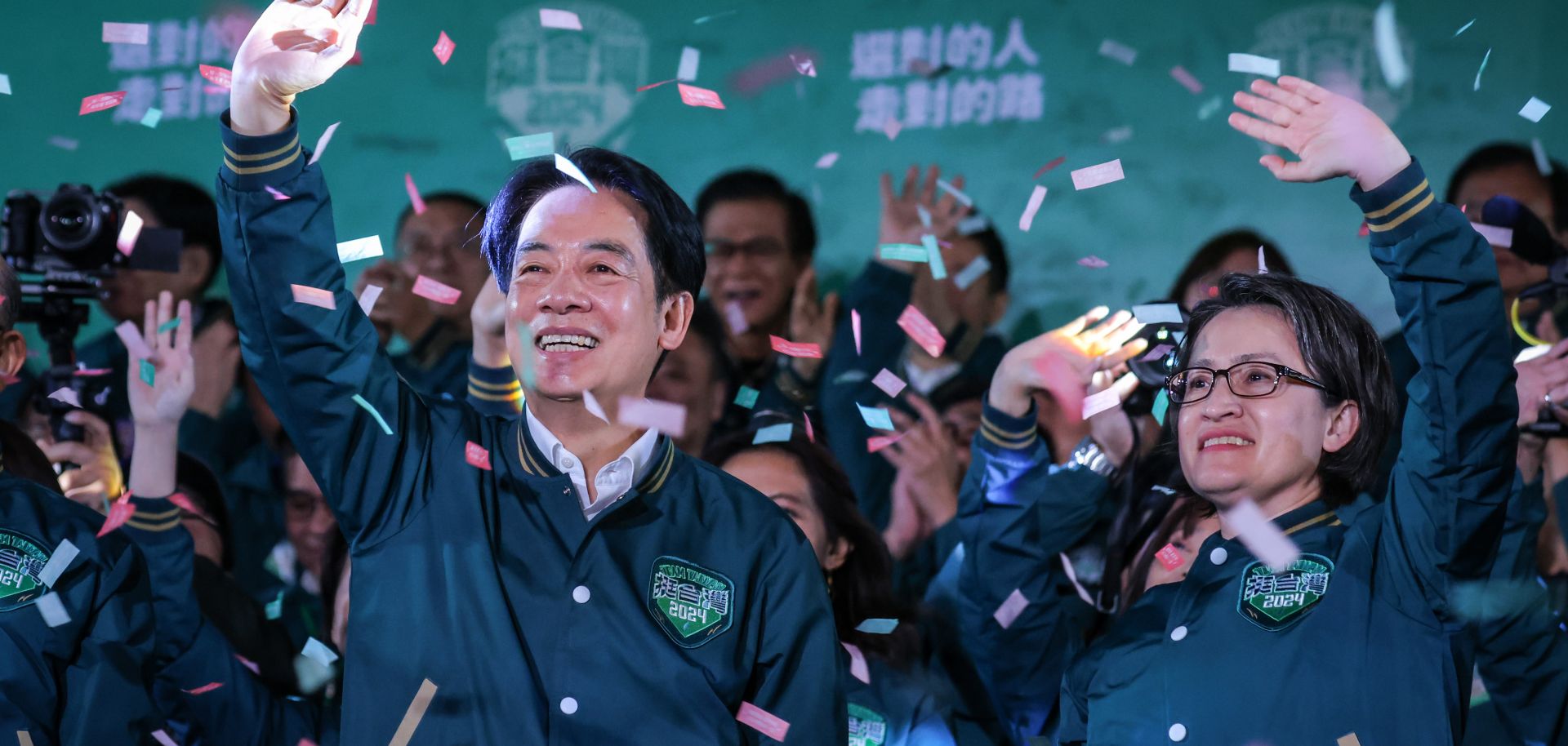
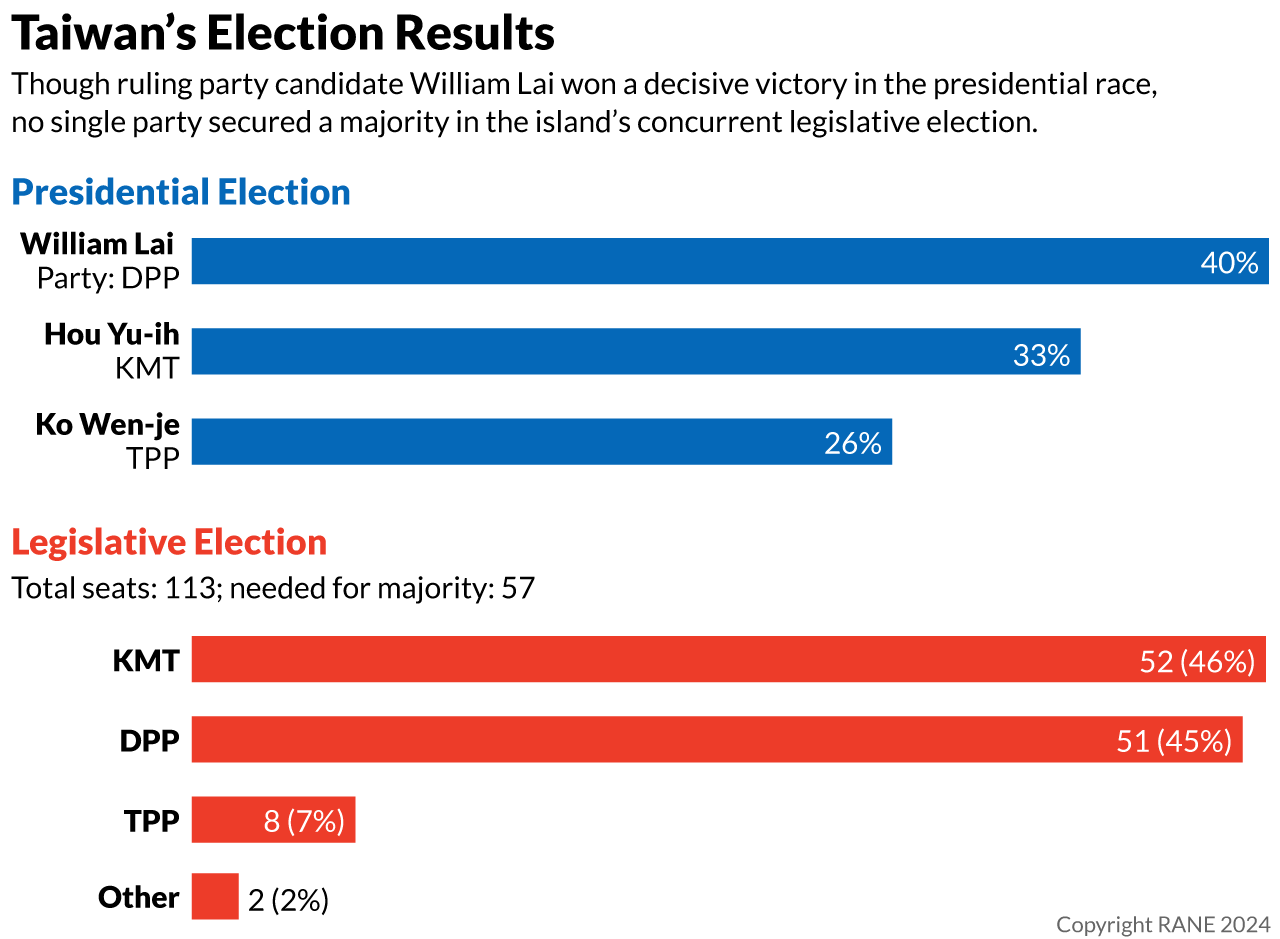
In Taiwan, the ruling party's continued control of the presidency will see China steadily escalate its military and economic coercion against Taipei in the coming years, which will impede U.S.-China efforts to curb strategic competition, while presenting a low risk of blockades or an invasion of Taiwan's outlying islands. William Lai of Taiwan's ruling Democratic Progressive Party (DPP) won the Jan. 13 presidential election with 40% of the vote, versus 33% for Hou Yu-ih of the conservative opposition party Kuomintang (KMT) and 26% for Ko Wen-je of the centrist Taiwan People's Party (TPP). Lai's victory will give the DPP an unprecedented third consecutive term in the presidency, with current President Tsai Ing-wen set to step down in May after reaching a two-term limit. Despite Lai's presidential win, the DPP lost its majority in the Legislative Yuan, Taiwan's unicameral legislature; while no party secured a new majority, the KMT gained a slight plurality with 52 seats to the DPP's 51 seats, with the TPP picking up eight seats. On the campaign trail, including in a Jan. 12 speech just before the election, TPP presidential candidate Ko Wen-je stated that the TPP would support pragmatic policies and work with the other parties, confirming that the TPP will be a key swing vote bloc to reach the 57-vote bar necessary to pass legislation. U.S. Secretary of State Antony Blinken congratulated Taipei on the election, which he said was representative of Taiwan's ''robust democratic system,'' but President Joe Biden stated ''We do not support [Taiwan's] independence'' when asked for his reaction on Jan. 13. A spokesperson for China's Taiwan Affairs Office reasserted China's sovereignty claim over Taiwan and noted that the election demonstrated that the DPP ''cannot represent the mainstream public opinion on the island [of Taiwan].''
- The DPP advocates for Taiwan's de facto independence, but has not pushed for de jure independence (constitutional change) under Tsai. Lai has indicated that he does not intend to deviate from Tsai's and the party's stance on this matter. However, Beijing has often portrayed the DPP as bent on achieving true independence in order to justify China's cutting of diplomatic and economic ties with DPP-led Taiwan.
- The KMT, which asserts that friendlier relations with China is the key to cross-strait peace, has not held the presidency since Ma Ying-jeou's two consecutive terms from 2008-2016. Ma's first term (2008-2012) saw deepening cross-strait economic ties, but China-Taiwan relations cooled during Ma's second term (2012-2016) when Beijing grew impatient with the KMT's unwillingness to hold negotiations on China's unification with Taiwan. Since then, the Taiwanese people have grown even more sovereignty-minded, with only 7% wanting unification and 61% wanting to keep the status quo (de facto independence).
- On the campaign trail, the TPP tried to tap into Taiwanese citizens' discontent with ''toxic two-party politics'' and focused on pragmatic social and economic policies at home, while keeping mum about cross-strait relations. Ko Wen-je, who founded the TPP in 2019, is quite popular among younger Taiwanese voters (those under 40 years old), but not among elderly voters. The TPP's novelty also means it has been underfunded, as parties in Taiwan get government subsidies respective to their performance in elections.
- After eight years of DPP rule, voter fatigue was high during the 2024 election. But the KMT and TPP's failure to negotiate a joint presidential ticket in November assisted Lai's victory by splitting the opposition vote. Lai's staunch support of national defense and Taiwan's de facto sovereignty appears to have also resonated more with voters than his two challengers' vague prescriptions for ''better dialogue'' with China.
China is unlikely to seek rapprochement under Lai's new government, and will instead ramp up coercive efforts against Taipei. Unlike his predecessors who generally delayed resolving the Taiwan issue, Chinese President Xi Jinping has sought tangible progress on unification, primarily by ramping up coercive measures against Taipei. China has cut off economic and diplomatic dialogue mechanisms with Taipei under the DPP — which Beijing considers a ''separatist'' entity — since President Tsai took office in 2016. Beijing is unlikely to change this policy unless Lai affirms China's sovereignty over Taiwan, something he is ideologically and politically ill-motivated to do. Absent such mechanisms, China will lean on military and economic coercion to erode the DPP's electoral support and convince the international community that support for Taiwan isn't worth a war with China. The rivalrous dynamic in cross-strait relations is thus poised to deepen over the next four years of DPP rule, even as Beijing attempts to bolster its ties with KMT and TPP legislators to undermine the DPP's ruling legitimacy.
- KMT and TPP legislators could somewhat reduce the frequency of triggers for Chinese coercion by, for example, rejecting pro-sovereignty legislation (rare as it is) and bills that aim to limit China's influence operations in Taiwan. But they would do so at their own electoral peril — especially TPP lawmakers, who rely on support from China-skeptic young voters.
China's coercion will mainly focus on growing military exercises, but there is a slight chance it could invade Taiwan's outlying islands, which would accelerate regional military buildups. There will be a moderate risk of Chinese military drills around Taiwan in the coming weeks following the election, as well as surrounding Lai's inauguration in May and any potential visits to the island by American lawmakers ahead of U.S. elections in November. Over the next four years of DPP rule, China will very likely steadily escalate other military coercive tactics by, for example, conducting more naval exercises around Taiwan, along with a greater number and variety of incursions into the island's unofficial airspace — thereby elevating concerns in Japan, South Korea, the United States and the Philippines about a war in the Pacific. In addition, there is a low risk that China will take more severe military action (still short of invasion) later in Lai's term in order to communicate Beijing's seriousness about unification and dissatisfaction with Western efforts to bolster Taiwan's defenses, e.g. in response to a major arms deal. Such severe action could include launching artillery attacks or even a full-scale invasion against Taiwan's Kinmen and Matsu islands, which are located over 90 miles from the main island of Taiwan but within eyesight of China's coast. By invading these two lowly populated islands, Beijing would aim to erode the credibility of U.S. defense commitments in the region — and with it, the will of U.S. partners like Japan, the Philippines, and South Korea to incorporate peace for Taiwan and the South China Sea into their national security policies. But China's national security crackdown in Hong Kong and military brinkmanship in the South China Sea in recent years has had the opposite effect on Taipei and the broader region: namely, a greater commitment to militarily oppose the threats posed by China. For Beijing, an invasion of Kinmen and Matsu would thus be high risk and low reward.
China will also escalate its economic coercion against Taiwan, with a similar low risk of extreme measures, but key global electronics flows are unlikely to be interrupted. In recent years, China's coercion against Taiwan has mostly involved military actions, with economic coercion mainly focused on import restrictions on minor Taiwanese exports like pineapples and grouper fish. But in response to Lai's election, there's a good chance China may expand its suspensions of tariff exemptions on Taiwanese exports under the Economic Cooperation Framework Agreement (ECFA), especially as Beijing has already done so once in December and threatened to do so again this month. This could prompt the Taiwanese government to seek other markets for sellers of industrial and agricultural products, as Taipei has done in the past. However, China remains unlikely to target the crucial trade in high electronics (including advanced semiconductors) for which many countries, including China, rely on Taiwan. That said, there is a low chance that China could take more extreme economic action, perhaps in retaliation for some new Taiwanese security agreement with a regional partner. This could include a lengthy de facto blockade in which China conducts extended military drills near Taiwan's key ports of Taipei and Kaohsiung, which could delay shipments of key goods entering or leaving Taiwan for weeks. However, such a move could be tantamount to an act of war and, similar to severe military action, would be more likely to array U.S. regional partners against China, not convince them to stand down. Given these risks, any Chinese blockade activities are more likely to provide ample geographic space for shipping and air traffic to complete their routes, as they have in the past.
- Ostensibly in retaliation for Taiwanese trade restrictions, China removed tariff exemptions on imports of 12 Taiwanese petrochemical goods on Dec. 21, out of the 539 Taiwanese goods covered by the ECFA, a cross-strait trade agreement signed in 2010. On Jan. 9, China's commerce ministry also noted it was contemplating suspending preferential tariff rates on imports of Taiwanese auto parts and textiles, as well as agricultural, fishery and machinery products.
- After then-U.S. House Speaker Nancy Pelosi visited Taipei in August 2022, China conducted live-fire military drills in six regions off the coast of Taiwan and near key Taiwanese ports. The drills caused some shipping traffic to reroute and even prompted commercial airliners to cancel a handful of flights, but they caused minimal supply chain disruptions and ended after 11 days.
Growing Chinese military and economic coercion against Taiwan under Lai will also impede U.S.-China efforts at re-engagement. Over the past six months, the United States and China have made efforts to improve their diplomatic and military relations, including by restarting military, climate, and counter-narcotics dialogues. These efforts were already unlikely to markedly ease the pace of U.S. and Chinese economic competition — particularly the growing scope of trade and investment restrictions — due largely to a bipartisan U.S. commitment to combat Chinese national security threats with tech and economic restrictions, and Beijing's equal and opposite commitment to combating U.S. restrictions and opposing national security threats (like espionage and leaks of state secrets) associated with foreigners, especially Americans. But China's growing economic and military coercion against Taiwan under Lai will make U.S.-China rapprochement all the less likely, as Washington will see such coercive tactics as further evidence that China threatens U.S. national security interests — particularly trade continuity in the Taiwan Strait and U.S. naval dominance in the western Pacific. Furthermore, the leadup to the U.S. elections in November will see ample anti-China and pro-Taiwan rhetoric from U.S. congresspersons across the political spectrum. To display their commitment to Taipei ahead of the ballot, U.S. lawmakers may even visit Taiwan in the months before November, which would only further impede U.S.-China efforts at re-engagement, given that Pelosi's controversial trip to Taipei in August 2022 was what originally prompted China to sever military and other dialogues with the United States. While the re-election of former U.S. President Donald Trump in November would engender various policy changes, Trump would still perpetuate the competitive trajectory of U.S.-China relations and increase U.S. security cooperation with Taiwan, even if he uses different means toward these ends compared with Biden.
- At the Asia-Pacific Economic Cooperation Summit in November, during which Biden and Xi met in a bid to ease tensions, Xi asserted that mutual understanding on Taiwan is the foundation of bilateral relations and Biden stated that Beijing must not use force to challenge the status quo of Taiwan's de facto sovereignty.
