
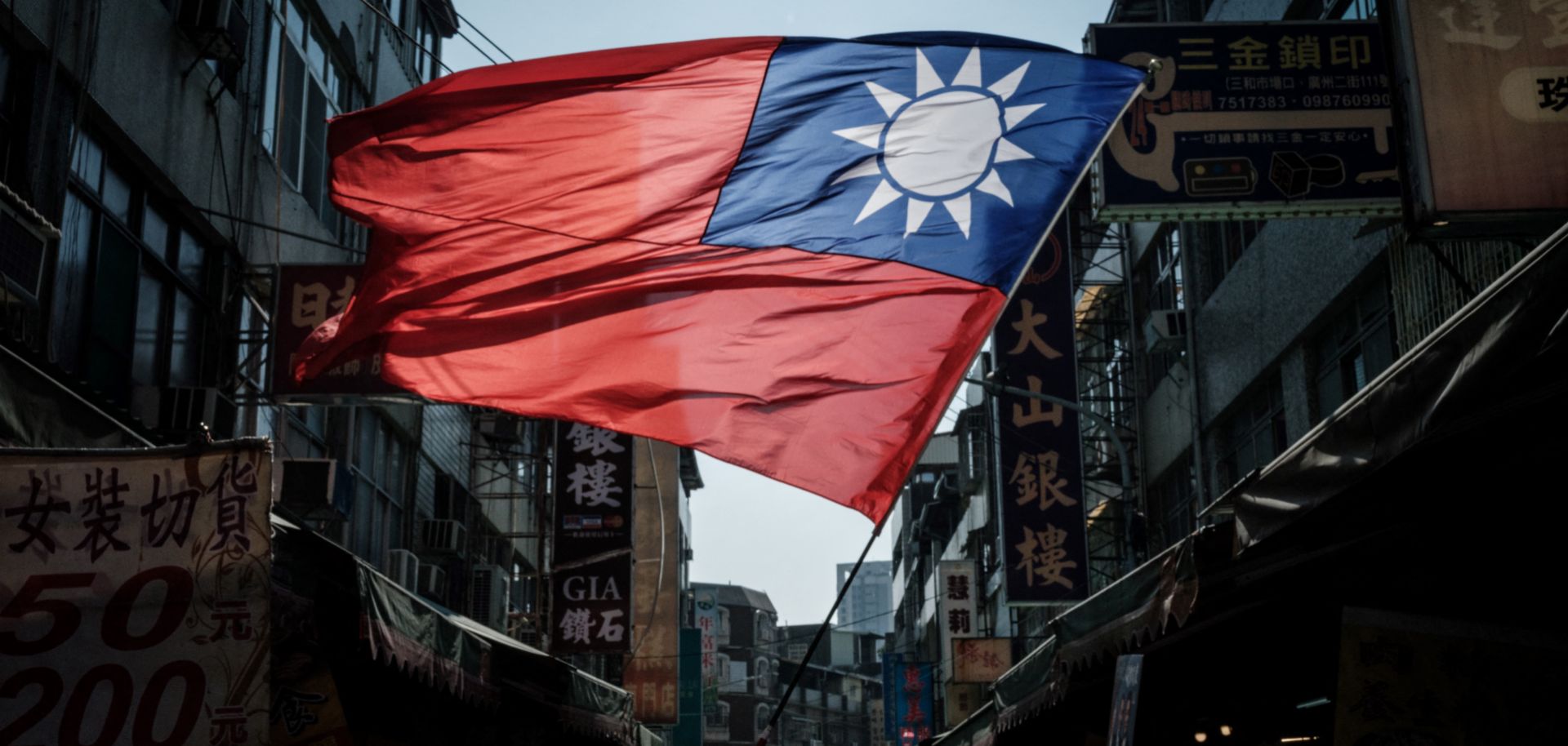
Taiwan's divided legislature will facilitate energy and trade policy even as it impedes military readiness and economic reform, while diplomatic isolation will keep Taiwan dependent on outside powers for its security and economic well-being. Taiwan's latest elections brought in a hung legislature that will help Taipei pursue long-delayed trade negotiations and its energy transition, but the country's reliance on foreign partners for its national security and economic development will persist — partly due to internal policy disputes, and partly due to structural realities related to Taiwan's economic size and geographic location. The Jan. 13 elections saw William Lai of the liberal and pro-sovereignty Democratic Progressive Party (DPP) win the presidency with 40% of the vote against a split opposition. No party won a majority in the legislature, however, with the conservative and comparatively pro-China Kuomintang (KMT) winning 52 out of 113 seats, the DPP winning 51 seats, the centrist Taiwan People's Party (TPP) winning eight seats, and independents winning two seats.
- Current Taiwanese President Tsai Ing-wen, also from the DPP, has been in office for the legal maximum of two four-year terms, and will step down when Lai is inaugurated in May.
- Prior to 2024, no political party in Taiwan had ever won the presidency in three consecutive elections, at least not since democratization in the early 1990s.
Taiwan's emerging three-part legislature increases the possibility of expanding the nuclear sector, removing agricultural protectionism to facilitate trade deals, and increasing the executive power's accountability. The latest elections marked a shift from a two-party to a three-party democracy. The Legislative Yuan (LY), Taiwan's unicameral legislature, is now divided between three ideologically distinct parties for the first time since democratic elections for the LY were first instituted in 1992. Taiwan's first genuine multiparty legislature will facilitate progress on long gridlocked issues — like expanding the nuclear energy sector, curbing agricultural protectionism, and pursuing campaign finance reform — as the TPP wields its swing votes to dilute the DPP and KMT's ability to obstruct policymaking on party lines. Progress on these issues could reduce Taiwan's vulnerability to import-related energy disruptions, facilitate trade agreements, and reduce public concerns about corruption. If the DPP and KMT resist legislative compromise, they risk strengthening support for the TPP, whose platform denounces ''toxic two-party politics'' and policy obstructionism. During the nomination process for the president of the LY, the TPP will also wield its swing votes to pressure the DPP and KMT to agree to reforms designed to curb the powers of Taiwan's executive branch, known as the Executive Yuan, including by making the president more accountable (via formal inquiries) to the legislature, which would modestly increase legislative power in a political system heavily influenced by the president.
- The legislature was also split three ways after the 2000 and 2004 elections, but the third party in those ballots, the People First Party, was an offshoot of (and ideologically aligned with) the KMT.
- Under President Tsai, the DPP has staunchly opposed nuclear energy. But on the campaign trail, Lai evinced a willingness to ease this position, especially since the TPP and KMT asserted that nuclear was the only real solution to Taiwan's reliance on fossil fuels, which makes it vulnerable to shipping disruptions (e.g. during wartime).
- Taiwan's president is quite powerful in the budgetary process. After the president proposes a budget, the legislature can only decrease funding for existing budget items and reject funding for newly requested items, but cannot add new budget items, reallocate funding, or hold up government funding by refusing to pass the budget.
- Party disputes over ractopamine, a feed additive that increases meat yield in cattle and swine, have held up U.S.-Taiwan trade negotiations for almost 20 years. The KMT opposed U.S. ractopamine meat imports in 2006 (with support from Taiwanese farmers), followed by the DPP in 2012, and the KMT again in 2020. In each case, the party opposing the imports was in the opposition. President Tsai finally permitted the imports in 2020, and U.S.-Taiwan trade negotiations have since proceeded, albeit slowly.
This legislature will also stymie Lai's efforts to bolster Taiwan's military readiness and counter-espionage policies, keeping Taipei reliant on foreign security umbrellas, while Lai will struggle to diversify trade away from China. Under outgoing President Tsai, the Taiwanese government has increased restrictions on cross-strait labor and investment flows to curb industrial espionage, labor poaching, and leaking of state secrets and intellectual property, particularly related to Taiwan's world-leading semiconductor industry. Taipei has also increased the service requirement for military conscription from four months to one year for all males, and has attempted to build out Taiwan's domestic military-industrial capabilities as well, including by producing its own submarines. These efforts will continue after President-elect William Lai takes over, but KMT and TPP opposition to conscription and domestic arms manufacturing (in favor of voluntary service and higher quality arms imports), as well as the two parties' hesitancy about letting espionage concerns curb cross-strait trade, risk policy gridlock about how exactly to improve Taiwan's military readiness and prevent espionage. This gridlock will impede Taiwan's domestic ability to expand military readiness and deter Chinese military aggression, keeping the country heavily reliant on implied (but never guaranteed) U.S. and Japanese security pledges. Tsai also attempted to reduce Taiwan's trade dependence on China, and thus its vulnerability to Chinese economic coercion, via the New Southbound Policy. Lai will continue this economic diversification policy, but it will remain only mildly effective due to Taiwan's open market economy and the difficulty of replacing trade with China, a very large and geographically close economy.
- The New Southbound Policy was launched in 2016 and aimed to increase trade with South and Southeast Asia. That year, 40.1% of Taiwan's exports by value went to China (including Hong Kong), while 19.2% of Taiwan's imports came from China. By the third quarter of 2023, those shares had changed to 35% of exports and 20.9% of imports.
Taiwan's political environment and global economic conditions will make reforms unlikely for key household issues, like low wages and an indebted pension system, and will also make it difficult for the DPP to hold onto power in the 2026 and 2028 elections. From the campaign trail to the presidential and vice presidential debates, the top issue ahead of the 2024 election, aside from China, was domestic economic reform. Specifically, Taiwanese citizens are concerned about housing affordability, inflation outpacing wage hikes, and the country's heavily indebted state pension program. Taiwan's housing problems may ease somewhat, as the Taiwanese market seems to be temporarily cooling, with Q3 2023 housing prices dropping 2.8%, breaking nearly 20 straight quarters of consecutive price rises. But the past two dips in Taiwan's housing market (in 2008 and 2015) have coincided with dips in Taiwan's overall economic growth, which appears to be what's happening now. If this trend continues, it won't bode well for Lai's public approval, even if citizen complaints about housing subside. Though Lai could crack down on mandatory, unreported overtime (a widespread phenomenon in Taiwan that depresses real wages), the overall drop in Taiwan's real wages — which were down 1.53% after adjusting for inflation in the first 10 months of 2023 — will likely persist as long as globally high costs for commodities and industrial inputs do. Major reform of Taiwan's long underwater pension system is unlikely under Lai, as it would require benefit cuts and tax hikes (neither of which are winning electoral strategies) or sweeping cuts to national security spending (which would contradict DPP campaign promises). These difficulties in addressing the chief economic concerns of Taiwanese citizens, combined with growing voter fatigue after eight years of DPP rule, suggest the DPP will likely lose the 2026 local elections, as well as the 2028 general elections, barring that either ballot yields another split opposition or China conducts kinetic military action (e.g. artillery shelling of the Matsu or Kinmen Islands), which for now remains unlikely.
- Taiwan's real GDP growth slipped to 1.4% in 2023, down from 2.6% in 2022 and 6.6% in 2021, though the Taiwanese economy is projected to grow by 3.4% in 2024.
Under Lai, Taiwan will continue to lose diplomatic recognition, but its informal ties with the United States, Europe and Japan will expand alongside growing concerns about Chinese military aggression. Only 12 countries (mainly small economies in the Pacific Islands and Latin America) diplomatically recognize Taiwan as a sovereign state, and China selectively poaches these partners. With Lai at the helm, China's diplomatic poaching will persist, as evidenced by Nauru's Jan. 24 switch to recognize China. This limited recognition will impede Taiwan's efforts to gain formal membership to most world fora, like the United Nations and the World Health Assembly, access to which is granted by majority vote. Moreover, Taiwan will struggle to develop comprehensive trade agreements (including tariff exemptions) under Lai, as Beijing has only allowed Taiwan to sign these agreements (i.e. by withholding Chinese economic retaliation) under KMT governments. Nonetheless, Taipei will persist with efforts to sign minor agreements with the United States, Canada and other sympathetic nations already bristling at China's economic coercion, but these agreements will focus on non-tariff barriers, such as expediting customs procedures and duties payments. Taiwan's informal ties with the United States, Europe and Japan will steadily grow — primarily via foreign legislative visits to Taipei and U.S. arms and military training assistance — alongside Western concerns about Chinese maritime aggressions. But Western diplomatic recognition of Taiwan or formal defense agreements with Taiwan remains unlikely, as these have long been seen as triggers for significant Chinese military escalation, possibly including an invasion of Taiwan.
- Nauru, a tiny island country in Micronesia with only 12,500 inhabitants, announced on Jan. 24 that it was switching from recognizing Taiwan to recognizing China. Taiwanese officials allege the decision came after Beijing promised $100 million in annual funding to Nauru.
- Besides Taiwan's Economic Cooperation Framework Agreement with China — which removes tariffs on hundreds of goods — and similar agreements with the small Latin American and Pacific Island nations that currently or recently recognized Taiwan, the country has just two bilateral trade agreements that include tariff reductions. Those agreements are with Singapore and New Zealand, both signed in 2013 under Taiwanese President Ma Ying-jeou.
