
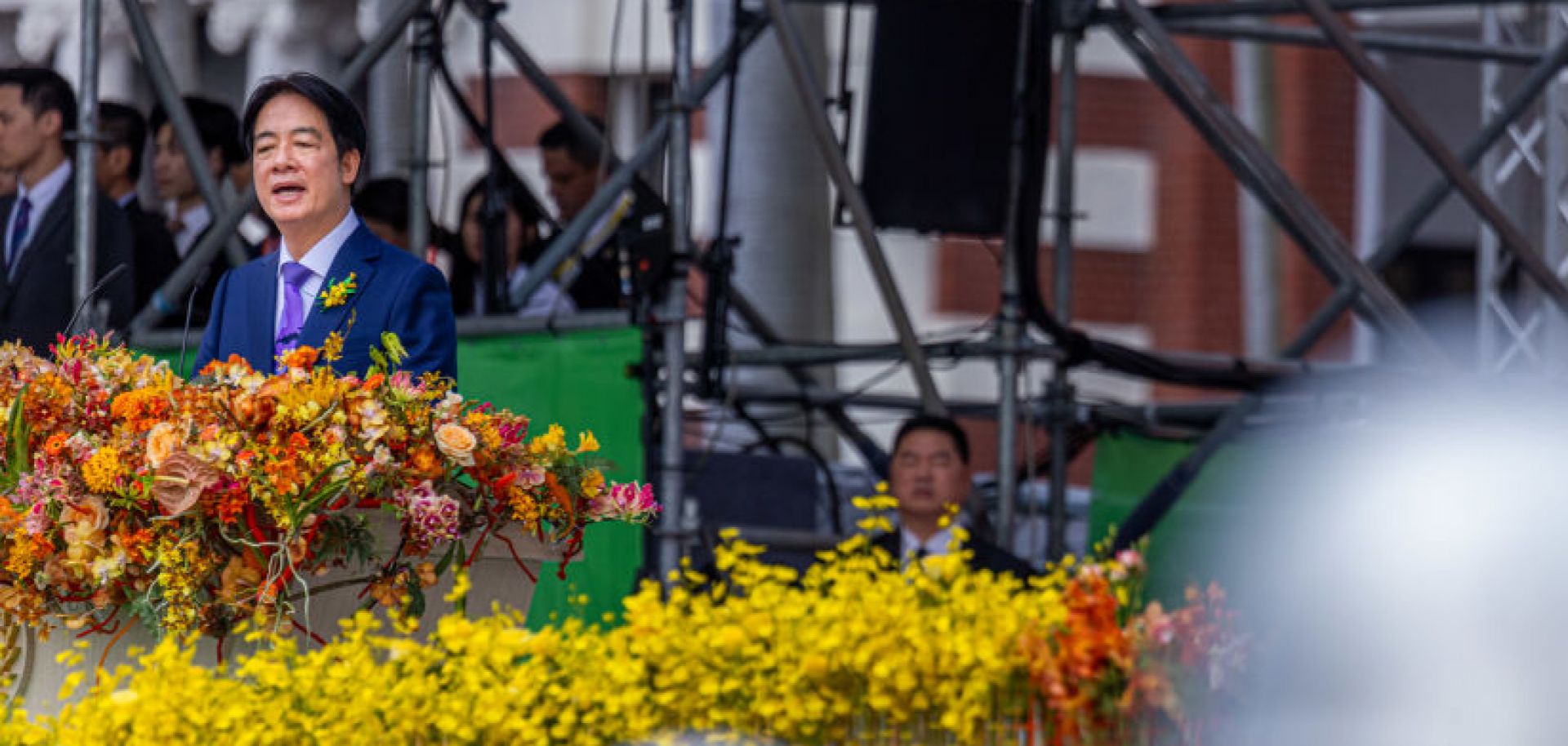
Taiwanese President William Lai will persistently use more pro-sovereignty rhetoric to boost global support for Taiwan, risking more Chinese military drills that weaken already dim prospects for cross-strait diplomatic engagement and deepen Western military engagement in the Indo-Pacific to deter Chinese aggression. During an Oct. 5 event commemorating Taiwan's upcoming National Day, President Lai gave a speech in which he asserted Taiwan — officially named the Republic of China (ROC) — was a ''sovereign and independent country'' that will celebrate its 113th anniversary on Oct. 10, whereas the People's Republic of China (PRC) just celebrated its 75th anniversary on Oct. 1. Lai then went on to claim it was ''absolutely impossible'' for the PRC to be the motherland of the ROC because the former was younger than the latter, adding that the ROC may actually be the motherland of the PRC. Lai is due to give another speech on National Day on Oct. 10, where he is expected to use similar rhetoric supporting Taiwan's de facto sovereignty. Meanwhile, former Taiwanese President Tsai Ing-wen's office has confirmed she will travel to Prague, Czech Republic, to give a speech at the Oct. 13-15 Forum 2000 Conference, which focuses on issues like democracy, civil society and human rights. Sources cited by Reuters claim Tsai will also visit two other European countries during her trip, likely France and Belgium.
Lai's rhetoric and his predecessor's trip to Europe risk triggering another round of retaliatory Chinese military drills, which will only harden Taipei's stance toward Beijing and the West's resolve to strengthen joint military deterrence efforts with Taiwan. China may decide to conduct more large-scale military drills around Taiwan in the coming days because, in Beijing's eyes, Lai's Oct. 5 and Oct. 10 speeches and Tsai's upcoming trip to Europe contribute to the internationalization of Taiwan's efforts to promote its sovereignty. Such drills would likely be smaller and shorter than the 11-day drills China held in August 2022 following then-U.S. House Speaker Nancy Pelosi's visit to Taiwan, as Beijing will perceive these latest developments as less provocative than Pelosi's trip. Instead, China is more likely to conduct drills akin to the smaller ones it held in April 2023 (following then-Taiwanese President Tsai's U.S. trip) and May 2024 (following current President Lai's inauguration). This would likely involve fielding new air or sea assets (i.e. drones) in the Taiwan theater and expanding joint operations and fire drills, though probably without provocative missile launches over Taipei, as occurred in August 2022. While unlikely to cause significant supply chain disruptions, such large-scale military activity would still raise regional fears about a Chinese blockade of Taiwan or an outright invasion. More importantly, a new round of drills — coming on the back of numerous such drills in recent years — would continue to harden the resolve of all political parties in Taiwan, including those traditionally more sympathetic to Beijing, to protect national security and reduce already minimal room for formal cross-strait diplomatic engagements. For Taiwan's Western and Asian allies (like the United States, South Korea and Japan), additional Chinese drills would also reaffirm the need to modernize their militaries and increase regional exercises and kinetic asset deployments (e.g. U.S. and Japanese missile platforms in Okinawa) to deter Chinese military action against Taiwan.
- In response to Pelosi's August 2022 trip to Taiwan, China held military drills around Taiwan that lasted for 11 days, which saw Chinese forces practice activities necessary for a blockade of Taiwan and raised concerns about supply chain security in some of the world's busiest shipping lanes
- Lai's May 20th inauguration speech juxtaposed Taiwan and China as two separate entities, rather than using common euphemisms like ''the two sides of the strait'' that past Taiwanese presidents have employed to avoid directly contradicting Beijing's view that Taiwan is a part of China. In response to Lai's remarks, China accused the new Taiwanese president of being a ''separatist'' and then conducted the Joint Sword 24A military drills around Taiwan on May 23-24, which for the first time integrated Chinese coast guard and naval assets and involved exercises near Taiwan's Kinmen and Matsu islands, expanding the geographic scope of previous drills.
- On April 5, 2023, then-President Tsai visited California to speak with then-U.S. House Speaker Kevin McCarthy. This spurred China to conduct the April 8-10 United Sharp Sword drills around Taiwan, which involved simulated strikes on Taiwan and the participation of four J-15 fighter jets launched from China's Shandong aircraft carrier. China also pledged to conduct inspections of cargo ships in the Taiwan Strait, but did not follow through on the threat.
Throughout his presidency, Lai will continue to use more direct rhetoric asserting Taiwan's sovereignty to appeal to voters and make it harder for more pro-Beijing parties to win future elections, but he will not pursue de jure independence. Despite Beijing's assertions of Lai's ''die-hard separatism'' — largely informed by his 2014 pro-independence comments, which he has since moderated — Lai remains unlikely to take formal legal action to assert Taiwan's independence, particularly by revising the Taiwanese constitution to remove references to China. This is partly because such actions would prompt much stronger Chinese military retaliation. But it is also because any constitutional changes would require a national referendum, which Taiwanese voters would likely reject as most support the current status quo of de facto (not de jure) independence. However, most people in Taiwan also see themselves as Taiwanese and have no desire for unification with China. To appeal to these voters, Lai will continue to remove rhetorical ambiguity about Taiwan's de facto independence by, for example, reducing references in his speeches to ''the two sides'' and denying Beijing's ''motherland'' rhetoric. Such rhetoric also serves to normalize more explicit political messaging around Taiwan's sovereignty, thus normalizing the more pro-sovereignty positions of Lai's ruling Democratic Progressive Party (DPP). In turn, the DDP hopes this change in rhetoric will make it harder for Taiwan's opposition leaders to get elected in the future if they continue to speak euphemistically and abstractly about China-Taiwan ties, as the main opposition Kuomintang party tends to do.
Lai's rhetoric and more Chinese drills will also help bolster Western diplomatic, economic and (to a lesser extent) military engagement with Taiwan, though Western fears of war will slow the pace of new engagements. In addition to bolstering support at home, Lai's rhetoric is also intended to more clearly express to the rest of the world Taiwan's position on its de facto sovereignty. In doing so, Lai is hoping to create more space in international fora like the World Health Assembly for Taiwan's participation, as well as more space in Western legislatures — which are increasingly concerned about the spread of authoritarianism and territorial revanchism (especially following Russia's invasion of Ukraine) — for bills supporting Taiwan in the face of Chinese threats, which could take the form of policies formalizing more frequent delegations to Taiwan, and for pursuing trade agreements with Taiwan. In this environment, with increasing Chinese military drills, Taiwan's diplomatic and economic engagement with the West will likely gradually grow, as evidenced by Western policymakers' recent efforts to facilitate Taiwanese envoys participating in the United Nations and Taiwan's slow-going efforts to ink a trade deal with the United States. But outside of U.S. arms sales, direct Western defense engagement with Taiwan (e.g. joint drills, defense treaties) will remain unlikely in the next few years. Still, Western demonstrations of concern for stability in the Taiwan Strait, like recent transits of the sea lane by German and Japanese naval vessels, will proliferate. Beijing, for its part, is wise to these efforts by Taipei to gain greater international support, and will continue waging military drills in an attempt to convey to Western governments the potentially high costs (i.e. a regional war) of continuing to support Taiwan. However, if anything, such Chinese provocations will only slow the pace of growing Western engagement with Taiwan, not reverse the trend.
- On Sept. 12, lawmakers in the Netherlands passed a motion by a vote of 147-3 to reject the United Nations' interpretation of U.N. Resolution 2758 that asserts Beijing as the rightful representative of China to the United Nations, which U.N. leadership has used as a pretext to bar Taiwanese representatives from proceedings. The Dutch motion asserts that the resolution has no bearing on Taiwan's U.N. membership and urges Dutch officials to lobby other European capitals for Taiwan's inclusion in U.N. proceedings. Prior to this, on Aug. 21, the Australian Senate passed a resolution challenging the United Nations' interpretation of Resolution 2758.
