
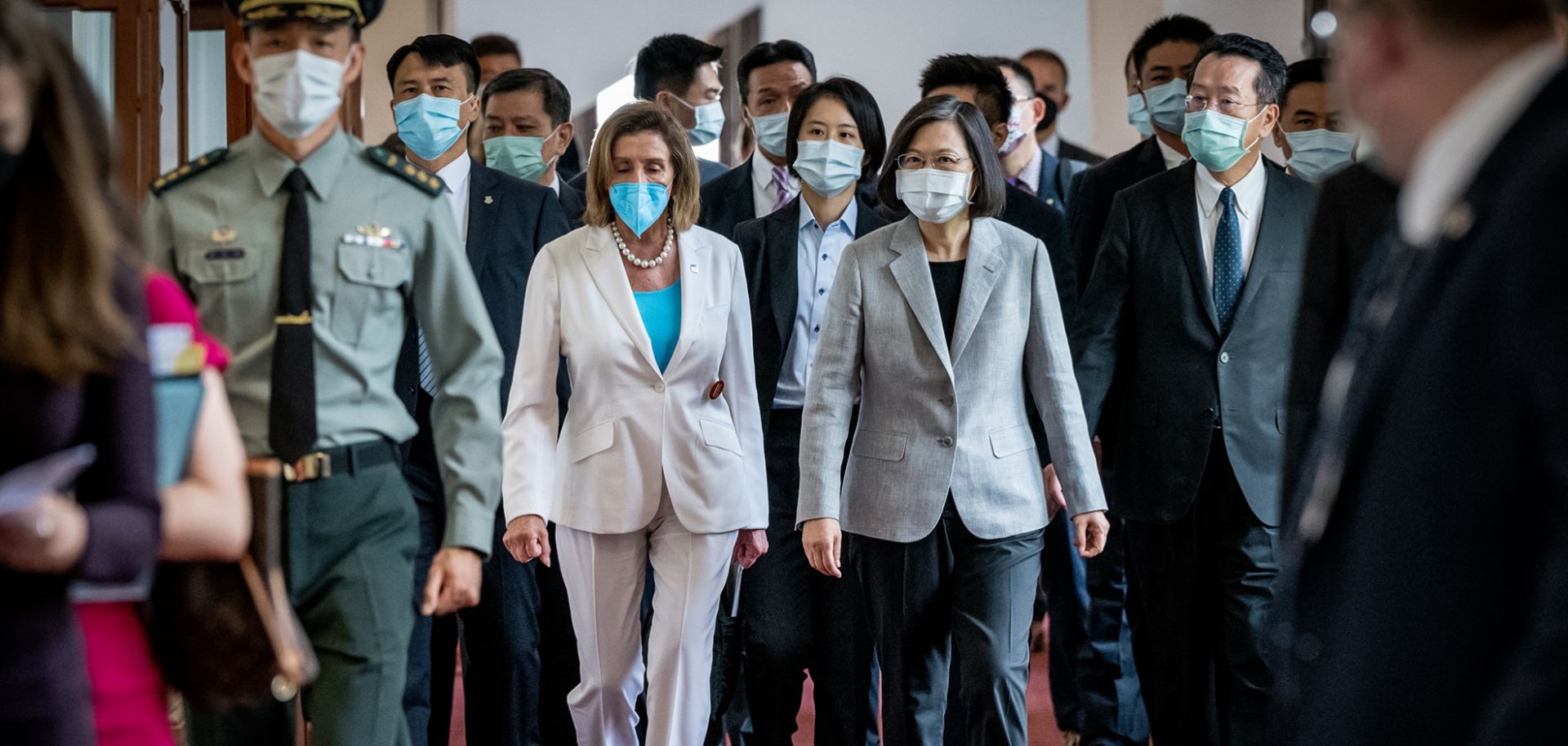
Then-U.S. House Speaker Nancy Pelosi (center left) walks alongside Taiwanese President Tsai Ing-wen after arriving at the president's office in Taipei on Aug. 3, 2022.
Editor's Note: This assessment is the fourth and final part in a series exploring China-Taiwan relations through the lens of economics, politics, military affairs and diplomatic relations.
Taiwan's shifting diplomatic ties hold great potential to accelerate China's military and economic coercive efforts and catalyze the decoupling of global supply chains, though they're unlikely to spur a Chinese invasion any time soon. Over the past five decades, most countries have switched diplomatic recognition from Taiwan to China, partly in order to gain access to the Chinese market (which Beijing still predicates on diplomatic non-recognition of Taipei). Now, only 13 small nations in the Pacific Islands, the Caribbean and Latin America formally recognize Taiwan, and even these relations are under threat. Taiwan has also been excluded from participation in most international institutions, including the World Health Assembly (WHA). But in the wake of Russia's invasion of Ukraine in February 2022, the West appears to be reconsidering the value of preventing revanchist military aggression against smaller nations, especially those that are strategically located like Taiwan. The trade disruptions caused by the ongoing war in Ukraine have also renewed the United States and its allies' focus on bolstering supply chain resilience, even if it means putting them on an economic collision course with China. This has resulted in growing political support for Taiwan from the United States, Japan and, to a lesser extent, Europe.
- Many Western legislators have expressly stated that "Taiwan is the next Ukraine" and have thus called for a reexamination of ties with China, as happened for Europe's ties with Russia in the wake of last year's Ukraine invasion. However, in countries that are deeply dependent on Chinese trade, many leaders (including German Chancellor Olaf Scholz) and business lobbies have expressed concerns about a hasty reorientation away from the Asian superpower.
- In the developed world, there is growing momentum to pass policies focused on supply chain security, which may include reducing trade reliance on China. For advanced economies, the strategic importance of Taiwan's independence is also becoming more apparent due to the sheer volume of global trade (particularly of high-end semiconductors) that flows from and around the island and the wide-scale destruction of a would-be Chinese invasion. Nonetheless, most governments remain mum about their willingness to support Taipei militarily in such a scenario.
The U.S. relationship with Taiwan has for decades been based on a gentleman's agreement to protect Taiwan from Chinese aggression, and this relationship has frequently stirred U.S.-China tensions. Taiwan's diplomatic relationship with its most important partner, the United States, has been complicated since Kuomintang (KMT) forces first administered the island in 1945. Washington and Taipei signed a Mutual Defense Treaty in 1955, after China's attempted aggression against Taiwan during the Korean War. But starting with U.S. President Nixon's visit to China in 1972, Washington aimed to improve relations with China to counter the Soviet Union amid the Cold War. In January 1979, the United States officially recognized the People's Republic of China as the sole government of China, including Taiwan. But driven by concerns for Taiwan's security, Congress simultaneously passed the Taiwan Relations Act (TRA), a framework for U.S.-Taiwan unofficial relations to this day. The TRA establishes de facto embassies and pledges that Washington will provide Taiwan with the means necessary (including arms) to defend itself and maintain the capacity of the U.S. military to protect the people of Taiwan. But the TRA critically does not promise that the United States will defend Taiwan in the event of war with China. Though the United States pledged to China it would not officially recognize Taiwan, Washington liberally interprets the scope of its ties with Taiwan, while Beijing interprets them more rigidly, and this difference of opinion has prompted cross-strait action in the past.
In recent years, the United States has expanded its informal legislative, military and trade ties with Taiwan, which has been the primary external driver of China's latest military activity against Taiwan. The United States has begun to send stronger signals about its commitment to Taiwan as its threat perception of China has grown alongside Beijing's expanding military brinkmanship in the Indo-Pacific maritime space. Perhaps most notably, the last two U.S. House Speakers have met with Taiwan's leader: Kevin McCarthy sat down with Taiwanese President Tsai Ing-wen in April 2023, as did his predecessor Nancy Pelosi in August 2022. While domestic political jockeying partly drove these meetings, both McCarthy and Pelosi affirmed their support for democracy and peace in the Indo-Pacific in their discussions with Tsai. In addition, between October 2021 and September 2022, U.S. President Joe Biden contradicted U.S. commitments in the TRA on three separate occasions by saying the United States would defend Taiwan in the event of a Chinese invasion. Each time, his words prompting diplomatic protests from Beijing and clarifications from the White House that the U.S. position on Taiwan hadn't changed. On November 2022 and January 2023, Washington and Taipei also held rounds of negotiations to discuss a potential trade agreement, with a preliminary agreement expected to be signed in the coming weeks. Furthermore, on May 9, the U.S. State Department for the first time since 1994 did not add the caveat "where statehood is not a requirement" in its annual announcement pushing for Taiwan's participation in international institutions. These expanding U.S. interactions, particularly the legislative component, are the main external driver of China's recent uptick in military coercion against Taiwan, along with internal drivers like Beijing’s growing impatience with the lack of political reunification negotiations with the government in Taipei.
- Since 2020, in response to Tsai's presidency and U.S. interactions with Taiwan, China has swapped out economic coercion for military coercion as its primary tool for political leverage against Taiwan. The primary goal of this strategy is to send a message to Taipei, Washington and the developed world at large that China's military power in the strait reigns supreme, and that supporting Taiwan's continued de facto independence and growing diplomatic engagement with the world is not worth sparking a global war. This military coercion has taken the form of increasingly frequent and high-tech aerial and naval incursions into Taiwan's air defense identification zone (ADIZ), as well as occasional live-fire drills around the island. The Chinese military Aug. 2022 live-fire drills also constituted a de facto (if partial) two-week blockade against Taiwan, following Pelosi's trip to Taipei.
Following the United States, Taiwan's next most important relationship is with Japan, mainly due to the two countries' shared history. But Japan has traditionally tried to avoid interactions with Taiwan that would provoke a response from China. Though Taiwan was a Japanese colony between 1895 and 1945, Japan's legacy in the country is not as controversial as in other Southeast and East Asian countries (such as Korea) and Taiwan-Japan relations are exceptionally good. Though their occupation was far from controversy-free, the Japanese colonizers built highways and railways and established a modern school system, and to this day Japanese culture holds a large sway in Taiwan, including in the architectural, culinary and fashion realms. After the U.N. General Assembly passed a motion to recognize China instead of Taiwan on the world stage in 1972, Japan established diplomatic ties with China, partly because China offered to renounce its demand for World War II reparations from Japan. This involved claiming Taiwan was a part of China, but Tokyo has since maintained informal relations with Taipei, primarily through economic and cultural exchanges. Like most countries, however, Japan's trade with Taiwan is limited by a lack of a free trade agreement. This is because Beijing has for decades wielded market access to China as a sword of Damocles that hangs over any country considering negotiating trade and security pacts directly with Taiwan. Japan has had little in the way of an outward-facing military in the last 75 years and thus has not wielded its military to prevent China from aggressing against Taiwan, unlike the United States. The Japanese government has been careful to minimize tensions with China over Taiwan, as seen following the 2011 Tohoku earthquake, when Tokyo explicitly thanked every nation that supported the disaster relief and recovery efforts, except for Taiwan, despite Taiwan being the top donor of earthquake aid. Due to this low-profile approach, Japan-Taiwan relations have not been a major driver of Beijing's coercive efforts against Taiwan.
Japan, however, has begun slowly shifting away from its low-profile approach to Taiwan, raising the prospect that Tokyo could spur more Chinese military coercion against Taiwan, as well as provoke legal retaliation against Japanese companies and citizens. Japan's increasing wariness of China's assertive maritime presence around Taiwan and in the East China Sea has recently seen Tokyo's legislative engagement, rhetoric and military stance on cross-strait tensions become more overtly pro-Taipei. Over the past few years, Japan has committed itself to rebuilding its army and becoming a military power in its own right in the Western Pacific, rather than just a staging ground for U.S. troops. Current Prime Minister Fumio Kishida has pitched this military normalization as necessary amid changing security dynamics in the Indo-Pacific, including North Korea's nuclear expansion and China's threats toward Taiwan. Kishida on May 5 claimed that ''stability in the Taiwan Strait is critical not only for Japan's security, but also for the stability of international society'' and that Japan's fellow Group of 7 (G-7) nations must ''never tolerate a unilateral attempt to change the status quo by the use of force in the Indo-Pacific.'' In addition, on Dec. 10, the chairperson of Japan's ruling Liberal Democratic Party's Policy Research Council met with Tsai in Taipei, the highest level Japan-Taiwan diplomatic meeting since 2003. If Tokyo expands the scope of its diplomatic interactions with Taiwan (e.g. with a Pelosi-level visit), takes its rhetoric about the importance of Taiwan to more global fora, and/or expands its economic or military cooperation with Taipei, China may wield military coercive tools against Taiwan (akin to the live-fire drills it conducted in August and April). Beijing could also target more Japanese firms or individuals with fines, import restrictions, or arbitrary detentions.
Europe's informal engagement with Taiwan is also growing, but is less likely to prompt Chinese military action around Taiwan. Though not as dynamic as U.S. and Japanese relations with Taiwan, other nations, particularly in Europe, are slowly changing their approach toward the island nation, mainly via high-level rhetoric and legislative visits, and by establishing new diplomatic missions. These moves are driven by a desire to deter China (which European countries increasingly see as a military threat), as well as a growing recognition that a Chinese invasion could jeopardize global supply chains, given around half of the world's container fleet and 88% of the world's largest container ships sailed through the Taiwan Strait in 2022. But while parliamentary leaders of some smaller nations (like the Czech Republic) have visited Taiwan, the larger, more powerful nations in Europe — namely, Germany, France and the United Kingdom — have refrained from replicating U.S. high-level legislative visits and have not suggested significant changes to their trade or defense ties with Taiwan. In China's eyes, Europe's informal attempts to move closer to Taiwan are thus not as escalatory as those of the United States or Japan, and are in turn less likely to trigger a forceful response from Beijing.
- Many European leaders have warned China against using force against Taiwan in recent years, with European Commission President Ursula von der Leyen doing so just last month. European parliamentary delegations continue to visit Taiwan, including delegations from the United Kingdom and the Czech Republic in November and February, respectively.
- In November 2021, Lithuania established a Taiwan (not ''Taipei'') Representative Office in Vilnius. In response, China silently slashed trade with Lithuania by 80% over 2022, which also impacted shipments from other European nations en route to China via Lithuania. The European Union is now suing China through the WTO for this move.
As foreign ties with Taiwan deepen, Beijing will similarly expand its tools for coercion, including demonstrations of force and expanding economic channels of retaliation, with a number of events in the coming years serving as likely triggers of Beijing's retaliation. The most obvious of China's retaliatory methods include incursions into Taiwan's ADIZ — including more platforms and new geographical areas — and occasional demonstrations (if not full use) of its blockade capabilities. So far, Beijing has largely avoided retaliating against Western companies operating in Taiwan and China in an attempt to preserve China's business environment. But if increased military coercion fails to deter countries from further deepening ties with Taiwan, China may start to target Western firms doing business in Taiwan and China via fines, court cases, visa revocations and exit bans. There are a number of diplomatic triggers that could prompt Beijing to take such escalatory steps, including: more high-level diplomatic meetings with Taiwan's leaders; expanded U.S. military involvement with Taiwan (including training and arms sales); the election of a Republican president in the United States in November 2024; a formal trade agreement between Taiwan and the United States or Canada; and more explicit commitments to defend Taiwan by Washington or other capitals (e.g. Tokyo).
- The outcome of Taiwan's January 2024 presidential election could act as a catalyst or an inhibitor for China's retaliations to Taiwan's diplomatic interactions. If the pro-sovereignty Democratic Progressive Party (DPP) wins, the severity of China's responses to foreign interactions with Taipei will grow and Beijing's threshold for retaliation will decrease. Conversely, a win by the opposition KMT would decrease China's reactivity and the severity of its responses. A win by the third-party Taiwan People's Party (TPP), however, would be uncharted territory for China, and so Beijing would likely act with restraint early on to test the new administration, but could turn to military and economic coercion if the TPP's stance toward diplomatic interactions begins to resemble the ruling DPP's.
