
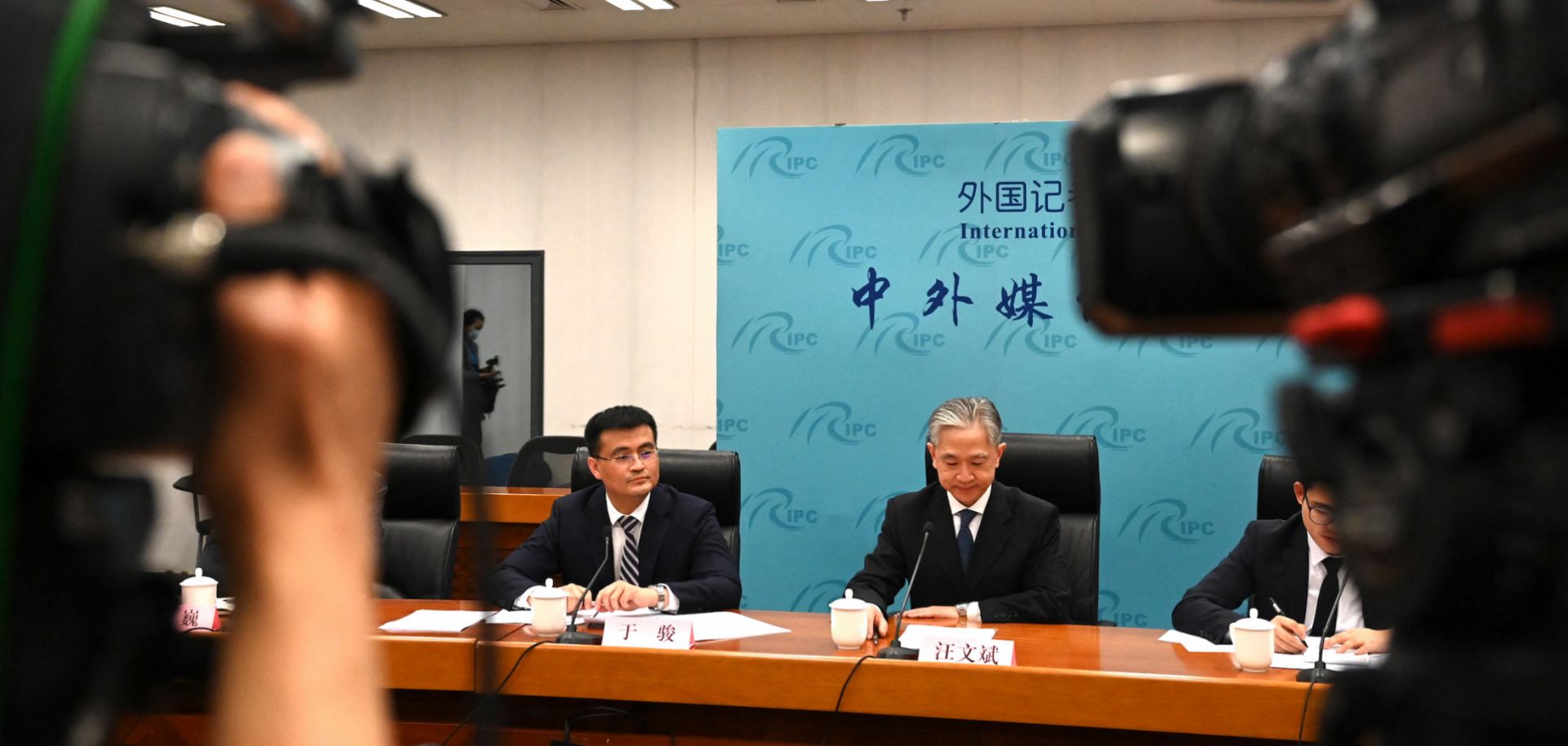
Yu Jun (left), the deputy director of the Chinese Foreign Ministry’s Eurasia Department, and Chinese Foreign Ministry spokesman Wang Wenbin (right) hold a press briefing in Beijing on April 26, 2023, following Chinese President Xi Jinping’s phone call with Ukrainian President Volodymyr Zelensky earlier that day.
China's efforts to frame itself as a promoter of peace in Ukraine are unlikely to achieve progress in the foreseeable future and its activities will remain aligned with Russia's goals. On April 26, Chinese President Xi Jinping spoke with Ukrainian President Volodymyr Zelensky over the phone, in their first conversation since Russia invaded Ukraine in February 2022. The readouts of the call, which Beijing said was held at Kyiv's initiative, included numerous statements intended to reassure the other side (and the world) of the resilience of China-Ukraine ties, despite the lack of meaningful high-level contact between the two countries over the past year. Xi claimed China-Ukraine relations had reached the level of ''strategic partnership,'' noting that ''both sides should focus on the future'' and ''plan for bilateral relations in the long term,'' and also assured that Beijing would be ready to work with Kyiv ''no matter how the international situation changes.'' Zelensky, for his part, reiterated that Ukraine adheres to the ''one China'' policy. He also expressed confidence in China's continued development under Xi's leadership and welcomed Beijing's diplomatic efforts to restore peace in his country. But the most significant development to come from the two leaders' call was an announcement that Beijing had designated former Chinese Ambassador to Russia Li Hui to head a new ''special delegation for the settlement of the 'Ukraine crisis,''' and that Kyiv had designated former Strategic Industries Minister Pavlo Ryabikin as its first ambassador to China since 2021.
- Xi and Zelensky had not spoken since January 2022, just weeks before Russia launched its ''special military operation'' in Ukraine, to celebrate the 30th anniversary of diplomatic ties. Reports that Xi was preparing to call Zelensky first emerged before Xi's three-day state visit to Russia on March 20.
- When asked about the significance of the call, Russian Foreign Ministry spokeswoman Maria Zakharova claimed China's peace initiative was broadly in line with Russia's goals, and that it was Kyiv's efforts to retake its territory that made progress on such initiatives impossible, adding that ''any calls for peace can hardly be adequately received by the puppets controlled from Washington.''
- U.S. National Security Council spokesman John Kirby described the Xi-Zelensky call as ''a good thing,'' and noted that the United States had long been calling for ''President Xi and [other Chinese] officials to avail themselves of the Ukraine perspective.''
- In the weeks leading up to the call, former Russian President and current Security Council Deputy Chairman Dmitry Medvedev said on April 8 that ''no one in the world needs Ukraine and therefore it will cease to exist,'' calling the current Ukrainian state a ''misconception, created by the dissolution of the Soviet Union.''
Ukraine is casting the call as a positive development, compared with China's previous lack of engagement. But Beijing's actions will not result in a drastic change in China's approach toward Russia and the war. The Ukrainians were encouraged by the call and China's subsequent move to create a new diplomatic delegation focused on resolving the ongoing war in their country, believing China could have just as easily continued with its previous status quo of disengagement. Kyiv is hoping that the establishment of these new contacts with Beijing will provide some new instruments with which Ukraine and its Western allies can attempt to steer China's position on the war away from Russia's. But Beijing has its own motivations to reestablish contact with Zelensky's government. The fighting in Ukraine is widely expected to accelerate in the coming weeks, as the weather warms and Kyiv prepares to launch a counteroffensive against Russian troops. It's very doubtful Beijing believed a phone call between Xi and Zelensky would spur meaningful diplomatic engagement prior to Ukraine's counteroffensive, let alone delay it. But China likely still wanted to reengage with Kyiv before the war intensifies, in the hopes of creating space to allow EU-China relations to refocus on trade by assuaging the constant pressure Beijing has been under from European leaders in recent months about China's lack of engagement with Kyiv and support for Russia. Indeed, Xi's call with Zelensky will provide ammunition to Europeans pushing for the region to not economically ''decouple'' from China. It will also enable Beijing to fashion itself as a credible mediator for the conflict and thereby further divide the West on Ukraine, even as Beijing maintains its extensive economic support for Moscow.
- Zelensky said the hour-long phone call was ''long and meaningful.'' In regards to China's ''peace plan,'' his spokesman Sergiy Nykyforov noted there were ''points of intersection from which we can start developing dialogue,'' adding it was ''nice that China is interested in restoring peace."
- During their three-day visit to China in early April, French President Emmanuel Macron and European Commission President Ursula von der Leyen reportedly urged Xi to speak directly with Zelensky and pressure Russia to somehow end the war in Ukraine. Spanish Prime Minister Pedro Sanchez also made similar appeals when he met with Xi in China on March 31.
Despite its mediation proposals, China remains very unlikely to take any action that could be perceived as undermining its support for Russia, and will thus remain focused on reaching a cease-fire that ensures Moscow meets its perceived security interests, including controlling parts of Ukraine's territory. China's foreign ministry indicated Li's delegation will travel to ''Ukraine and other countries'' to conduct ''in-depth communication'' with all parties for a political settlement, but did not provide further details on when, exactly, Li would visit Ukraine and what ''other countries'' he'd also visit as part of the new mission. Ukraine will continue to resist Russia's invasion so long as it receives sufficient Western military and economic support to do so. Moscow, meanwhile, will continue to maintain its claimed annexations of all the Ukrainian territory it occupies and insist that the war can only be brought to an end via direct talks with the United States. Given Washington's deep involvement in the conflict as Kyiv's primary supporter and Moscow's primary strategic rival, Li's delegation would thus need to hold productive talks with the United States to make any notable progress toward achieving peace in Ukraine. But the prospects of such talks remain grim due to the generally poor state of U.S.-China relations, and the fact that Chinese media has colored the United States as a war-monger and profiteer in Ukraine. The largest constraint to Chinese diplomatic efforts in Ukraine, however, will not be Beijing's strained relationship with the United States, but its strong relationship with Russia — and China's desire to preserve that relationship. Beijing knows that any indication that Russia should give up the Ukrainian territory it has seized over the past year would not only severely harm ties with Moscow, but have significant political ripple effects inside Russia that could destabilize President Vladimir Putin's regime. To avoid these risks, China will diplomatically remain committed to reaching a cease-fire in Ukraine sooner rather than later, which would de facto ensure that Russia retains control over nearly all territory of Ukraine it occupies at the time of its agreement. In addition, China will continue to tune its support for Russia in line with the evolution of the battlefield situation during the upcoming fighting season this summer and fall. Fears of triggering crippling U.S. sanctions will deter Beijing from supplying a large flow of weapons to Moscow in the near term. But to keep Russia from falling into chaos, Beijing will also keep using its economic heft to both ease the impact of Western sanctions on Moscow, as well as weaken Europe's resolve to get more heavily involved in Ukraine.
- A 67-year-old veteran diplomat, Li has held numerous high-ranking positions in China's foreign ministry related to the Eurasia region, including some that predate the Soviet Union's collapse in 1991. Most importantly, Li served as China's ambassador to Russia from 2009 to 2019, and was awarded Russia's ''Order of Friendship'' by Putin upon leaving that post. But he also served as First Secretary of the Soviet Union and East European Affairs Department from 1985 to 1990, as First Secretary of the Chinese Embassy in Russia from 1990 to 1992, and as First Secretary of the Chinese Embassy in Kazakhstan from 1992 to 1995.
