
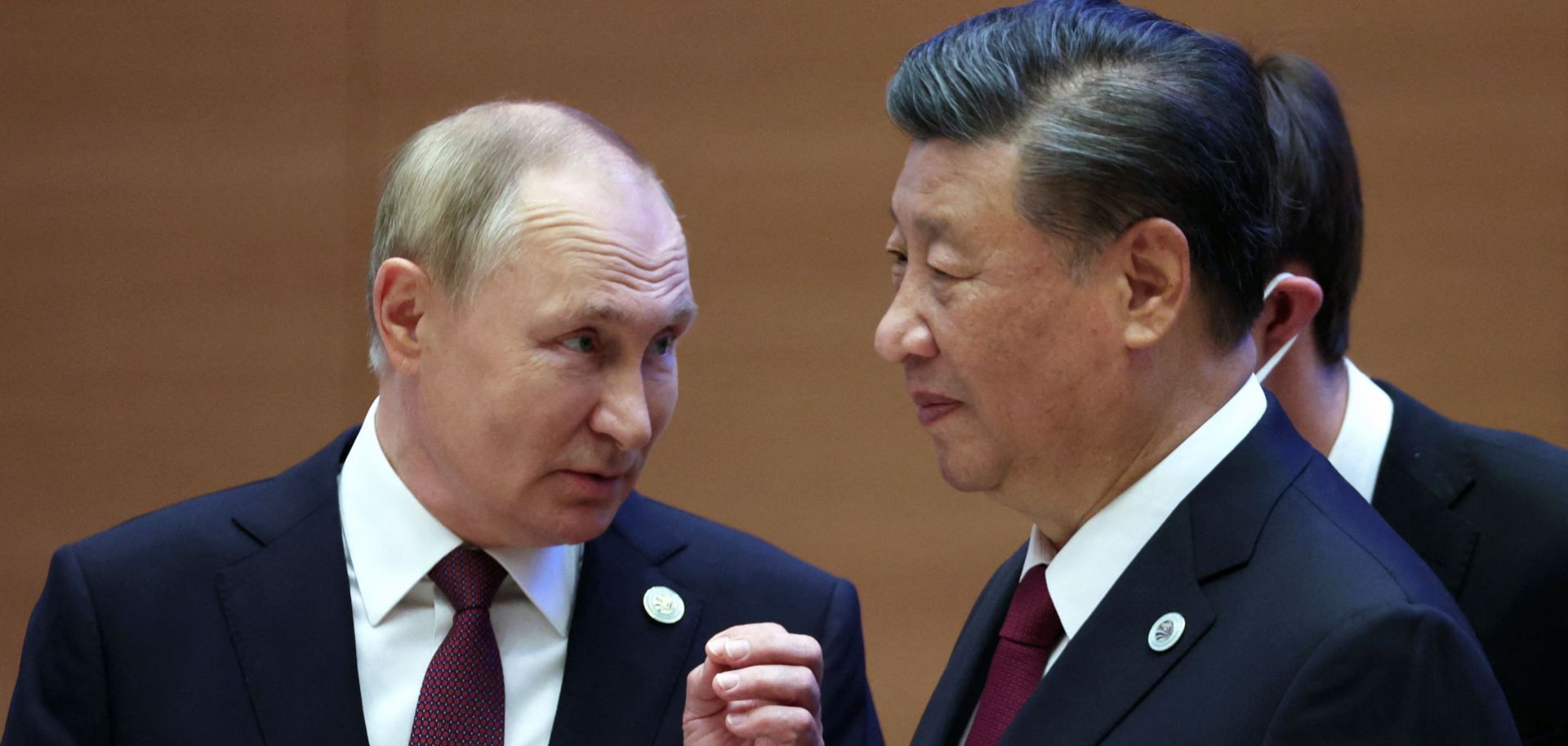
Russian President Vladimir Putin speaks to Chinese President Xi Jinping during the Shanghai Cooperation Organisation (SCO) leaders' summit on Sept. 16, 2022.
Editor's Note: This is the second in a two-part series examining how Beijing could weigh the costs and benefits of providing military aid to Moscow for its war in Ukraine. In part one, we laid out the two broad scenarios and their general impacts. In part two, we delve deeper to examine various aspects of China's cost-benefit analysis on providing lethal weapons aid to Russia.
According to claims made by U.S. Secretary of State Antony Blinken, China is ''strongly considering'' providing lethal military aid to Russia for its war in Ukraine — a move that would have sweeping consequences for not only the war, but China's development and its relations with the West. If China is indeed mulling such a monumental decision, there are numerous historical, economic, political and strategic considerations that could influence whether Beijing sends weapons to Moscow.
China's History of Non-Interventionism
Chinese weapons sales to Russia would mark a significant deviation from China's decades-long policy of remaining on the sidelines of major international conflicts, particularly in Europe. Since the end of the Cold War, Beijing has by and large practiced military non-interventionism and advocated respect for the sovereignty and territorial integrity of all nations (though critics point to China's recent encroachment in the South China Sea, coercive measures toward Taiwan and failure to condemn Russia's invasion of Ukraine as evidence to the contrary). China has often supported combatants in civil wars, like Myanmar's ongoing post-coup turmoil. But in the past three decades, Beijing has largely sought to avoid providing arms to combatants in international conflicts. Furthermore, China has not gotten involved in European conflicts since World War I, when it sent over 140,000 citizens to offer non-combatant support to the British army under the Chinese Labor Corps, though Beijing would argue its fight against the Japanese in World War II enabled the Allied powers to focus on defeating Germany. Especially in the last decade under President Xi Jinping, Beijing has lauded its non-aggressive stance and placed it in stark contrast to those of the United States and other Western powers, which Chinese officials alternatively characterize as ''interventionist'' or ''hegemonic.''
In response to Blinken's Feb. 18 allegations regarding China's potential arms aid, China's Foreign Ministry spokesperson Wang Wenbin claimed on Feb. 24 that China ''does not provide any arms sales to conflict areas or belligerents.'' Though the cases of Myanmar and China's arms aid to mujahideen rebels in the 1979-1989 Soviet-Afghan War, among others, discredit Wang's broader claim, history shows that post-Cold-War China is indeed reluctant to sell arms to major international conflict zones — particularly in Europe, which Beijing has viewed as too geographically removed to pose a pressing national security concern.
China's Fragile Economic Position
Should China provide weapons to Russia, it would mark a major departure from Beijing's strategy regarding the Russia-Ukraine war, which has so far been focused on mitigating damage to the Chinese economy. Since the war began, Beijing has condemned Western ''unilateral sanctions'' against Russia as ''financial hegemony,'' but has also urged all Chinese state-owned enterprises and private companies to review their supply chains closely to ensure they don't violate Western sanctions. Even in the peace plan for Ukraine that Beijing released on Feb. 24, China's leadership emphasized the importance of preserving global supply chains — including energy and grain shipments — amid the war. This emphasis on sanctions compliance and supply chain resiliency in Beijing's Ukraine policy is driven by China's shaky economic growth over the past three years, with the initial COVID-19 wave in early 2020 and a more severe wave of outbreaks in 2022 causing massive downturns in industrial activity as Beijing imposed strict lockdown measures as part of its ''zero-COVID'' policy. Though Beijing abandoned this ''zero-COVID'' policy in December, China's economy remains fragile, with the real estate sector in crisis, consumer spending recovering slowly and Western demand for Chinese exports down (and expected to remain deflated throughout 2023 as the United States and Europe teeter toward recession).
Thus, the incentives remain in place for China to avoid, at all costs, instigating further Western sanctions and informal trade restrictions, including the slowdown in China-Europe trade and investment deals that would occur if China provided weapons to Russia. And given China's high reliance on Western high-tech goods and services for its own industrial development, there is still plenty of damage that the West can do to China's economy going forward — on top of recent U.S., Japanese and Dutch restrictions on China's access to high-end chip technology. It is worth noting that additional restrictions would also hurt Western economies. But Washington, in particular, has recently shown a heightened willingness to bear that economic pain in order to punish Beijing for human rights abuses and stymy China's technological development, as evidenced by the United States' myriad sanctions and trade restrictions against China since 2017.
The Risk of Domestic Unrest
Closely related to these economic considerations is the Chinese Communist Party's (CCP) political self-preservation instinct, which most clearly manifests in the CCP's need to preserve social stability. Since the collapse of the Soviet Union in the early 1990s, the CCP has made preventing unrest and defusing threats of regime change its prime directive, given the common historical and ideological ties between the Communist Party of the Soviet Union and the CCP. This policy prioritization was most evident in late November 2022, when Beijing found itself dealing with nationwide demonstrations as citizens raged against lockdowns and other COVID-19-related restrictions. These were China's largest and most widespread protests since 1989 and reminded the CCP just how fickle social stability can be when the people have a unifying cause. Security services put down the protests and authorities defused their proximate cause by abruptly ending the government's ''zero-COVID'' policy. Nonetheless, Beijing's policy capitulation has emboldened would-be protesters across China, and the risk of new demonstrations remains elevated as economic grievances — many stemming from the COVID-19 hangover, but also from long-term risks like the ongoing real estate crisis — and Beijing's policy capitulation has emboldened would-be protesters. In this way, the CCP's constant fear of social instability and the related threats to regime continuity is intimately tied to economics. Put another way, theCCP's traditional social contract with the people, whereby the CCP provides Chinese citizens with economic growth and stable living conditions in return for the citizens' political loyalty (or at least quietude), remains more or less intact.
President Xi's Echo Chamber
As the CCP gains power over the state and President Xi purges the elites of all but his acolytes, an ideological and information bubble may obscure to Beijing the true drivers and constraints of myriad policy issues, including the war in Ukraine. Since he came to power in 2012, Xi has used an anti-corruption campaign to purge rivals and concentrate governing power in CCP (not state) organs via the establishment of countless supervisory commissions. Furthermore, as evidenced by the composition of the 20th Politburo in October 2022, Xi has surrounded himself with cadres whose most common attribute is their patronage network connections to Xi or their loyalty to his ideologies. In this environment, the majority of critical voices in China have either self-censored or been silenced by the state, with lower-level bureaucrats and ambitious party members motivated to produce information flows that please their superiors and align with Beijing's political predispositions, rather than those which paint a more accurate (if ideologically displeasing) picture of reality.
This is as true with Beijing's relationship with Russia and stance toward Ukraine as it is with any issue. Over the course of his presidency, Xi has fostered a close personal relationship with Russian President Vladimir Putin — meeting with him 38 times, which is more times than Xi has met with any other world leader since he took office. On the issue of Ukraine, China's stance — tacit support for Russia — has raised opposition from Chinese academics and even anonymous officials who question why Beijing would wed itself to Moscow's poor decision to go to war. This suggests China's Ukraine policy may be informed by Xi's close personal connections to a fellow anti-Western ideologue and autocrat, in addition to raw strategic calculations and historical relations with its northern neighbor.
Xi's Growing Focus on National Security
Chinese weapons sales to Russia would mark a major victory in Xi's push to place more emphasis on preserving national security, challenging economic development as Beijing's traditional top priority. Xi has pushed the CCP to reemphasize national security in policymaking over the last decade, incorporating national security into everything from industrial growth plans to digital regulations, educational curricula and even the movie industry. And contained within this expanded definition of national security is China's ability to push back against what Beijing increasingly sees as a pro-Western world order that disadvantages China's mixed economy and authoritarian political system. According to this logic, support for Russia in Ukraine could strengthen China's national security. Prior to Xi, however, Beijing's primary policy focus had unquestionably been economic growth, with former leader Hu Jintao mainly giving rhetorical support to the idea of rebalancing away from economic growth toward improving China's security. This CCP debate about the relative merits of national security and economic growth is still far from settled, as evidenced by Beijing's half-hearted campaign over the last six months to patch up diplomatic relations with the West as a means of counteracting a five-year trend of growing Western trade restrictions against China. But a decision by Beijing to aid Russia with arms sales would signal that Xi's pro-national security sentiment is beginning to win out over party members who would prefer to keep their eyes on the economy.
It is worth noting that the goals of national security and economic growth are not mutually exclusive. On the contrary, they have a degree of complementarity, with some actions that preserve national security supporting economic growth (like how bolstering disputed South China Sea territorial claims expands China's access to mineral reserves) and vice versa. But increasingly, key items on China's policy agenda place the two goals at odds. For example, Xi's decision to implement forced labor camps in Xinjiang, partially as a means of disincentivizing other Chinese provinces from pursuing secessionist inclinations, has prompted Western sanctions and frozen China's talks with Europe on the Comprehensive Agreement on Investment.
Strategic Considerations
In addition to these political and economic implications, raw strategic considerations will also factor into China's decision on whether to provide military aid to Russia, including:
China's perception of Russia and its path to victory in Ukraine.
The CCP sees itself, particularly under Xi, as in the midst of great power competition with the West, led by the United States. Washington's combative approach toward Beijing since 2017 and (to a lesser extent) Europe's slow turn against China have cemented in the minds of CCP leaders that this new strategic competition with the West is a long-term reality. Thus, China is in dire need of partners like Russia to combat the West's containment strategy. So Beijing must consider the possibility of a Russian loss in the Ukraine war, which in Moscow's eyes means a failure to hold Ukraine's eastern Donbas region, Crimea and the land bridge linking the two. Such a failure in Ukraine could lead to Putin's fall from power, or the eventual bankruptcy of Russia and a significant weakening of its state power, akin to the fate of the Soviet Union. Governance-wise, Russia is also a key partner of China. Beijing's partnership with Moscow — a fellow autocratic government that is also led by a singularly powerful leader — helps China justify the CCP's controversial authoritarian government model in the face of Western liberal criticism and the greater ideological competition that's slowly reemerging between the world's democracies and authoritarian governments. For these reasons, Beijing needs Russia to remain a viable power (not a client or vassal state) and avoid a crushing defeat in Ukraine.
Moreover, as evidenced in Beijing's recent peace plan, China's leaders remain worried about the prospect of Moscow escalating the war – including with the use of nuclear weapons, in the most extreme case – should Russia's prospects for victory fade in Ukraine. In providing Chinese weapons to Russia, Beijing could enable Moscow to hold the aforementioned key territories in Ukraine, which would prevent Moscow from resorting to such extreme methods. This would preserve Russia's national strength and the Putin regime's staying power, at least from the perspective of Chinese elites.
Thus, if China ends up selling weapons to Russia, it would not only highlight the importance Beijing places on preserving its strategic relationship with Moscow, but could suggest that China perceives Moscow's position in Ukraine to be increasingly precarious in the face of growing Western military support for Kyiv.
China's perception of the West's willingness to retaliate.
It is possible that Beijing believes the West would not levy heavy sanctions against China if it provided arms to Russia, perhaps over fears of economic collateral damage. However, Chinese rhetoric since the former Trump administration launched its trade war against China in 2017 suggests otherwise, with top officials increasingly claiming — and, in my view, genuinely believing — that the United States is bent on waging an all-out economic war to counter China's rise. Such concerns have likely only been exacerbated by the West's response to Russia's Ukraine invasion, as Chinese experts have expressed shock at the speed at which the United States and its European allies came together to launch a coordinated sanctions campaign against Moscow. And despite some challenges, that unity between European and U.S. leaders hasn't faded over the past year.
Compared with its predecessor, the Biden administration has adopted a more tailored approach to sanctions against China — targeting specific companies and high technologies exports. But even these types of sanctions could still significantly damage China's economy, if Beijing provides military aid to Russia and the White House retaliates. Take the Chinese drone manufacturer Xi'an Bingo Intelligent Aviation Technology as an example. If the company follows through with its alleged plans to make and sell 100 ZT-180 prototype drones for Russia, Washington could sanction not only Xi'an Bingo Intelligent Aviation Technology, but also any entity that funds the company or provides it with research. Any entity that assists Xi'an Bingo Intelligent Aviation Technology's supply chain via labor, assembly, transportation or inputs (including cameras and advanced machine parts, like wings) could be targeted by U.S. sanctions as well — expanding the economic impact far beyond any individual Chinese firm that's doing business with Moscow.
When adding in recent warnings by U.S., German and EU officials about the severity of consequences for arms sales, it thus seems unlikely that Beijing would underestimate the West's willingness to retaliate against any moves to provide military support to Moscow amid the ongoing war in Ukraine.
