
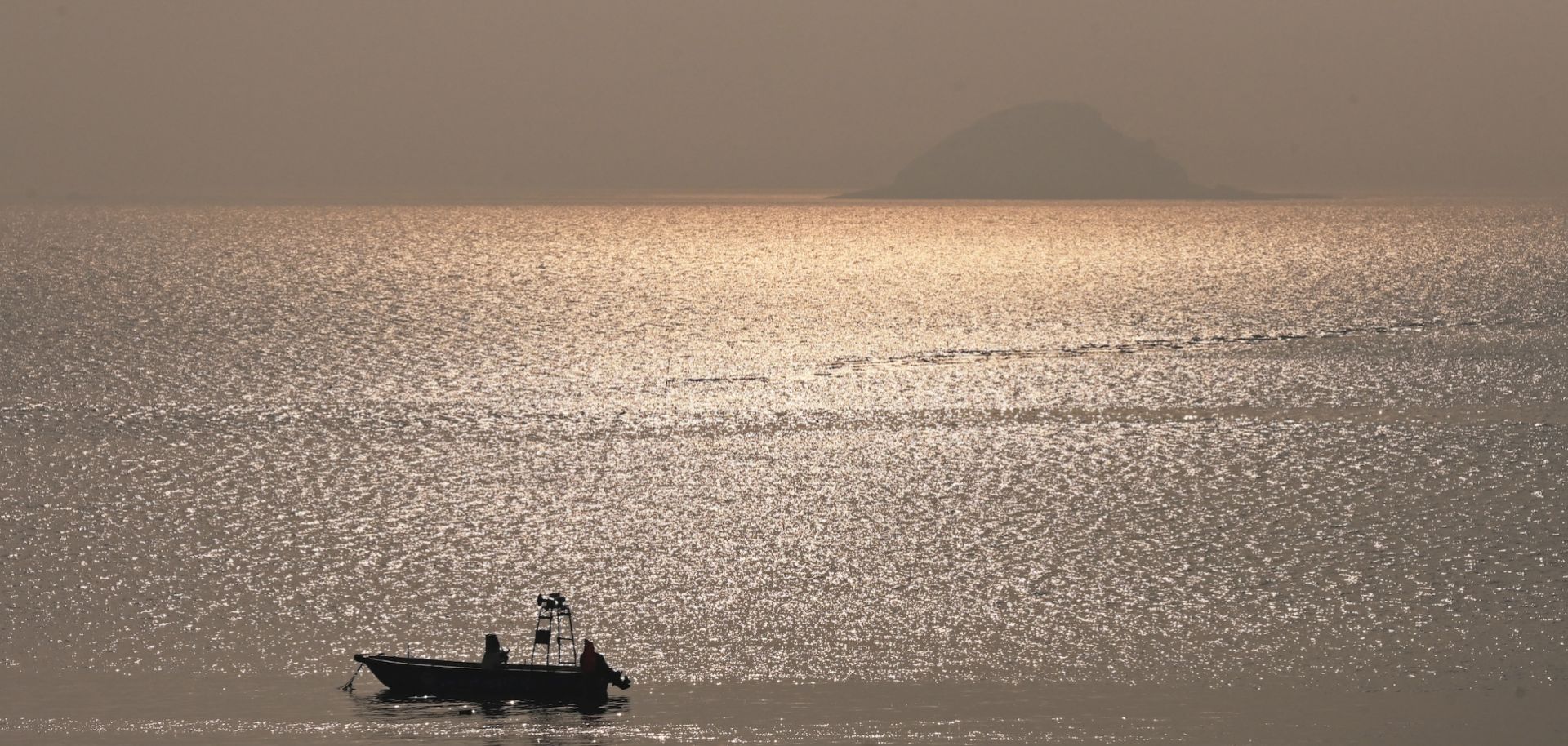
China is seizing on a deadly incident in the Taiwan Strait to exercise greater control around Taiwan's Kinmen islands, which in the short term will risk additional escalatory encounters and in the longer term suggests China is altering the strategic status quo in its favor. In recent days, tensions have spiked between China and Taiwan in the Taiwan Strait over the jurisdiction of waters around the Kinmen archipelago, a group of islands governed by Taiwan located just six miles from mainland China. On Feb. 15, two Chinese fishermen drowned about one nautical mile off the archipelago after being chased by Taiwan's coast guard. The incident occurred after the fishermen entered prohibited waters in the area and attempted to flee. China condemned Taiwan's coast guard, alleging it used ''violent and dangerous'' methods with ''malicious intent.'' Though Beijing did not issue any additional threats at that time, on Feb. 17 the Chinese coast guard's Fujian division announced it would more intensely monitor, patrol and enforce its legal jurisdiction around Kinmen. This new approach led to another incident on Feb. 19 where the Chinese coast guard forcefully boarded and inspected a Taiwanese tourist vessel bound for Kinmen.
- The Kinmen archipelago is located just six miles from the Chinese city of Xiamen, rendering it geographically isolated from Taiwan's main island, which by contrast is 170 miles to the east. In the 1990s, Taiwan established a doctrine of ''restricted waters'' around the Kinmen and Matsu islands (the latter of which similarly hugs China's coastline), which both sides broadly adhered to, until now.
- Maritime deaths between China and Taiwan are rare, with the last known fatal incidents occurring in 1990. Chinese forces interdicting and boarding Taiwanese civilian vessels is also rare and marks a new precedent in the Kinmen context.
The Chinese coast guard's Feb. 17 announcement and follow-up action on Feb. 19 mark a deviation from a multi-decade status quo that has seen China not fully exercise its claimed jurisdiction over the Kinmen islands. China claims de jure legal jurisdiction over all Taiwanese territories. But it has seldom enforced that jurisdiction over the decades, which is why deaths at sea are so rare, despite persistently high tensions between Beijing and Taipei. The Feb. 17 China Coast Guard announcement and follow-up action on Feb. 19 thus mark a de facto doctrinal change, as China now intends to exercise what it says are its full legal rights to interdict and inspect Taiwanese craft. When paired with similar changes to airspace doctrine, this marks a larger shift, particularly evident since the Jan. 13 election of William Lai as Taiwan's president, who Beijing regards as a separatist even more so than current President Tsai Ing-wen. For example, China is also squeezing Taiwan's airspace, most recently by altering the M503 civilian aviation route near the Taiwan Strait median line on Jan. 31. In addition to bringing Chinese civilian aircraft into closer contact with Taiwanese military planes, this altered route also compounds the existing and growing presence of Chinese fishers in the waters around Kinmen by bringing Chinese planes and maritime vessels into closer proximity to Taiwanese coast guard and military assets.
- While Beijing does not necessarily send civilian fishing vessels toward Taiwan, the government certainly does not discourage these activities and likely encourages them, particularly as Chinese fishing boats are well known to serve a dual, gray zone purpose to stake territory and provide surveillance and monitoring capabilities.
In the immediate term, China will deploy significantly more coast guard assets to the area (as well as fishing boats), which will raise the risk of additional dangerous encounters with Taiwan. China's frequent naval maneuvers, combined with its gray zone tactics that mix civilian vessels like fishing boats and speed boats with military and law enforcement objectives, heighten the risk of misidentifications, miscalculations and accidents with Taiwanese military and civilian ships and vessels. By announcing that it now intends to carry out law enforcement activities in a maritime geography controlled by Taiwan, China is sending a larger message that it no longer respects either Taiwan's maritime or aerial boundaries, which, when combined with Beijing's similar treatment of airspace, effectively ends a 30-year status quo. Moreover, because of China's use of fishing boats to carry out gray zone tactics, Taiwan will likewise feel more compelled to interdict additional Chinese vessels. This will increase the likelihood of tit-for-tat interdictions between China and Taiwan, as each side now not only claims jurisdiction but also the right of enforcement. If such interdictions result in more casualties, it will only exacerbate already high tensions between China and Taiwan. Beijing refuses to cooperate with Taiwan's ruling Democratic Progressive Party, which recently secured another four-year term, meaning such deadly incidents would likely be marked by non-communication, thus heightening the risk of further escalation.
In the longer term, China will use its claimed jurisdiction to undermine Taiwan's control over the Kinmen archipelago. As time goes on, China's coast guard will use its jurisdictional power to stake maritime territory (otherwise referred to as ''salami slicing''), protect its fishing boats and monitor Taiwanese movements. This carries a medium-term implication of potentially cutting Taiwan off from its strategically important Kinmen archipelago (as well as the Matsu islands). Both Kinmen and Matsu host significant Taiwanese military outposts and, given their locations, have long been eyed as the logical jumping-off point if a war were to break out between Taiwan and China. China's new doctrine will likely see it gradually increase its presence to the point where it can challenge, disrupt or cut off Taiwanese resupply of these islands, altering the strategic status quo in its favor as it similarly exhausts Taiwanese ability to patrol its skies through frequent air incursions.
- Taiwan managed to retain control of Kinmen in 1949 when it defended it from a People's Liberation Army attack before the end of fighting in the Chinese Civil War, and has managed to hold it ever since. Nonetheless, in an invasion scenario, China would likely target Kinmen.
- China's new approach to the waters around Kinmen is similar to the one it takes in the South China Sea, where China changes facts on the ground (or on the water) via ''salami slicing'' in disputed territories, leading to regular incidents with its neighbors, such as the Philippines and Vietnam. Both the Philippines and Vietnam have sought external defense partnerships in response, and Taiwan is likely to similarly seek new or deepened security cooperation with its partners in the wake of China's growing aggression around Kinmen.
