
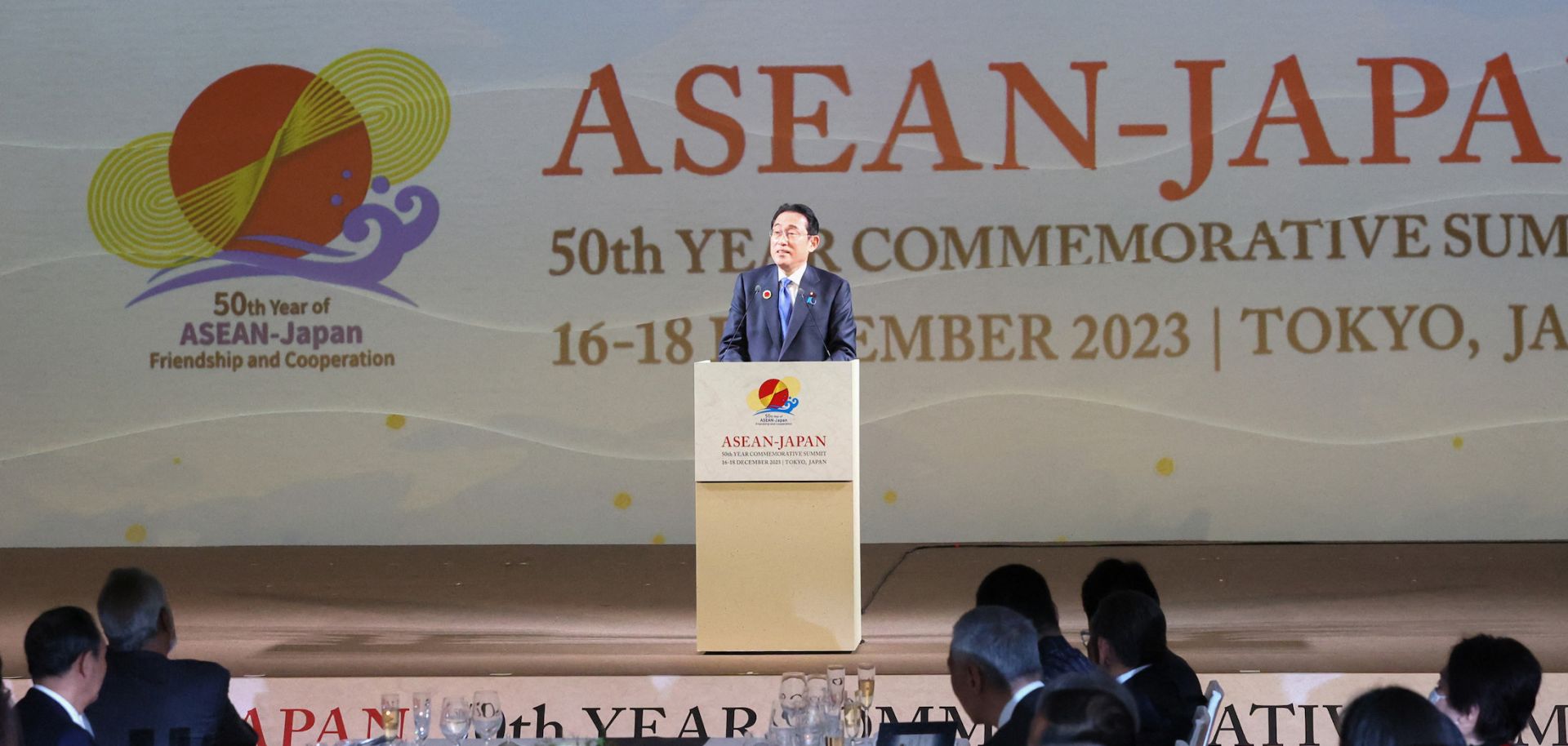
Over the next year, Japan will provide Southeast Asian countries with military equipment and more infrastructure investment, and may even deploy its own assets to the region, which will improve these countries' defense capacities but further deteriorate Japan's relationship with China. As Japan continues to evolve its national security doctrine, it is looking not only at its immediate neighborhood but increasingly at Southeast Asia. On Dec. 16, Japan and the Association of Southeast Asian Nations (ASEAN) celebrated 50 years of ties by upgrading relations to a ''comprehensive strategic partnership,'' the highest possible tier. As part of this upgrade, Japan committed to stepping up its infrastructure, technology and defense aid to ''like-minded'' Southeast Asian countries under Tokyo's Overseas Development Assistance (ODA) and its newly implemented Overseas Security Assistance (OSA) programs.
- Since its inauguration in 1954, the ODA program has provided economic and development assistance to Japan's partners in Southeast Asia and elsewhere through loans, private-sector finance and grants. By investing in developing countries' infrastructure projects, the program thus competes with China's Belt and Road Initiative. In April 2023, Japan launched its OSA program, which is designed to complement the ODA program by providing select developing countries with military hardware as well.
- Japan is pursuing its 2016 Free and Open Indo-Pacific (FOIP) strategy, which subsequent governments have continued to expand. The FOIP has three components: establishing and promoting ''fundamental values'' (such as the rule of law and freedom of navigation), pursuing economic prosperity (which includes digital and physical infrastructure connectivity), and committing to peace and stability (which focuses on maritime security and law enforcement). The strategy also aims to maintain the regional status quo, which means containing China and preventing it from taking Taiwan or achieving full control over the South China Sea. In short, Japan supports the existing ''rules-based order'' and opposes efforts to alter it.
A combination of security and economic imperatives is driving Japan to increase its engagement with Southeast Asia. Japan's pacifist constitution constrains its hard power, leaving Tokyo largely dependent on non-coercive means to achieve influence. This is particularly the case in Southeast Asia, where Japan has spent decades building trust after it occupied much of the region during World War II. For many of these decades, Japan's engagement with Southeast Asia has prioritized economic opportunities, largely for access to resources. But in more recent years, Japanese businesses have also sought to take advantage of the region's cheap labor and growing populations amid Japan's rapidly aging and shrinking workforce — demographic trends that will likely only intensify. Japanese companies' desire to reduce their exposure to China has further driven business to Southeast Asian countries, which are seen as less risky amid the recent uptick in arbitrary detainments and espionage accusations in China. Several Southeast Asian countries have largely welcomed this increased Japanese engagement, as they are apprehensive about Chinese aggressiveness around Taiwan and the South China Sea and thus want additional supply chain and security partnerships. As the United States and China's great power competition continues to escalate, there is also a broader, geopolitical desire among virtually all Southeast Asian states to partner with a third-party country like Japan.
- In 2010, China and Japan's trade with Southeast Asian countries totaled $219 billion and $236 billion, respectively. But by 2022, those numbers had grown to $722 billion and $269 billion, with Chinese trade in the region now far outpacing Japan's. The erosion of its trade advantage in Southeast Asia is, in turn, driving Japan to compete more intensely with China for influence and market access.
- Fewer than 30% of Japanese businesses active in China plan to expand in 2024, according to an annual survey by the Japan External Trade Organization.
- In October 2023, China arrested a Japanese businessman on suspicion of violating the country's anti-espionage law. This risk of arbitrary detainment along with attendant crackdowns on due diligence and consulting firms are spooking Japanese businesses in China.
- Japan consistently ranks as the most trusted major power in Southeast Asia according to surveys conducted by the Singaporean think tank ISEAS-Yusof Ishak Institute. In addition to Japan's strong business, agriculture and infrastructure ties to the region, this is also due to the high prevalence of Japanese media (such as anime and J-pop music) in ASEAN countries.
Southeast Asia is also a key focus of Japan's reinvigorated national security doctrine, which seeks to bolster aid to the region in an effort to counterbalance China amid growing doubts about future U.S. defense commitments. Japan relies on the South China Sea for much of its international trade, including critical energy supplies shipped from the Middle East, and Japan's nearest point to Taiwan is only around 70 miles away. Though not explicitly stated policy, Japan has indicated that it will come to Taiwan's defense if the island is attacked. In December, Japan approved a 16% increase in military spending while easing restrictions on exports of lethal weapons. This followed policy changes in 2022 that aimed to increase Japan's military spending to 2% of GDP by 2027 after capping that figure at 1% since 1960. One reason Japan is rearming is uncertainty over the upcoming U.S. presidential election, as Tokyo is worried that if former U.S. President Donald Trump is re-elected in November, the United States could seek accommodation with North Korea that would allow Pyongyang to keep its nuclear stockpile. Japan is also concerned that if he re-enters the White House, Trump could make good on his 2020 threat to withdraw U.S. forces from Japan.
Japan's deepening partnership with ASEAN countries will bolster its security by protecting critical shipping lanes, though financing could become a constraint on implementation. Given Japan's strategic priorities around Taiwan and the South China Sea, Tokyo will take further steps to deter China by bolstering Southeast Asian countries' defense capabilities. The most immediate beneficiary of this increased defense aid under Japan's OSA program will be the Philippines, Japan's doorway to the rest of ASEAN in terms of military cooperation and a test case for Tokyo's new rules on exporting military equipment abroad. But Malaysia, Bangladesh and Fiji will also receive part of the first batch of OSA. Developing Japan-Philippine defense ties will likely culminate in a visiting forces agreement in 2024, which would allow Japanese military assets access to Philippine territory, facilities and infrastructure, while bolstering logistical networks and systems interoperability. Over the next year, Japan will likely also step up provisions of defense technology and hardware to Indonesia and Vietnam (as well as additional provisions for Malaysia), providing assets such as coast guard vessels and radar. However, Tokyo will struggle to finance its OSA and ODA programs, which will require strong domestic policy support, and the political turmoil currently embroiling Japan's ruling Liberal Democratic Party could constrain commitments abroad and force Japan to reorient inwardly. Japan's stagnant economy further compounds this problem, and ODA funding is already limited. If Japan comes up short on its promises to ASEAN countries, it will help drive sentiment in the region back in China's favor and undermine Tokyo's broader Southeast Asia strategy.
- Since 2020, Japan has reached defense equipment transfer agreements with Indonesia, Malaysia, the Philippines, Singapore, Thailand and Vietnam. In December, Japan sent a radar system to the Philippines, which became the first Japan-made defense equipment exported to a foreign country.
- The LDP is suffering from a slush fund scandal that has implicated two of the ruling party's most significant factions. Support for Japanese Prime Minister Fumio Kishida has hit a low of 18.6%, while support for the LDP was only 14.6%, according to a poll conducted in January by the Japanese newspaper Jiji Press.
- Japan cannot meet every request for infrastructure. In 2019, for example, Tokyo rejected a Vietnamese proposal to build a north-south bullet train for $50 billion, which saw Hanoi turn to China instead to realize this ambition. Japan has previously rejected similar requests for high-speed trains in Indonesia, Malaysia and Thailand due to funding issues.
Security developments have also rendered Japan at risk of entanglements in conflicts beyond its immediate periphery for the first time in decades, and Japan's active stance will drive threat perceptions of potential adversaries like China. Japan's military buildup and its proactiveness abroad have sounded alarm bells in China, Russia and North Korea. In response to Tokyo's assertiveness, all three of these adversaries will likely press Japan on existing areas of friction — namely, the Diaoyu/Senkaku Islands dispute with China, the Kuril Islands dispute with Russia and nuclear brinkmanship with North Korea. This will manifest in increased China-Russia joint naval drills in and around the Sea of Japan, with both Beijing and Moscow leveraging diplomatic pressure to assert sovereignty over their respective claims while discouraging Japan from pursuing its own territorial claims. North Korea, meanwhile, will likely conduct more tests of nuclear weapons and intermediate-range ballistic missiles. Nonetheless, Japan's most likely area of conflict will remain regional conflagration stemming from Taiwan or the South China Sea.
Southeast Asian countries that receive Japanese assistance will benefit from business and infrastructure investments that are seen as less risky than China's BRI investments, but uneven distribution of aid could undermine aspired ASEAN unity. Japanese infrastructure has a higher upfront cost than Chinese alternatives, which is what initially attracted many ASEAN countries to China's Belt and Road Initiative (BRI). However, skepticism toward BRI is growing in the region, with countries increasingly concerned about the deliverability and reliability of China's infrastructure investments, as well as the prospect of being beholden to China. Such concerns are particularly acute among maritime Southeast Asian states with claims in the South China Sea, which has driven many to lean more toward Japan for infrastructure when the option is available. These maritime ASEAN states will also be less likely to sign up for new BRI projects and more likely to pull out of existing ones (or merely let existing projects languish in financing or construction stages without exiting). But they remain unlikely to fully pull out from the Chinese infrastructure initiative (like Italy did in December 2023) for fear of inviting Beijing's economic and military coercion. Using Japanese infrastructure also addresses a worry in ASEAN capitals of being entrapped in a ''new Cold War,'' because Japan tends to acquiesce to local interests and does not preach human rights, like the United States, nor does Tokyo push for policy concessions, like China's insistence that countries espouse a ''one China policy'' as a prerequisite for normal diplomatic relations. There are, however, downside risks from Southeast Asia's perspective, most notably the prospect of deepening the divide between countries able to attract new investments, and those seen as less attractive by investors. Unequal distribution of Japanese assistance, which is inevitable, could also lead to a rift between ASEAN countries, meaning maritime countries like Indonesia, Malaysia, the Philippines and Vietnam could be drawn toward Japan while countries less relevant to Japan's maritime interests like Cambodia and Laos will conversely go deeper into China's camp.
- In November 2023, the Philippines pulled out of four BRI projects. Vietnamese skepticism for the BRI, already strong, will heighten. In December 2023, Chinese President Xi Jinping visited Vietnam to discuss upgraded rail ties, which contrary to prior speculation, will not fall under the BRI umbrella.
- Pledged Japanese-built rail projects include the East-West Economic Corridor to connect Da Nang, (central) Vietnam with Myanmar via Laos and the Southern Economic Corridor to connect Ho Chi Minh City, (southern) Vietnam to Dawai, (southern) Myanmar via Cambodia and Thailand.
