
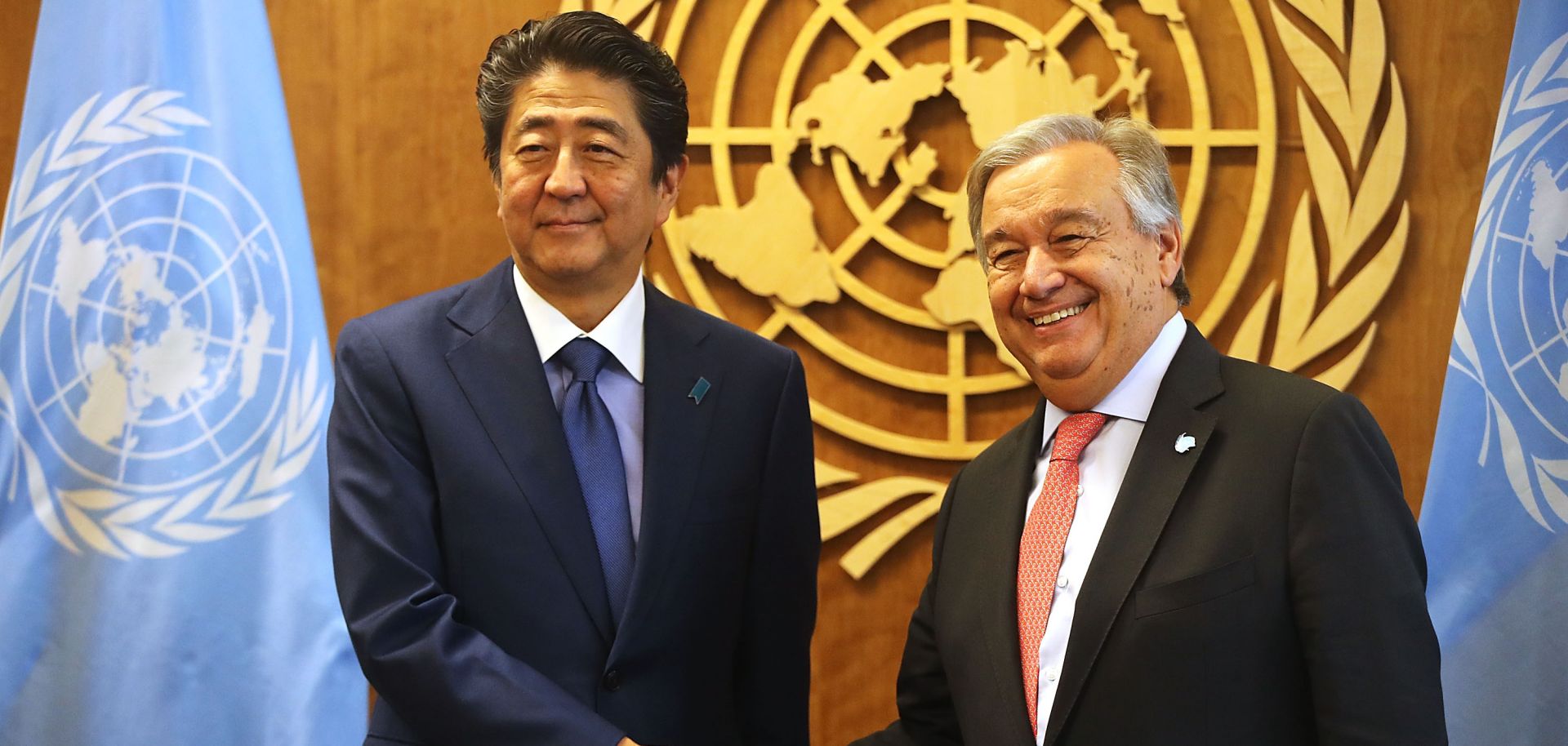
Then-Japanese Prime Minister Shinzo Abe shakes hands with the Secretary-General of the United Nations in New York City during the 73rd U.N. General Assembly on Sept. 25, 2018.
Editor’s Note: This assessment is the second of a two-part series on the life and legacy of former Japanese Prime Minister Shinzo Abe. The first part, which explores historical events and figures that shaped the late Japanese leader's ideologies, can be found here.
A Brief But Impactful First Term
When Abe first became prime minister in September 2006, he faced the immediate challenge of North Korea’s first nuclear test at a time when the United States appeared increasingly entangled in the Middle East and Central Asia. At home, Japanese GDP growth was slowing again after a brief uptick during his predecessor Junichiro Koizumi’s term, while Chinese GDP growth was skyrocketing. The United States, meanwhile, was fighting wars in both Iraq and Afghanistan, which Tokyo feared would limit Washington’s ability to ensure Japanese interests in the Asia-Pacific region. Abe’s brief first term, which lasted only a year, largely failed to address domestic economic issues and raised hackles with his push for education reform. But he used his short time in office to lay the groundwork for his broader strategic agenda.
Abe launched a strategic outreach campaign to South and Southeast Asia, seeking to strengthen ties with India, Australia, and several ASEAN states. To balance Japan’s economic and security ties, Abe reinforced defense cooperation with the United States, engaged with China, and sought a diplomatic end to territorial disputes with Russia. On a tactical level, he oversaw the transition of the Defense Agency to the Defense Ministry — creating a new cabinet-level position, the Minister of Defense.
Perhaps the most lasting contribution of Abe’s first term was his linking of the Pacific and Indian Oceans as a single area of concern. Abe and his Foreign Minister Taro Aso proposed the idea of an arc of freedom and prosperity along the Pacific rim. This highlighted concerns over U.S. bandwidth, but also emphasized Abe’s desire for Japan to take a leading role in regional security and economic prosperity, rather than sit in isolation or simply follow others’ lead (particularly that of an emerging China). These initiatives laid the groundwork for the concept of a free and open Indo-Pacific (FOIP), the Quadrilateral Security Dialogue (QUAD), and ultimately the U.S. Defense Department’s decision to transition the Pacific Command (PACOM) into the Indo-Pacific Command (INDOPACOM) in 2018.
Abe’s lack of economic prowess, along with a relapse of health issues triggered in part by a robust travel schedule and stress, led him to step down as prime minister in September 2007 just a year after taking office. His resignation also marked a return to revolving-door governments in Japan after Abe’s predecessor Koizumi served nearly five and a half years (which, at the time, was the third-longest term served by any Japanese prime minister since World War II). The five years between Abe’s first and second terms as prime minister saw the rise and fall of two governments under Abe’s Liberal Democratic Party (LDP), as well as three governments under the Democratic Party of Japan.
The cut-short term was also a bitter failure for Abe, who was unable to accomplish most of his intended tasks. But that first term set the stage for his later return to office, and set in motion a reframing of how the United States looked at the Indo-Pacific region. Japan was re-emerging as a focal point for U.S. security in Asia, and Washington stepped up its encouragement for Tokyo to move beyond its constitutional constraints and take a more active security role not only in the region, but far beyond. Abe also used his time out of office to slowly rebuild his political capital and influence, develop his economic knowledge, hone his strategic vision, and ultimately make his surprise comeback to resume his place as LDP leader and Japan’s prime minister.
Between his resignation in 2007 and his return to office in December 2012, the world had been shocked by the global financial crisis. The geopolitical climate was shifting, too; the United States was seen as a declining power, China was an ascendant power with Xi Jinping taking the helm, Russia had invaded Georgia, and North Korea had carried out a second nuclear weapons test. Japan’s relations with China were also strained, to say the least, after Tokyo nationalized the disputed Senkaku/Diaoyutai Islands. On top of this, Japan was still reeling from the Fukushima nuclear crisis. But with China as a looming regional threat and potential future hegemon, and with the United States seeking (unsuccessfully) to pivot to Asia, Japan was also positioned to take a key role in the region.
Prime Minister Abe, Take Two
Shortly after retaking office in 2012, Abe once again went on the diplomatic offensive, seeking to build on his past outreach to India and Australia, and to Southeast Asia, while keeping communications open with Russia and strengthening security ties with the United States. Abe also sought to increase Japan’s own independent defense capabilities, both through regulatory and constitutional reinterpretations and expanded defense spending. This required walking a line between national independence and a strong partnership with Washington.
Enhancing Japan’s military capacity was seen as a way to serve both ends. But it was a hedge against any future reduction in U.S. regional power as well. During his second run as prime minister, Abe oversaw the creation of a Japanese National Security Council. He also spearheaded numerous revisions of rules allowing increased exports of Japanese defense materials, more liberal interpretations on the right of collective self-defense, and greater leeway for the deployment of Japanese forces abroad.
Domestically, Abe finally took the economic challenges Japan was facing head-on — seeing a weak Japanese economy as both a drag on national strength and confidence, as well as an anchor that held Japan back from taking a proactive regional leadership role.
Abe’s economic policy, coined “Abenomics,” focused on three main pillars: monetary easing, fiscal stimulus, and a series of reforms aimed at increasing private investment and spurring economic growth. Despite his perceived traditionalist and nationalist bent, those economic reforms included greater opportunities for women in the labor force, a recognition of the need for foreign labor, and a partial assault on Japan’s sacrosanct agriculture interests.
Abe’s economic policies were often unpopular. And they largely failed to spur the higher growth rates he sought. But his willingness to take on entrenched interests, including agriculture, the automotive industry and the power industry, played into his greater successes in the international arena.
Abe’s Approach Abroad
Reluctantly at first, Abe embraced the Trans-Pacific Partnership (TPP), seeing the U.S.-led trade pact between Pacific rim countries as both a way to signal Japan’s role in the region, and a way to tap into markets as part of his domestic economic policies. As with most trade deals, the agriculture and auto industries were the major constraints on Japan’s involvement in the TPP, forcing Abe to make compromises to ensure Tokyo’s participation. When Hillary Clinton came out against the TPP in her bid for the U.S. presidency in 2016 (mirroring her competitor Donald Trump, who ultimately went on to win the election), Abe adapted and played a central role in keeping the TPP alive.
These efforts saw Japan push to formally rebrand the TPP as the Comprehensive and Progressive Agreement for Trans-Pacific Partnership (CPTPP) in 2017. The revised CPTPP suspended 20 key parts of the original deal, including provisions related to biological products, medical devices, telecommunications and investment. But despite these revisions, Abe’s success in saving the TPP highlighted Japan’s leadership, and showed Tokyo’s continued promotion of globalization at a time when protectionism was on the rise. As with his defense policies, Abe sought to balance Japan’s national independence and its regional and global integration. Both benefited Japan so long as it played a leadership role, rather than sitting on the sidelines.
But trade agreements weren’t the only obstacles standing in the way of Abe’s desire to strengthen Japan’s international role. As part of his domestic agenda to overcome the social constraints of the post-war era, Abe made headlines by visiting the controversial Yasukuni Shrine, which commemorates convicted war criminals from World War II along with other fallen Japanese soldiers, in 2013. The visit triggered a rapid decline in relations with China and South Korea, and also stressed his early ties with the administration of then-U.S.President Barack Obama.
Then there was the issue of the rapid expansion of Chinese island-building in the South China Sea, increasing Beijing’s power projection through a key line of supply for resource-poor Japan. China further asserted its hegemony over the sea through increased fishing and maritime patrols and the establishment of an Air Defense Identification Zone (ADIZ) over much of the South China Sea.
In some ways, China’s island-building actually strengthened Abe’s position by reinforcing the perception of China’s revisionism and the importance of Japan’s strategic location and capability. Abe locked in the concept of the free and open Indo-Pacific in 2016, and the United States adopted the idea just a few years later. Abe reframed geopolitical competition and placed Japan as the keystone in a series of security frameworks among primarily maritime democracies.
But Abe was not without further challenges. His outreach to Russia was undermined by Moscow’s invasion of Ukraine in 2014, ending his initiative to resolve the territorial dispute. 2016 then saw the election of U.S. President Donald Trump, who considered Japan an economic competitor rather than a partner, and threatened to reduce U.S. forces in and around Japan. China’s Belt and Road Initiative took advantage of the close relations between government, banking and industry to rapidly expand Chinese economic (and political) influence, leaving the liberal democracies behind. The U.S.-China trade war rippled out to the global economy, with the focus on technology competition creating both opportunities and challenges for Japanese industry. Trump’s outreach to North Korea left Japan on the sidelines, and South Korean President Moon Jae-in, who won office after the impeachment of former President Park Geun Hye, reversed Japan’s easing of tensions with Seoul and threatened trilateral intelligence cooperation among Tokyo, Seoul and Washington.
Nonetheless, as Abe maneuvered Japan through the transition to a multipolar world system, he looked toward a moment that was supposed to represent the rebirth of a new Japan and mark its formal reemergence among the ranks of the global leaders: the 2020 Tokyo Summer Olympic Games.
Abe saw the Olympics as a potent symbol of Japan’s renewed international role, and as a way to drive national unity and pride, critical to his vision of Japan’s rebirth. But he would be sorely disappointed. Cost overruns amid the ongoing economic malaise led the Olympics to be a divisive, rather than unifying, issue domestically. And the COVID-19 pandemic proved to be the death knell. Abe fought to keep things on track, but was forced to postpone the Olympics, and face rising criticism of the venture at all, amid the public health and economic crisis. In September 2020, after serving eight years in office (the longest of any Japanese prime minister), Abe resigned, citing health reasons once again.
A Complicated Legacy
In reviewing Abe’s legacy, we see a Japanese leader who provided continuity and carried Japan through tumultuous geopolitical changes, including the end of perceived U.S. hegemony, the rise of China, the early stages of the Russian resurgence, and North Korea’s nuclear breakout. He positioned Japan to adapt to multipolarity, identifying the opportunities for a re-emerging middle power. He strengthened Japan’s indigenous defense capability while strengthening security ties with the United States and solidifying Japan as the central partner in U.S. regional security initiatives. He drove broader regional and global integration of Japan’s economy through free trade agreements, championing globalization and Western liberal global norms amid rising nationalism and protectionism. In much of the region, he overcame residual animosity from World War II (aside from Korea and China) and normalized the idea of Japanese economic, political, and even security cooperation.
At the same time, many of his key initiatives failed. The combination of domestic economic challenges and a constantly shifting geopolitical landscape meant that Abe was often reactive, and never found the right moment to accomplish his long-standing desire to revise the Japanese Constitution. He failed to spur the revival of the Japanese economy and had little impact on the seemingly intractable issue of Japan’s dire demographic situation. While he did strengthen the role of the prime minister, his efforts to fundamentally reshape the way the government and party work remain unfulfilled. And more significantly, Abe never brought society around to support his view of Japan as a regional and global leader, as Japanese society remains inwardly focused.
Abe’s most enduring geopolitical legacy, however, is the concept of the Indo-Pacific. By linking the two oceans into a single economic and security concept, emphasizing an arc of (mostly maritime) democracies hemming in China, Abe revised and updated the geopolitical concepts of the likes of U.S. geopolitician Nicholas Spykman, who saw the “rimland” where maritime and continental power met as the main zone of challenge in geopolitical competition. The free and open Indo-Pacific concept is now a central component of U.S. strategic thought and policy, a defining characteristic of the competition between Washington and Beijing, and the underlying framework for Washington’s adaptation to multipolarity. Abe failed to change the Japanese Constitution, but his impact on regional, and even global, strategic security is far more profound.
