
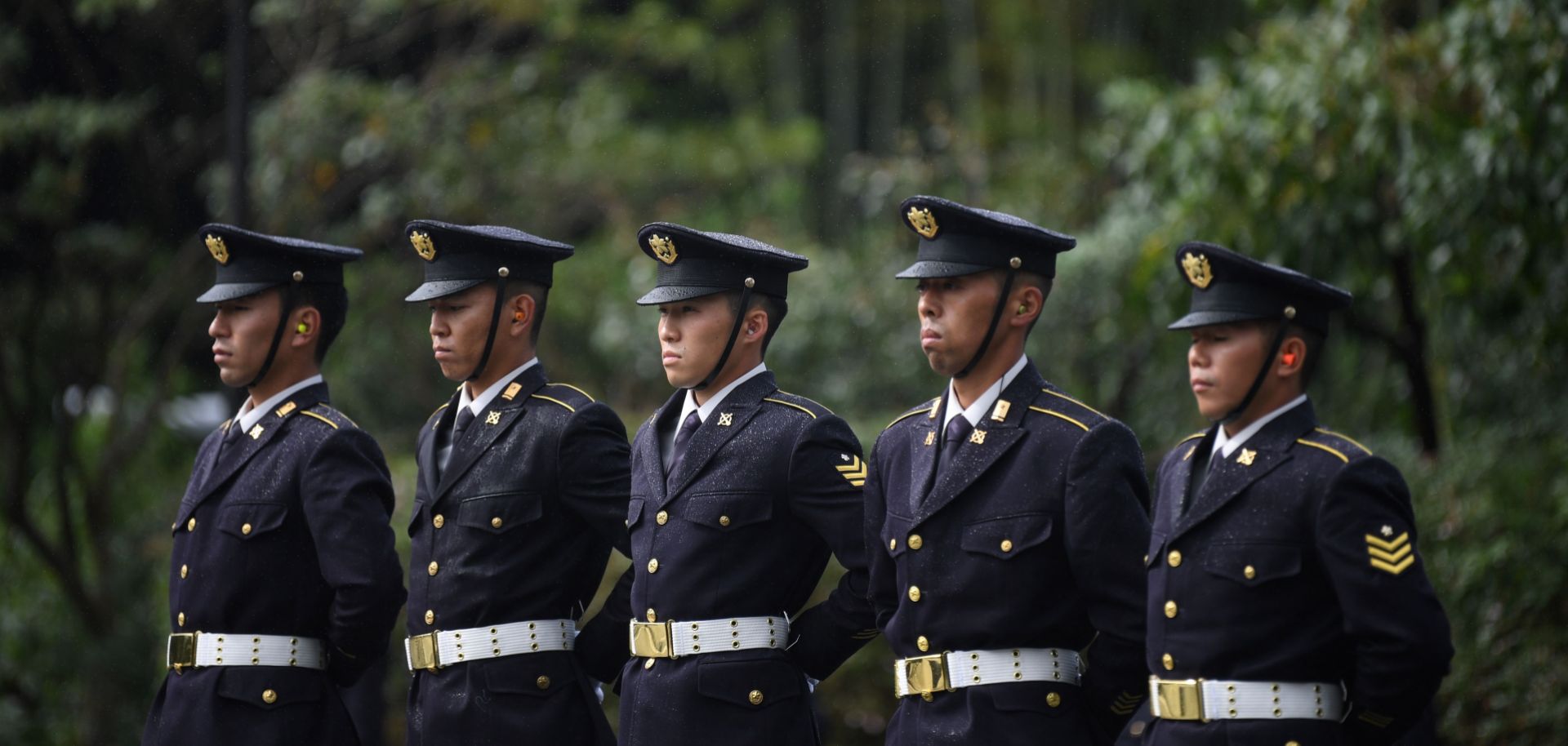
Japanese Self-Defense Forces stand guard at a park in Tokyo on Oct. 22, 2019.
Japan has long operated beyond the pacifist constraints of its post-war constitution, but a growing and more assertive China is accelerating Tokyo's development of its offensive capabilities. Japan's core strategic imperatives are shaped by economic concerns — the islands are resource-poor and thus import-dependent. This shaped its post-World War II Yoshida Doctrine, in which Japan largely outsourced its national security to the United States while focusing its energy on economic development at home. With Japan less confident in its dependence on the United States, the same vulnerability is now driving Tokyo to take on a more active role in its neighborhood. Japan's increased economic and security engagement in the Indo-Pacific provides a regional alternative to China for Southeast Asian nations, but may raise tensions with neighboring South Korea.
Moving Beyond the Yoshida Doctrine
Just as Chinese President Xi Jinping has moved China past Deng Xiaoping's doctrine, which called for China to avoid showing its strength while it rebuilt internal power, Japanese Prime Minister Shinzo Abe has sought to move beyond the strategy Japan adopted under its postwar prime minister, Shigeru Yoshida. Though several factors have shaped Japan's defense evolution, today Tokyo is driven by the changes in Chinese international behavior and the growth of Chinese power. China's economy has far surpassed Japan's, leaving the island nation a distant third behind the United States and China in national GDP. China is rapidly increasing its technological capabilities, challenging Japan in traditional areas of strength, from semiconductors to high-speed rail. China has increased its investment and trade footprint throughout the region via its Belt and Road Initiative (BRI), supplanting earlier Japanese soft power gains.
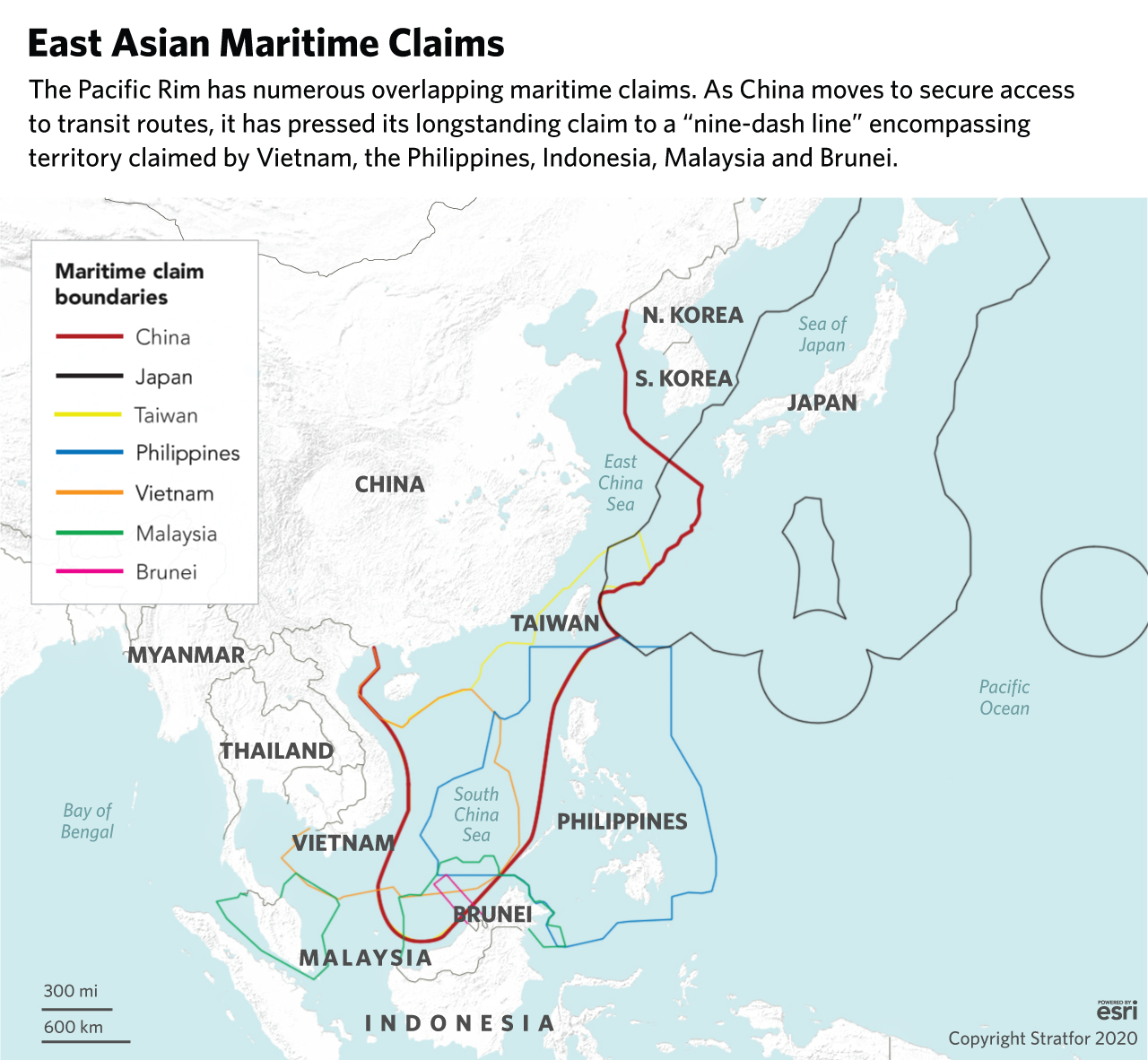
China's navy development over the past decade has outstripped Japan's, and the People's Liberation Army Navy (PLAN) now operates freely in the East and South China Seas, as well as into the West Pacific. Chinese construction of artificial islands in the South China Sea, along with the Philippines' rebalance away from the United States toward China, raises the risk of interrupting vital Japanese maritime supply lines. Chinese port development and investment stretching through Southeast and South Asia and into East Africa also create additional areas where China could interfere with Japanese supply lines.
Japan's Economic and Diplomatic Response
Japan uses its identity as both a democracy and the second-largest regional economy to strengthen its position as a viable alternative for regional leadership. Despite its wartime history, Japan is largely seen as a non-threatening partner throughout much of Asia, except of course by neighboring China and the Koreas.
In response to China's growing global presence, Prime Minister Abe traveled to Kenya to launch his "Free and Open Indo-Pacific" initiative in 2016, which emphasizes building economic, social and security connections from East Africa through Asia to Japan. Abe's declaration had followed China's 2015 launch of the Asia Infrastructure Investment Bank, and while Tokyo toyed with also joining China's initiative, it ultimately decided to offer an alternative source of development loans and aid. Japan also took a leading role in revising the Trans-Pacific Partnership after the United States pulled out in 2017, strengthening its regional trade arrangements through the re-named Comprehensive and Progressive Agreement for Trans-Pacific Partnership.
Tokyo has stepped up diplomacy, aid and cooperation across Southeast Asia, among the Pacific Islands and into the Indian Ocean Basin, with the intent of countering Chinese advances and strengthening Japan's economic and security position. In 2017, Japan helped revive the defunct Quadrilateral Security Dialogue (also known as the "Quad") comprising Japan, Australia, India and the United States. Japan is supplying the Philippines and Vietnam with new coast guard ships, and has eased its self-imposed restrictions on arms exports. Tokyo is actively incentivizing Japanese companies to reduce their supply chain dependencies on China and move operations to Southeast Asia, with Vietnam currently standing out as a preferred spot.
Redefining Self-Defense
Japanese governments have frequently reinterpreted Article 9 of the country's post-war constitution, which renounces war and nominally requires Japan to possess only a defensive military capacity to avoid a repeat the imperial actions that led to World War II. Abe has sought to formally change Article 9 by rewriting the constitution, but his attempts have continuously been sidelined by more immediate priorities or a lack of consensus. But despite his failure to amend Article 9, a more liberal interpretation of "self-defense" has allowed Japan to still make substantial strides in reorienting its military toward emerging geopolitical threats.
Over the years, Japan has revised what it considers "offensive" versus "defensive" weapons systems. Japan has added in-air refueling capabilities, approved the acquisition of long-range cruise missiles, and is now discussing the development of anti-satellite systems to protect its space-based assets. Following Japan's June announcement that it was canceling its plans for purchasing and deploying the U.S.-made Aegis Ashore missile defense system, elements of Abe's ruling Liberal Democratic Party (LDP) have revived discussions around Japan acquiring the capability to strike at foreign missile sites — something once taboo under the constitution.
Japan has already begun the process of updating its Izumo-class helicopter destroyers to take on F-35 joint strike fighters. In June, the United States approved the sale of 105 such aircraft to Japan, including 42 short take-off and vertical landing (STOVL) variants, which would bring Japan's total to 147 — the second-largest F-35 fleet in the world. Japan is also building an airbase on Mage Island off Kagoshima Prefecture for field carrier landing practice for the U.S. Navy and Japanese pilots.
In addition to its aircraft carrier development, Japan carried out its largest scale amphibious training drill since World War II in November 2019, honing its ability to retake island territory in case of war. Japan has also stepped up space cooperation with the United States, and is slated to lead a major multi-national cyber defense exercise later this year. Japan has an overseas base in Djibouti and has eased restrictions on the use of arms abroad by the country's Self-Defense Forces. Japan is expanding its basing through the Ryukyu Islands (bringing it closer to Taiwan), and is increasing regional port visits along and joint training exercises with the United States, Australia, India and other regional partners.
Regional Implications
Japan is positioning itself as a regional alternative to China for economic, political and security relations. While its pockets are not as deep as China's, Tokyo leverages assertions of better quality in both development and financing. Japan offers an alternative to China's BRI financing, both alone and in conjunction with partners including Australia and the United States. Japanese financing may require more careful considerations and planning by recipients than Chinese financing, but it also comes with fewer political strings, less fear of becoming a "debt trap" and with a higher level of trust in the technical acumen and quality of infrastructure.
Tokyo is also emerging as an alternative supplier of defense equipment, though primarily focused on maritime defense. Japan's involvement gives countries such as the Philippines and Vietnam greater confidence in standing up to Chinese challenges for their maritime territory, particularly as Japan's own reliance on the South China Sea represents a clear shared interest in ensuring open transit. Japan continues to enhance its regional security relationships, both in concert with its U.S. defense ties and independently, but has also maintained dialogue and cooperation with China and Russia, even as it sees China as the primary regional security threat. This balancing act enables Japan to simultaneously be a critical component of U.S. regional security and avoid a Cold War-type rift with China.
Japan's re-emergence as a regional military power, even without formally changing its constitution, is largely seen in a positive light as a local counterbalance to China (though China and the Koreas, of course, see this differently). The slow revision of the role of Japan's Self-Defense Forces over the last several decades, as well as Japan's lack of territorial disputes (aside from those with China and the Koreas), has engendered little overt concern of any new Japanese imperialism from Southeast Asia, and none from South Asia and East Africa. Tokyo's tensions with South Korea, however, remains a major complication, both for Japan's regional position and for the trilateral relationship between Japan, the United States and South Korea.
