
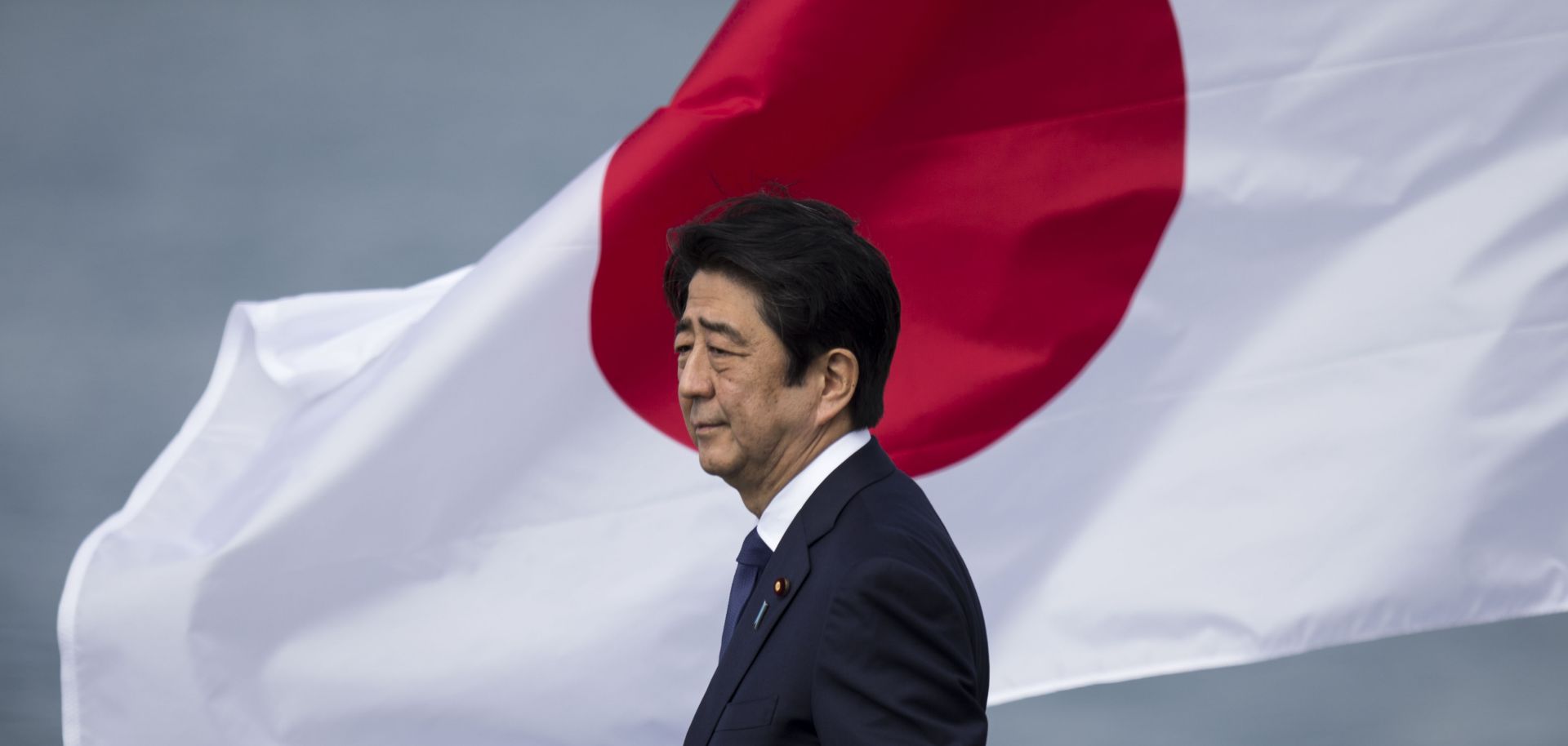
Shinzo Abe visits Joint Base Pearl Harbor-Hickam’s Kilo Pier in Honolulu, Hawaii, on Dec. 27, 2016. Abe was the first Japanese prime minister to visit Pearl Harbor with a U.S. president and the first to visit the USS Arizona Memorial.
Editor’s Note: This assessment is the first of a two-part series that explores the life and legacy of former Japanese Prime Minister Shinzo Abe, who was assassinated while giving a speech at a political rally on July 8.
Former Japanese Prime Minister Shinzo Abe may have failed in many of his domestic reform initiatives. But his conceptualization of the Indo-Pacific as a single strategic region remains a potent concept that will leave an enduring mark on geopolitics.
Remembering Abe
Former Japanese Prime Minister Shinzo Abe will be remembered for many things. To some, he was seen as a right-wing nationalist, visiting the controversial Yasukuni Shrine (where among others several Class A war criminals are interred) and trying (unsuccessfully) to revise the Japanese Constitution to remove constraints on the military. To others, he was the driver of “Abenomics,” an evolving economic policy aimed at reflating the Japanese economy, spurring industry, and addressing Japan’s demographic crisis.
Abe was Japan’s first prime minister born after the end of World War II. He was also the longest-serving prime minister in modern Japanese history. As a key member of Japan’s new conservatives, Abe championed a view that Japan should break free from both its post-war constraints and decades of economic stagnation, and take its rightful place as a proactive leader in Asia and beyond.
Abe emerged as a politician at a volatile time, winning his first Diet seat in 1993, just four years after the death of the Showa Emperor and the fall of the Berlin Wall, and two years after the collapse of the Soviet Union and the bursting of Japan’s financial bubble. The end of the Cold War and heightened economic competition with the United States left Tokyo unsure of Washington’s future commitment to defend Japan. The end of the Japanese miracle and the descent into economic malaise also left Tokyo unsure if it would be able to defend itself. Abe and other new conservatives saw this as proof that Japan needed to be reborn, to adapt to a post-Cold War world, and to take control of its own destiny or risk getting left behind.
Abe was both a nationalist and a globalist, a defender of traditional Japanese culture and the increased involvement of women and foreigners in the workforce, and a backer of an independent defense capability and simultaneously closer security ties with the United States. His contradictions highlighted an ability to adapt to the shifting geopolitical context of the region and the world. While unsuccessful in many of the changes he sought, Abe at times dragged Japan out of its inward focus and into a recognition of the need to adapt to an assertive China, a distracted United States, and a global system in flux. His legacy will remain disputed, but his vision, policies, and actions highlight the need and space for middle powers to reshape their role in the evolving multipolar global system. Abe’s most enduring legacy, however, is less national than international: the idea of the Indo-Pacific as a single geopolitical framework.
Like (Grand)father, Like (Grand)son
Abe was heavily influenced by his grandfather, former Prime Minister Nobusuke Kishi. Kishi was a member of the Tojo government, an economic administrator in the Manchukuo puppet state, and a suspected war criminal imprisoned by the American forces after the war. But Kishi was rehabilitated along with numerous other members of the wartime government as the emerging Cold War brought rapid changes in U.S. relations with Japan. Amid the fear of spreading communism, and later followed by the outbreak of the Korean War, Washington sought the cooperation of right-wing politicians and administrators in Japan (and neighboring Korea), and pushed to rapidly rebuild Japan’s industrial capacity and economy to support U.S. strategic aims in the Asia-Pacific. Kishi was released from prison in 1948, and less than a decade later, he was appointed prime minister of Japan.
From the start, Kishi sought to overturn or at least revise the U.S.-written Japanese Constitution, particularly Article 9, which denied Tokyo the right to a military and thus significantly constrained Japan’s ability to defend itself and its interests. This wasn’t necessarily driven by a desire to rebuild Imperial Japan, but rather a desire for Japan to be reintegrated into the international community as a normal nation, to move past the humiliation of defeat, and to allow Japan the ability to identify and secure its own strategic interests.
In pursuing Japan’s full independence, Kishi showcased another concept that would shape Abe’s ideals — the desire to rebuild strong leadership in Japan, to interpret democracy not as the leaders following the people, but as the leaders guiding the nation. Both Kishi and later Abe saw the government's primary role as protecting Japan's strategic interests and independence, even if the voters were not necessarily ready for some of the changes to economic or defense policies. Neither Kishi nor his grandson was ultimately able to change the Japanese Constitution. But Abe, in particular, oversaw numerous re-interpretations of Article 9 that significantly altered the capability and reach of the Japanese defense forces.
The Shaping of Abe’s Ideology
Abe was also heavily influenced by his study and interpretation of the mid-19th century Meiji Restoration, which had revived the central role of the emperor, broke the back of the shogunate, and adapted foreign ideas to strengthen Japan internally and ultimately pave the way for the country to compete as a modern nation with the Americans, Russians, and Europeans. For Abe, restoration wasn’t just a social, economic, or security concept, it also carried on to deep government reform. This would require overcoming entrenched interests in a status quo Liberal Democratic Party (LDP).
Much of the groundwork was done before Abe even took office. Prior to rising to the post of Prime Minister, Abe served in the government of Junichiro Koizumi, who actively sought to break his own ruling LDP, which had evolved into a ponderous set of factional fiefdoms, ruled through backroom deals and tied into a bureaucracy and industry that left efficiency and innovation by the wayside and seemed to work only to keep the LDP in power.
Koizumi shook up both the bureaucracy and the LDP, bringing in young and often untested new politicians to stand for seats in the Diet, drawing on populism to press forward his agenda. Koizumi was so successful at disrupting the party and traditional politics that, after being the longest serving Prime Minister since the 1970s, he was followed by three short-lived LDP governments (Abe’s first term among them), and then the loss of leadership to the opposition Democratic Party of Japan (DPJ). The lesson for Abe was finding the right balance between the necessity of the bureaucracy as a stabilizing force, and the need for innovation and adaptability in a rapidly shifting region and world.
Abe's study of Japanese history also drove him to focus on education reform. Abe saw Japanese education and its continued focus on pacifism and critique of Japan’s past as undermining Japanese patriotism and social strength. For Japan to compete in the new world, it needed proud citizens who loved their nation and worked toward its success. Abe and his factional partners played an important role in the revision of Japanese textbooks, which often sparked criticism from South Korea and China, where these changes were seen as glorifying Japan’s militaristic past and failing to accept responsibility or apologize for past actions. But for Abe, it was time to move on. Japan had already suffered for its past, and it didn’t need to forever walk with its head down. From Abe’s perspective, Tokyo certainly didn’t need to be cowed by Seoul and Beijing, or even its key partner, the United States.
Another area Abe gravitated toward was the abduction of Japanese citizens by North Korea. While the incidents were largely things of the past by the time Abe was in the Diet and government, the kidnappings highlighted Japan’s inability to defend its own citizens against foreign aggression. The Japanese government believed at least 17 citizens were abducted by North Korean agents, most forced to work as language and culture instructors in North Korea. Abe used the abduction issue to compel Tokyo to take a harder line toward North Korea, particularly as Pyongyang carried out maritime incursions in Japanese waters and accelerated its missile and later nuclear weapons programs. Washington’s initial disinterest in the abduction issue further highlighted the need for Japan to take greater responsibility for its own security, and that meant changing rules and regulations around the Self Defense Forces (SDF).
Finally, building off of his grandfather’s ideas of economic and social policy (and watching as Japan slid into long-term stagnation), Abe sought to revitalize the Japanese economy as a way to ensure national strength. But Abe’s economic ideas were poorly defined during his first short-lived term as prime minister. He had little economic experience, and it wasn’t until well into the 2000s that he linked up with reflation advocates and put significant effort into understanding and shaping a coherent economic policy - what would later emerge as “Abenomics.”
Early on, Abe understood the need for a strong economy as a necessary prerequisite for a strong, independent nation. But it took his failure as a first-term prime minister and observing the impact on Japan of the global financial crisis to compel a deeper study of economics. This would also shape Abe’s views on women in the labor force and the need to accept and expand skilled migrant labor — ideas that seemed to contradict his more traditionalist social mores.
Check back next week for part two of this series, in which we’ll explore the geopolitical and strategic context (and impact) of Abe’s eight-year term as prime minister.
