
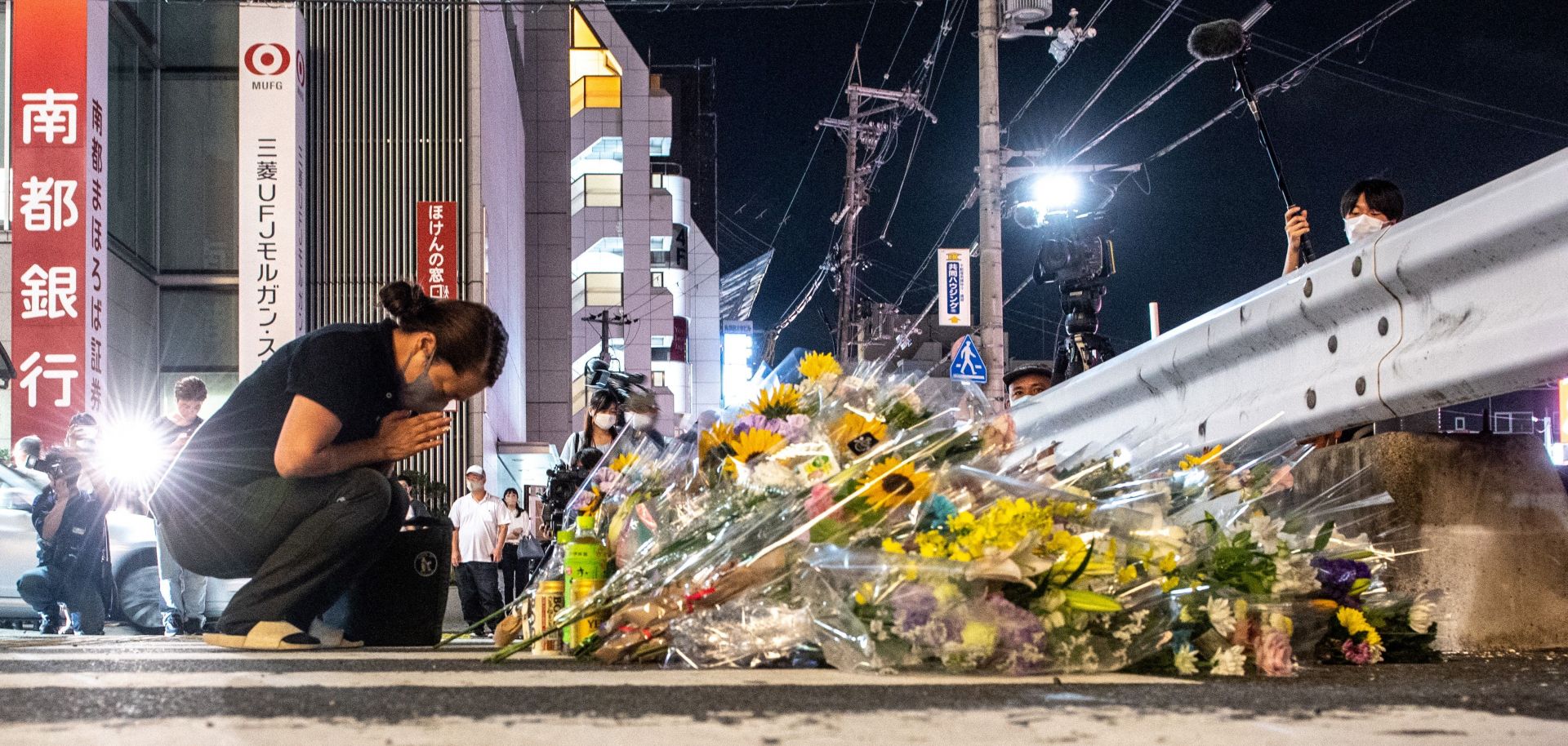
A woman mourns in front of a makeshift memorial outside the train station where former Japanese Prime Minister Shinzo Abe was shot and killed earlier that day on July 8, 2022.
The power vacuum left by former Japanese Prime Minister Shinzo Abe’s assassination could see a cycling in and out of new leaders in his ruling Liberal Democratic Party (LDP). But Abe’s absence is ultimately unlikely to affect the party’s major policy agenda and could, in fact, help the LDP pass more legislation by improving its prospects in upcoming parliamentary elections. On July 8, while giving a speech at a rally at a train station in Nara, Japan, Abe was shot and killed by an attendee. Abe was speaking to give support for LDP candidates ahead of the July 10 upper house elections. The assassin, who was quickly arrested, used a homemade gun and gave no motive for the killing aside from claiming to dislike Abe. Abe stepped down as prime minister in 2020, citing longstanding health issues. But he had remained an influential power broker in the LDP in the two years since leaving office.
- Police identified the assassin as 41-year-old Tetsuya Yamagami, who served in the Japanese Maritime Self Defense Force from 2002-2005.
- Abe held office between 2012-2020. He was Japan’s longest-serving prime minister.
- Abe's death has been met with shock and sadness by many in Japan, where gun violence is extremely rare. Political killings are also relatively uncommon, with the most recent ones being in 2007 and 2002.
The LDP will leverage Abe’s assassination to gain an advantage in the Diet’s upper house ahead of this weekend’s elections, which could enable the party to push through more of its major policy priorities. According to polls conducted prior to the assassination, the LDP’s conservative coalition was already expected to win a supermajority in the upper house. Abe’s death will almost certainly improve these odds, as the LDP will likely use the tragic loss of its leader to generate even more support for its candidates in the July 10 polls. A supermajority in the upper house would enable the LDP to pass key pieces of legislation, like the various constitutional reforms that the party has proposed. Ratifying such amendments, however, would still require a two-thirds majority vote in the lower house of the Diet, where the LDP-led conservative coalition does not currently hold a supermajority.
- In a July 5 poll by Nikkei, the LDP was projected to win 60 out of 125 contested upper house seats. In that same poll, the broader conservative coalition, led by the LDP, was projected to win 83 out of 125 available seats, which would give the LDP the supermajority needed in the upper house to pass legislation like constitutional reforms.
- The LDP has proposed several constitutional amendments. One would enshrine the role of the Japanese Self-Defense Force, which is not mentioned in Japan’s constitution. Another would increase the power of the central government in times of crisis, including natural disasters.
Abe’s death could see Japan return to more revolving-door prime ministers, as competing factions within the LDP scramble to fill the party’s leadership void. The LDP’s largest Seiwa Seisaku Kenkyu-kai faction, formerly led by Abe, will need a new leader. The party as a whole has also lost a major kingmaker, as senior politicians in Japan often influence the country’s leadership makeup even after they step down from office. Abe’s faction could find a new leader or dissolve as its members are absorbed into other factions like the Kochi-kai faction, which is led by current Prime Minister Fumio Kishida. While there are no signs that Kishida plans to step down anytime soon, long-term LDP leadership continuity will remain tenuous in the wake of the assassination — especially given Japan’s history of revolving-door prime ministers (with Abe’s long tenure being the exception). Japan’s next general election is in 2025, but increased competition between LDP factions vying for leadership could see Kishida resign before then, particularly if he feels threatened by the internal power struggles.
Regardless of internal party politics, however, the LDP-led government’s greater policy priorities are highly unlikely to change. When it comes to domestic policy, the LDP’s pro-nuclear platform may somewhat soften in Abe’s absence, as the former prime minister was the party’s most outspoken supporter of building new reactors and restarting old ones. Abe’s successor Kishida is not as not ardently pro-nuclear, but he will still push to restart old nuclear reactors to alleviate Japan’s growing energy crisis, which has seen electricity shortages and skyrocketing prices. Abe had also strongly advocated for advancing the country’s military capabilities and reducing the pacifist constraints of Japan’s post-World War II constitution. The LDP is unlikely to pursue more controversial moves, like removing the article in the country’s constitution that renounces war (which Abe had called for). But in the face of mounting regional threats posed by China and North Korea, Japan’s greater remilitarization will continue relatively unimpeded. For similar reasons, the recent warming of Japan’s relations with South Korea will likely be unaffected. Both Kishida and South Korea’s new President Yoon Seok Yeol have both stated a desire to improve their countries’ economic and security ties to hedge against Chinese and North Korean aggression. Likewise, the risks posed by Beijing’s increasing influence in the Indo-Pacific will continue to drive Japanese re-engagement in the region’s economic development as well.
- Article 9 of Japan’s constitution nominally requires Japan to possess only a defensive military capacity to avoid a repeat of the imperial actions that led to World War II by expressly forbidding “the threat or use of force as means of settling international disputes.” In a poll conducted by Kyodo News in May, 51% of Japanese respondents said they supported amending Article 9 of the country’s constitution to allow for some military action, which is up from 46% in 2021. However, most citizens still do not fully support removing the article.
- A Nikkei poll released in March found that 53% of respondents supported restarting nuclear power plants, compared with 44% in a similar poll released in September. The poll was conducted shortly after a 7.6 magnitude earthquake off the coast of Tohoku knocked six thermal power plants offline.
