
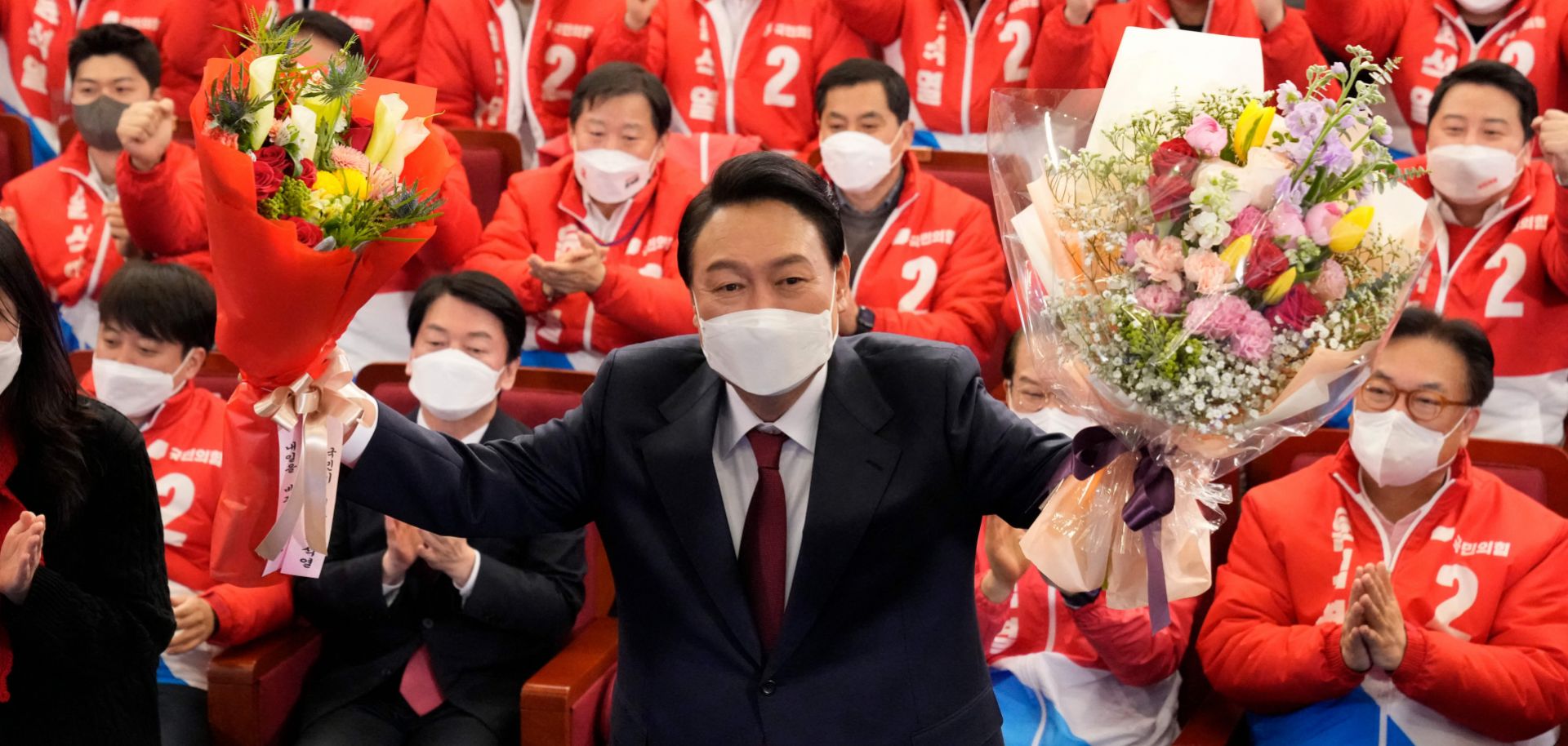
South Korean President-elect Yoon Suk Yeol holds bouquets as he is congratulated by members of his People Power Party at the National Assembly in Seoul, South Korea, on March 10, 2022.
Yoon Suk Yeo's victory in South Korea's presidential election portends warmer relations with Japan and a harder-line approach to North Korea, potentially aiding U.S. security interests in the Asia Pacific region. Domestically, legislative opposition to Yoon's economic deregulation policies could increase the risk of a housing crisis in South Korea. Yoon, a former top prosecutor from the conservative People's Power Party (PPP), was declared the winner of South Korea's presidential election on March 9. The election was a closely fought race to the end, with Yoon ultimately securing 48.6% of the vote against ruling liberal Democratic Party candidate Lee Jae-myung's 47.8%. Yoon's administration will take office in May.
- Yoon's move to merge his campaign with third-party conservative candidate Ahn Cheol-soo on March 3 ultimately appeared to give him the edge by unifying the opposition vote. Ahn will likely be appointed to a high-ranking position in Yoon's incoming administration.
Pushback from left-wing lawmakers in South Korea's National Assembly will impede Yoon's pro-business domestic policy agenda, which means that the risk of South Korea entering a financial crisis will persist. Yoon's campaign platform focused on removing regulations on South Korea's economy and mitigating the skyrocketing cost of housing in the country through market-led solutions. Implementing such policies, however, will be difficult without support from the National Assembly, where lawmakers from Moon's ruling center-left Democratic Party currently control the majority. Yoon's conservative People's Power Party will not have the opportunity to pick up seats in the assembly until the 2024 elections, which will make passing legislation difficult for Yoon in the meantime — especially when it comes to market deregulation, which runs counter to the Democratic Party's policies of greater government intervention. But without swift action to mitigate South Korea's economic issues, Yoon risks not only losing support from South Korea's business community and feeding popular perceptions of government inaction, but triggering a wider housing market crash.
- South Korea's ratio of household debt to GDP is roughly 103%, with the average family in debt 18 times their annual wages. This has put South Korea at risk of a housing market crash that would heavily impact the value of the won and the government's ability to service its own debts.
- South Korea is colloquially known as the ''chaebol'' economy, with large companies like Samsung, Kia and Hyundai driving most of the foreign interest. However, around 80% of workers in the country are employed by small and medium-sized enterprises (SMEs).
- Yoon's push to remove bureaucratic red tape on market activity may open up faster financing for SMEs, easing the burden on businesses and investors to gain capital. Yoon has also criticized current President Moon Jae-in's policies aimed at aiding small businesses during the COVID-19 pandemic as weak and inefficient, gaining him support from the business owners and some investors.
When it comes to foreign policy, Yoon will have greater freedom to pursue his goals of strengthening South Korea's ties with the United States and Japan, which may in turn cool Seoul's relations with China and North Korea — altering the security dynamic and U.S. interests in the region. On the campaign trail, Yoon pledged to improve South Korea's traditional alliances and defense partnerships with the United States and Japan (Washington's other key regional ally) in order to hedge against a rising China and recalcitrant North Korea. This suggests the incoming Yoon administration will give the U.S.-led security push to curb Chinese influence in the region a higher priority than the current Moon administration, which has focused on improving relations with Beijing as a means to keep a dialogue open with North Korea. The United States, for its part, is likely to welcome any increased cooperation between Japan and South Korea, which will free up the U.S. forces in the region to pursue other objectives rather than constantly being the bridge between the two nations. Regardless of its security concerns, however, the Yoon administration's ability to take a tougher stance on Beijing will still be limited by its need to also maintain cordial economic ties with China, which is South Korea's largest trade partner (South Korean exports to China rose 22% in 2021 to a record $163 billion). Additionally, the ongoing Russia-Ukraine conflict will see South Korea continuing to work with the United States, while also trying to avoid alienating Moscow as a new strategic partner in Seoul's outreach to North Korea.
- During a televised debate with his opponent Lee before the election, Yoon said he would meet first with U.S. President Joe Biden, followed by Japanese Prime Minister Fumio Kishida, Chinese President Xi Jinping and North Korean leader Kim Jong Un.
- The United States has been slowly transferring operational control (OPCON) to the South Korean Armed Forces for over a decade, giving Seoul new military autonomy and increasing responsibility for its own defense. Yoon may seek to slow this transfer to maintain U.S. forces on the peninsula as a deterrent against North Korean aggression.
- Yoon is likely to pursue swift development and deployment of missile defense systems around the peninsula in response to the new North Korean conventional threat. Such systems will almost certainly perturb Beijing and could trigger Chinese economic coercion in the form of goods boycotts or accelerated customs scrutiny.
