
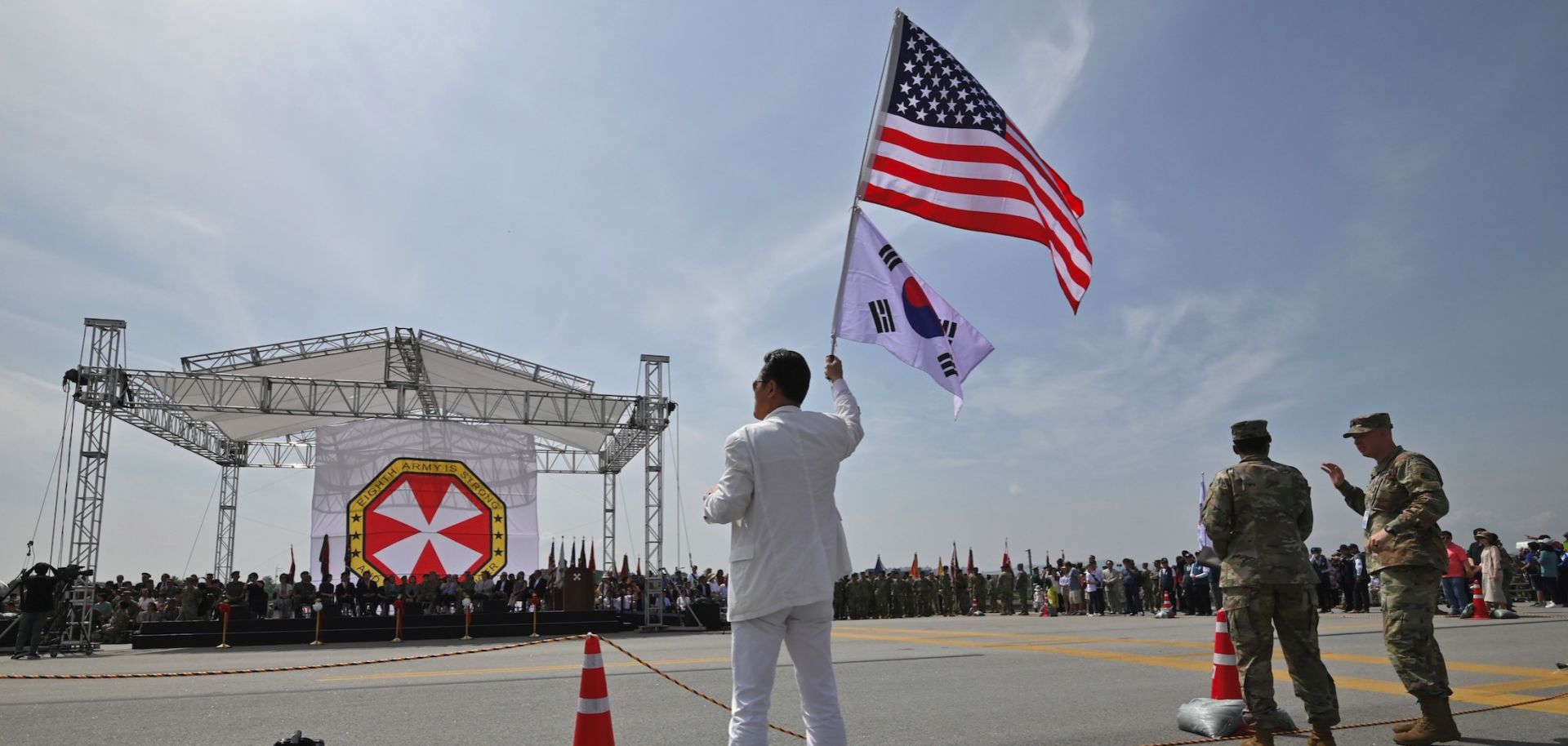
A man waves U.S. and South Korean flags during a military ceremony in June 2019.
The completion of a long-term, military cost-sharing deal resolves a point of tension between the United States and South Korea, signaling a renewed U.S. emphasis on regional allies. But it still leaves thornier bilateral defense issues and shifting U.S. priorities in the region, which will change the U.S.-South Korea defense relationship over the next ten years. On March 8, U.S. and South Korean negotiators reached an agreement in principle on the renewal of their military cost-sharing Special Measures Agreement (SMA) after three successive days of talks in Washington, South Korea's Foreign Ministry announced March 8. The U.S. State Department said on March 7 that the agreement would extend through 2025 and include a "meaningful increase" in South Korea's share of the expenses to support U.S. troop deployments in the country.
- Although the full details have not been released, earlier leaks indicated that as part of an effort to smooth over ties with South Korea, the Biden administration was willing to accept a 13% increase in South Korean contributions over the previous $925.3 billion agreement. If confirmed, this is far short of the administration of former U.S. President Donald Trump’s reported hardline push for a fivefold increase to $5 billion per year.
- As part of a global push to increase the military burden-sharing of allies, Trump had pressured South Korea to substantially expand its contributions. A one-year 2018-2019 agreement expired and gave way to over a year of fruitless talks that saw South Korean personnel furloughed for three months from April before Seoul offered $200 million in stopgap funding.
- On Feb. 17, a U.S.-Japan cost-sharing agreement was reached on their deal expiring in March that extended the current agreement to April 2022. The deal didn’t change the $1.9 billion in annual Japanese contributions to allow time for negotiations on a longer pact. The Trump administration had reportedly been pushing for an annual payment of $8 billion.
Inking this cost-sharing deal, however, was relatively easy compared with ongoing thornier discussions on issues, such as South Korea’s desire to regain wartime control of its armed forces from the United States. With around one year before South Korea’s next presidential election, such talks will be highly politicized given the internal divisions in South Korea between progressives favoring greater military independence and conservatives focused on continuity in the U.S. alliance.
- Before the March 2022 presidential election, the administration of President Moon Jae-in aims to regain Operational Control Authority (OPCON) from the United States, which would allow the South Korean government to control its military during wartime in contrast to the current arrangement in which such forces would be led by a U.S. general. The progressive arm of South Korean politics sees this as necessary to allow greater latitude in dealing with North Korea.
- The United States, however, may hesitate to make sweeping changes in OPCON given the continued North Korean threat amid the stagnation in the U.S.-North Korea outreach on denuclearization — a factor that former Chairman of the Joint Chiefs of Staff, Gen. Joseph Dunford, said in 2018 could allow for a drawdown during progress with Trump's outreach to North Korean leader Kim Jon-un.
The precise nature of the U.S.-South Korea defense relationship is still in flux. While the United States will continue to focus on South Korea as a key regional partner, it may shift away from massive troop deployments on the Korean Peninsula in favor of flexible and mobile troop deployments with greater standoff distance from the Asian mainland, with a particular focus on Japan.
- With countering China's regional rise firmly established as the key U.S. objective in the Indo-Pacific, Japan offers greater latitude for the U.S. military to maneuver without the liabilities of South Korean troop deployments, which are costly and leave U.S. personnel in the line of fire in the event of a deterioration in North Korean relations.
- On March 8, Biden’s nominee for undersecretary of defense for policy, Colin Kahl, told the Senate Armed Services Committee that the U.S. troop numbers in South Korea were not fixed and pointed to Biden's pledge to carry out a global posture review to realign military deployments with the global threat environment.
- On March 5, U.S. leaks indicated long-term plans to station precision-strike missiles along the so-called “first island chain,” which geographically runs from Japan through Taiwan to the Philippines, as part of the $27.4 billion Pacific Deterrence Initiative military fund that aims to counter Chinese regional clout.
