
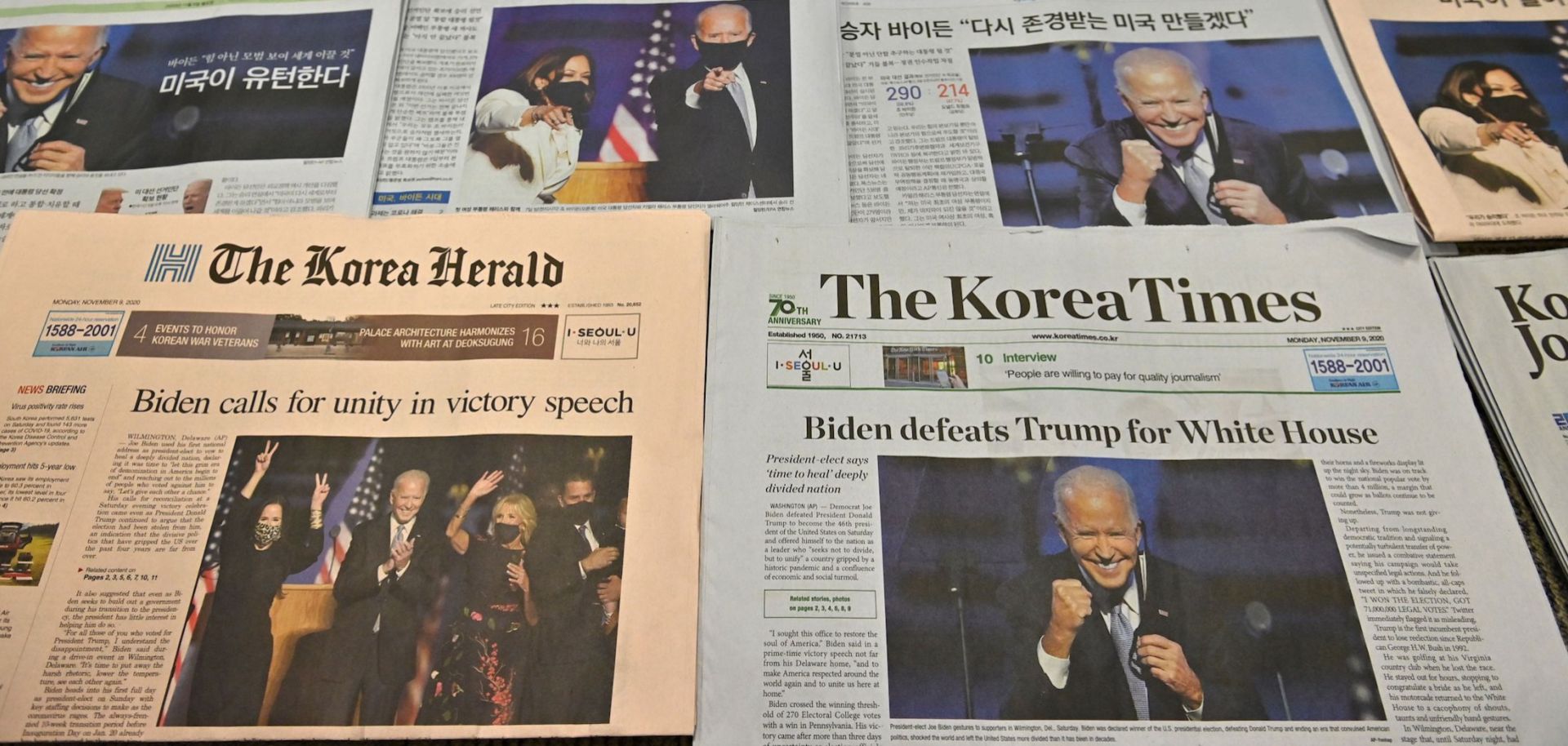
Photos and stories of U.S. President-elect Joe Biden dominate the headlines on the front pages of newspapers in Seoul, South Korea, on Nov. 9, 2020,
South Korea is seeking to quickly establish a dialogue with U.S. President-elect Joe Biden in an effort to strengthen its position in U.S. priorities and influence U.S. policies toward the Korean Peninsula. A day after personally congratulating Biden and U.S. Vice President-elect Kamala Harris on Twitter, South Korean President Moon Jae-in stated Nov. 9 that he would establish joint communications with the incoming administration to avoid any “vacuum” in bilateral relations. Moon’s actions reflect both optimism and concern with the impact of a changing U.S. administration on Seoul’s own priorities.
Once Biden takes office in January, the most immediate concern South Korea will seek to address is the current stalemate over defense sharing payments. Outgoing U.S. President Donald Trump had demanded a massive increase in Seoul’s spending, with a tacit threat to reduce the U.S. troop deployments on the peninsula if South Korea didn’t accede. Biden has said he would not make such demands, and his administration would probably seek an early resolution with a moderate increase in Seoul’s payments. Nonetheless, as the United States continues to reprioritize its international commitments and overall capacity in order to achieve the ideal defense posture, Washington will continue to review the viability of large overseas basing, including that in South Korea and Japan.
Seoul is also concerned that a Biden administration may be less likely to engage in bold initiatives with North Korea, and Moon’s quick congratulatory tweet probably reflects a desire to gain early input into any new U.S. policy direction Biden may pursue with Pyongyang. The Moon administration has pursued an engagement policy with North Korea, which was briefly bolstered by Trump’s direct talks with Kim Jong Un. But the collapse of those personal-level talks in the first half of 2019 prompted North Korean leaders to rethink their overall strategy. Pyongyang has since largely shuttered dialogue with South Korea, going so far as destroying the inter-Korean liaison office building established in Kaesong in June.
The South Korean government is hoping a Biden administration will be less critical of its economic and trade policies, as well as more open to increasing cooperation in the semiconductor and green technology industries, given Biden’s pledge to rejoin the Paris climate agreement. While South Korea inked a revised trade agreement with the Trump administration, it has also been the target of criticism from the current White House, leaving it caught economically between the United States and China. Managing this balance will become a central theme in early talks between Seoul and the incoming Biden administration.
- Shortly after taking office in 2017, the Moon administration agreed to deploy the U.S.-made THAAD anti-ballistic missile system. But the South Korean government feels it hasn’t received the economic or political benefits in return to counteract the impact of such actions on its relations with China.
Ongoing tensions with Japan mean South Korea will also be competing with Tokyo for prominence and influence in Washington’s Asian dialogue. Japan has stepped up its economic, diplomatic and military relations around the region, often in line with U.S. priorities. South Korea, however, has taken a more cautious approach, particularly on the defense side, due to its concerns with North Korea and with the impact on its ties with China. Even with Moon’s early engagement with the Biden administration, this reality will be difficult for Seoul to overcome. Indeed, Japanese Prime Minister Yoshihide Suga also quickly took to Twitter to congratulate Biden on his victory, getting a head start on ensuring Tokyo’s voice is clearly heard by the next U.S. administration as well.
