
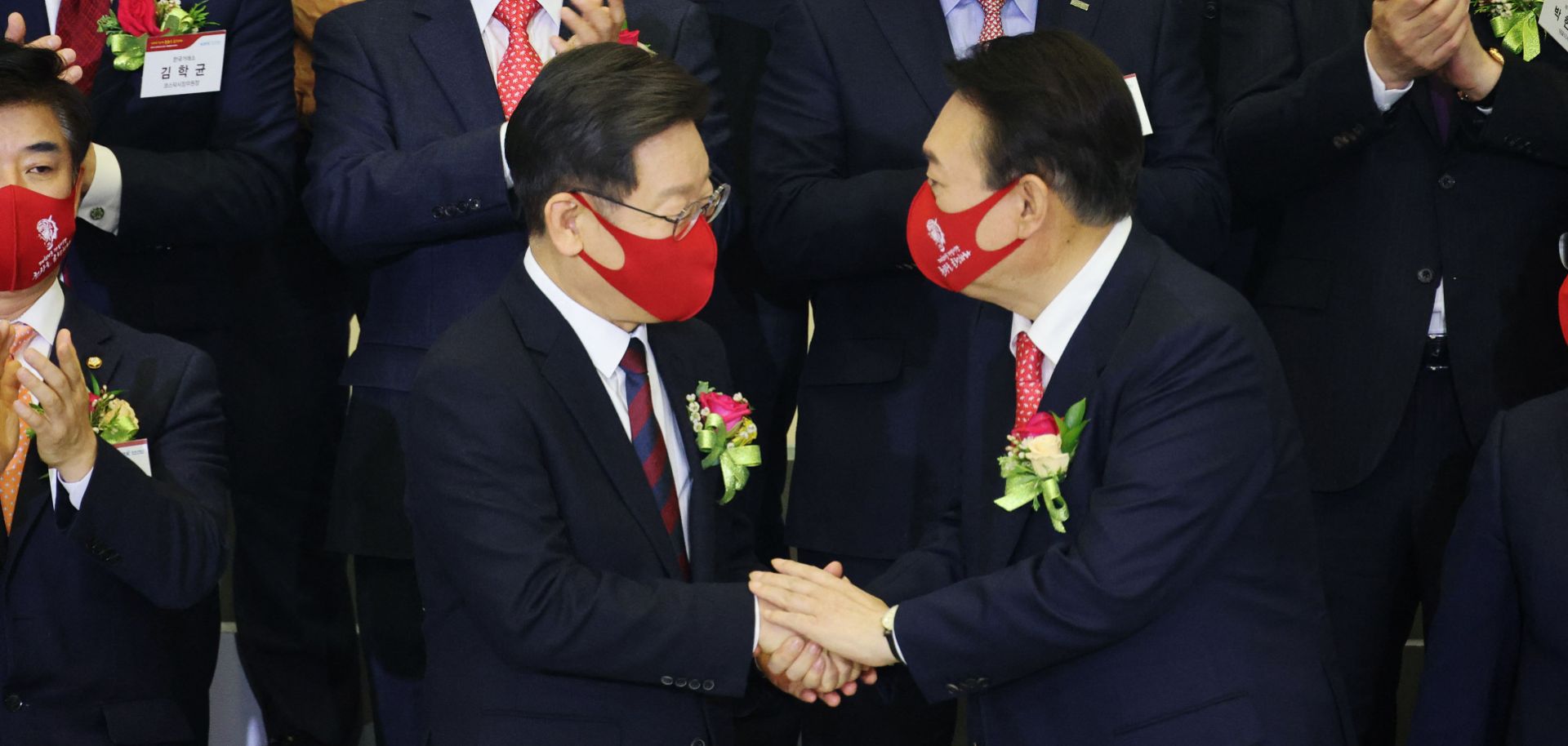
Yoon Suk Yeol (front right), the presidential candidate for South Korea's main opposition party, shakes hands with the ruling party’s candidate, Lee Jae-myung, in Seoul on Jan. 3, 2022.
South Korea’s upcoming presidential election could see sweeping changes to the country’s domestic and foreign policy due to the main candidates’ divergent views on how to address pressing economic issues and balance Seoul’s relations with China and the United States. On Feb. 15, the campaign period officially kicked off for South Korea’s March 9 presidential election. The top two candidates are Lee Jae-myung from the ruling center-left Democratic Party of Korea (DPK) and Yoon Suk Yeol from the conservative People’s Power Party (PPP), who are each currently polling at around 35-40%. Lee supports government-led economic development and a foreign policy agenda that prioritizes maintaining dialogue with North Korea and China. Yoon, by contrast, supports more market deregulation and a foreign policy agenda that focuses on building a stronger security alliance with Japan and the United States.
- Ahn Cheol-soo from the conservative People's Party is in the third position with roughly 10% support. While Ahn is unlikely to win the election, his continued involvement in the race threatens to pull votes away from Yoon. If, however, he merges campaigns with Yoon (as Ahn has requested), it could give the conservatives a significant advantage in the race.
When it comes to domestic policy, Lee is more likely to opt for greater state intervention to address hot-button issues like income inequality and affordable housing, while Yoon is more likely to take a “hands-off” approach to such market issues with a greater focus more on fiscal consolidation measures. Housing prices in South Korea have skyrocketed in recent years, upwards of 100% in parts of Seoul since 2017. Wages, however, have largely stayed stagnant. This combination is causing people to delay having children or decide not to have them at all. South Korea now has one of the world’s lowest birth rates and is expected to have one of the oldest populations by 2050, which will strain government resources and leave many jobs unfulfillable by the domestic workforce. In addressing these pressing economic issues, Lee has proposed further increasing the country’s minimum wage and providing South Koreans with a small basic universal income each year. As president, Lee is also more likely to expand current housing subsidies, which could saddle the government with increasing debt in the future. Yoon, by contrast, is against substantially raising the minimum wage and, if elected president, would likely seek to implement the PPP’s fiscally conservative policies. Compared with Lee, Yoon is also much less likely to push housing subsidies.
- The current administration of President Moon Jae-in significantly increased the minimum wage for 2022 to 9,160 won ($7.70) per hour, which many working-class citizens and students have celebrated. But some frustrated small business owners have argued such mandated wage increases further strain their already tight margins.
When it comes to foreign policy, Lee would likely continue Moon’s dialogue-based approach to North Korea and China, while Yoon would likely shift South Korea toward a triangular security alliance with the United States and Japan. Like past conservative presidents, Yoon’s foreign policy agenda would likely focus on bolstering Seoul’s ties with Washington and Tokyo to achieve a stable regional security environment. Cozying up with the United States, however, would cool South Korea’s relations with Beijing and potentially keep Pyongyang away from the diplomatic talks. Lee, on the other hand, is likely to favor a balancing act between China and the United States to avoid picking a side in the two geopolitical powers’ growing rivalry. He’s also likely to continue Moon’s policy of inviting North Korea to the negotiating table without preconditions, leaning on Beijing as another avenue to pressure Pyongyang into diplomatic talks as needed.
- Lawsuits against Japanese firms like Mitsubishi in South Korea have contributed to fraying the two countries' diplomatic ties since 2018. Yoon may pressure authorities to drop the suit, which would ameliorate Tokyo, while Lee may support these suits, which would cool relations with Japan and widen the rift between the two nations.
- In response to North Korean missile tests, Lee has called for dialogue and talks while Yoon has called to deploy more THAAD batteries, a highly controversial missile defense system. Consumers in China boycotted Korean department stores after South Korea first deployed THAAD batteries in 2017. Another deployment would further strain Beijing and Seoul’s security relationship.
