
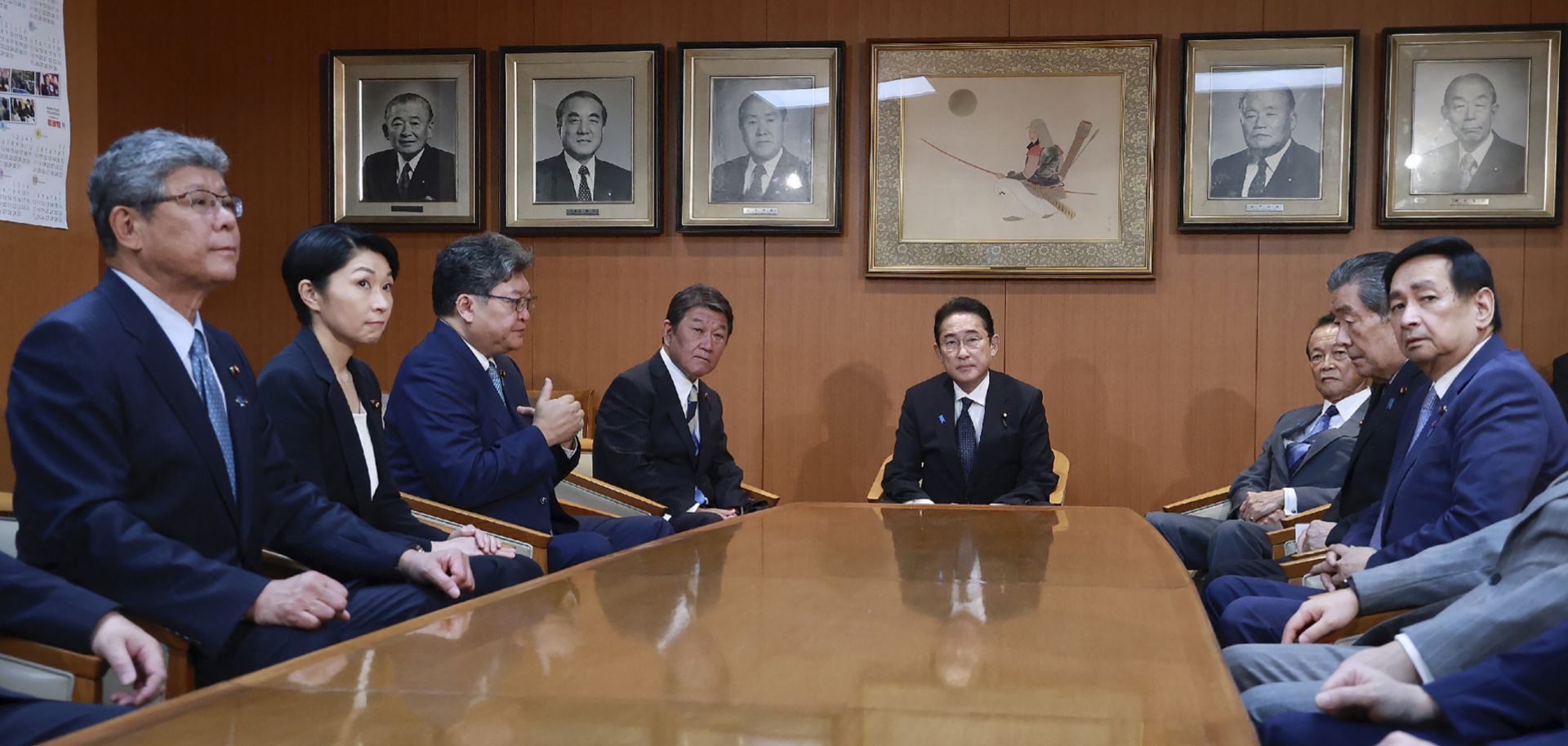
Japanese Prime Minister Fumio Kishida's Cabinet reshuffle and impending stimulus could expedite a snap election, bolstering his Western-facing security agenda and economic policies. Stimulus could also accelerate Kishida's plans to regain control over Japan's monetary policy. Kishida on Sept. 13 revealed 11 new members of a 19-member Cabinet, including five women (up from two previously), as well as new defense and foreign ministers. He also kept a mixture of figures from the ruling Liberal Democratic Party's (LDP) four largest factions in both his Cabinet and LDP party leadership itself. Much of the economy-related portfolios remained the same, including the finance and industry ministers, as well as the minister in charge of economic security. However, Kishida replaced Economic Revitalization Minister Shigeyuki Goto, formerly of the finance ministry (known for its budgetary prudence), with Yoshitaka Shindo, former vice minister of the economy and industry ministry.
- Kishida is balancing LDP and Cabinet leadership roles between the large but rudderless Abe faction, the second-largest faction under Vice President Taro Aso, the third-largest faction under LDP secretary-general Toshimitsu Motegi, and Kishida's fourth-largest faction.
The Cabinet reshuffle and Kishida's upcoming economic stimulus plan may give him the confidence to call a snap election, enabling him to deepen Japan's Western-oriented security policy and pursue his "New Capitalism" policies at home. With this new Cabinet, Kishida hopes to wield an economic stimulus plan, due to be released in October, to boost both his own support within the LDP and the LDP's support among the public. The plan, which follows a $43 billion stimulus from April and is likely to include tax relief and subsidies for food and gasoline purchases, is aimed at alleviating cost-of-living concerns. If it proves to be popular among voters, this stimulus could give Kishida the confidence to call the snap election he was rumored to be contemplating in May before his support rate tanked. If all goes according to Kishida's plans, this snap election would help the LDP coalition maintain its majority in both houses of the National Diet by limiting governing partner Komeito's potential loss of seats to the rising conservative opposition Japan Innovation Party. An early election with a strong LDP performance would enable Kishida to continue pursuing his key policy of strengthening military ties with South Korea and the United States in order to counter Chinese and North Korean security threats. Kishida's ability to work toward his "New Capitalism" policy, which aims to reduce wealth inequality through targeted wage growth, would also improve. However, if Kishida's stimulus fails to bolster support, he is likely to avoid a snap election rather than jeopardize his LDP leadership role.
- The Cabinet reshuffle follows a series of recent policy failures, including the rollout of the My Number national ID system, which was plagued by data privacy issues related to provisions of social services. It also follows a scandal involving Kishida's son using the official residence to host a party and a failure to address cost-of-living concerns as core inflation continues to surpass wage growth.
- These missteps have caused Kishida's support to drop significantly since hosting the May Group of Seven summit in Hiroshima. Approval for his Cabinet dropped from 47% in late May to 33% in late August before rebounding somewhat to 39.5% as of Sept. 14, following his Cabinet reshuffle.
Regardless of its electoral effect, the stimulus package may accelerate interest rate hikes by the central bank and raise the prospect of unpopular tax hikes and spending cuts. The inflationary effects of economic stimulus could accelerate the Bank of Japan's plan to transition away from ultra-loose monetary policy, allowing the central bank to more actively manage inflation and economic growth. Debt-based stimulus packages would raise the necessity of unpopular tax hikes and/or spending cuts, in order to keep national debt sustainable. These moves would pose yet another obstacle to Kishida's popularity and that of the ruling LDP, highlighting the importance of correctly timing the snap election, preferably before Kishida enacts such unpopular budgetary measures.
- Kishida proposed tax hikes in December 2022 to fund a $300 billion expansion in Japan's defense spending over the next five years in order to achieve Tokyo's goal of increasing defense spending from 1% to 2% of gross domestic product by 2027. But at the time, 84% of Japanese opposed this justification for a tax hike, and Kishida has since delayed the tax hike until an "appropriate time in or after 2024."
