
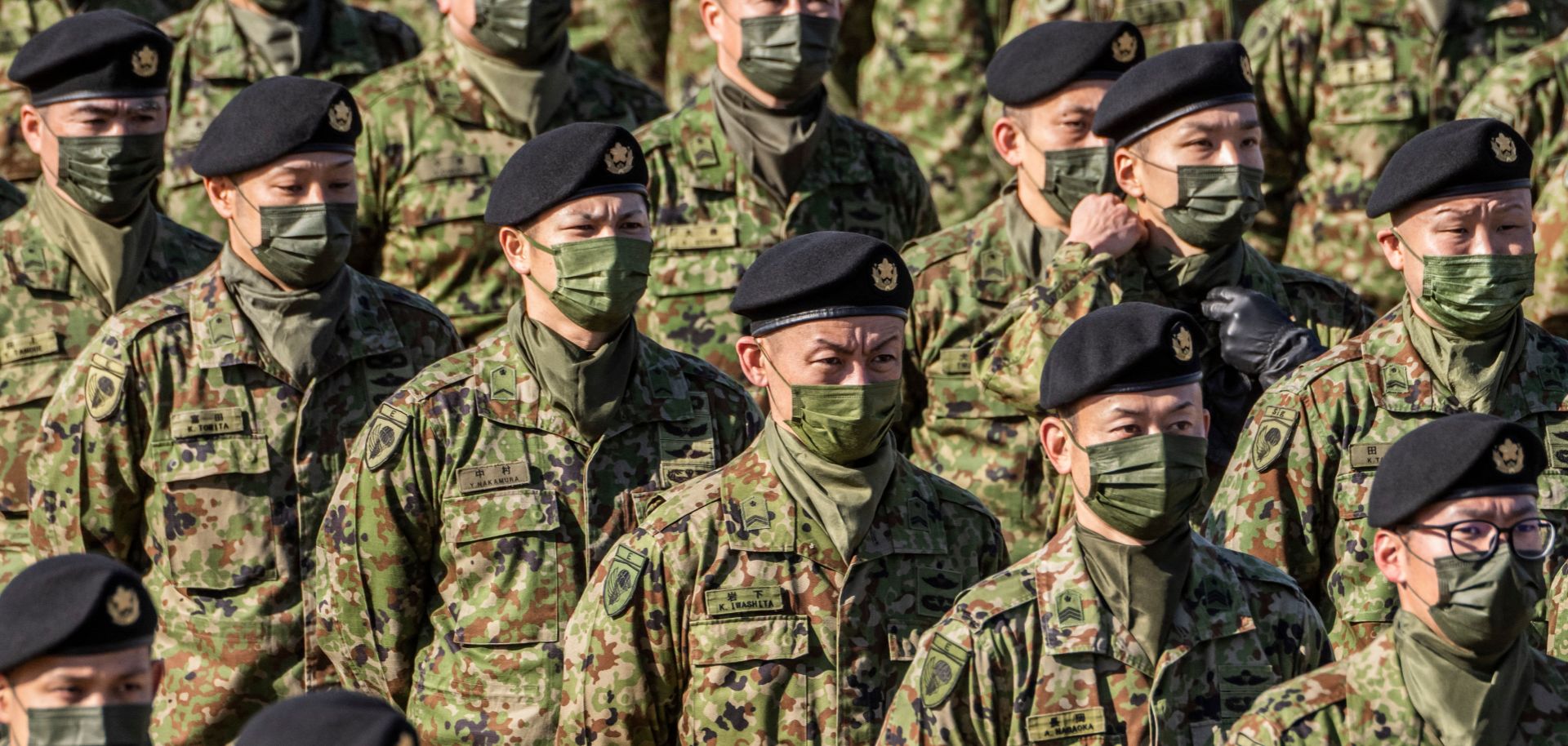
Members of Japan's Self-Defense Force stand in formation during the defense minister's speech following a joint military exercise with U.S., U.K. and Australian troops in Funabashi, Japan, on Jan. 8, 2023.
Japan's record defense spending push marks the next phase of a decades-long ''normalization'' push to bring its military capabilities on par with those of its peers in response to growing regional threats. On Dec. 16, the Japanese government, led by Prime Minister Fumio Kishida, announced a massive increase in defense spending, going from roughly 1.1% of GDP to 2% of GDP by 2027. Tokyo will spend roughly $320 billion over five years, and the defense budget will reach roughly $80-90 billion by 2027 — placing Japan third in the world for defense spending, behind only the United States and China (assuming other countries don't also ramp up their defense budgets in the coming years). The announcement is the culmination of decades of work by various leaders in the ruling Liberal Democratic Party, including former Prime Minister Shinzo Abe, to create a more robust defense structure and enable Japan to take greater responsibility for its own security without needing to completely rely on the United States.
- On Dec. 16, the Japanese government announced three updated documents, the National Security Strategy (NSS), the National Defense Strategy (NDS) and the Defense Buildup Program (NBS), which will enable the Japanese to preemptively strike enemy bases/territory.
- On Dec. 16, the Japanese government announced that it will acquire 500 Tomahawk cruise missiles from the United States, which have a range of up to 1,000 miles (1,600 km). Tokyo also announced that it will develop hypersonic missiles that are meant to evade radar and counter missile batteries.
Japan is not ''remilitarizing,'' but rather returning to normal state activities that were interrupted after World War II. International media outlets have been labeling Japan's increased defense spending as ''remilitarization,'' which implies a return to a pre-WWII form of militarism, regional imperialism, and a potential threat of war. This, however, is an inaccurate description of the current situation. France and Germany, for example, are also increasing their defense budgets to 2% of GDP, and yet there are no worries about Paris and Berlin going to war. Additionally, acquiring preemptive strike capabilities, and overhauling the Japanese Self-Defense Force to have a unified command structure for all branches is exactly how every state military functions. Therefore, this is a resumption of normal state activities that Japan interrupted in the 1950s — specifically through Article 9 of its post-World War II constitution, which denies Tokyo the right to form a military and has, in turn, significantly constrained Japan's ability to defend itself and its interests. There are other countries that lack a traditional military force, like Costa Rica. Those countries, however, are much smaller than Japan and do not have a belligerent neighbor (i.e. North Korea) threatening to attack. By increasing its defense budget and military capabilities, Japan is not necessarily preparing for an imminent war, but rather ensuring it can be more proactive in enforcing its maritime territory against North Korean (and Chinese) threats without needing the United States' sign-off on every action, like every other ''normal'' sovereign nation.
- Japan does not have a traditional military, only the Japan Self-Defense Force, in accordance with Article 9 of the country's constitution. The article renounces the right to belligerency (war) and nominally requires Japan to possess only a defensive military capacity to avoid a repeat of the imperial actions that led to World War II by expressly forbidding ''the threat or use of force as means of settling international disputes.''
- Japan is currently the only country in the world that has given up the right to declare war.
- According to the CIA, there are over 30 countries without a traditional military. However, in those countries, the police or coast guard performs basic military functions like border patrols and enforcement.
Increased threats from China and North Korea are pushing Japan to accelerate its long-held goal of becoming more militarily independent and reducing its reliance on the United States. Japan has slowly been developing its offensive capabilities since the United States pulled the rug out from under the Japanese economy in the 1980s by imposing trade restrictions on Japanese exports (namely automobiles). This period not only highlighted Japan's overreliance on the U.S. market, but left Japanese leaders unsure of whether they could count on Washington to consistently operate in Japan's best interests. In recent years, those fears have only grown in tandem with Chinese and North Korean aggression by making Tokyo increasingly concerned about whether the United States would be willing to fully commit to defending Japan — especially against a nuclear-armed country like North Korea.
- Up until recently, China and North Korea were not threats to Japanese sovereignty, as China was not developed enough, and North Korea was primarily concerned with the potential for a peninsular conflict. Current Japanese leadership is able to use the increasing threats from North Korea and the potential for Tokyo to be pulled into a Taiwanese conflict to justify the increase in defense spending, whereas those threats did not exist before.
- In 2022, North Korea launched over 50 ballistic missiles that landed in the waters between Japan and North Korea, conducted one overflight of Japan with an intercontinental ballistic missile on Oct. 4, and increased the bellicose rhetoric labeling Japan an enemy.
- In the 1980s, the United States imposed trade restrictions on Japan. This included a voluntary export restraint that limited the number of Japanese cars that could be exported to the United States to just over 1.5 million cars from 1981 to 1994.
Tokyo will use its bigger budget to stimulate its domestic defense and construction industries, which could bring jobs to and revitalize rural towns. This will be a major economic and policy victory for the LDP, which could eventually help the ruling party secure enough support to remove Article 9 of Japan's post-war constitution. The LDP ultimately wants to remove the pacifist article from Japan's constitution, but it currently lacks the legislative and popular support needed to ratify such an amendment. The boosted defense budget, however, will help the LDP work toward that end goal by enabling the party to advance its economic agenda. The massive increase in military spending, in particular, will invigorate Japanese defense industries, such as the fighter jet program and shipbuilding. Major construction projects will also be required to take place outside of Tokyo and other major urban areas, building infrastructure and new military installations away from major civilian populations. As a result, investment in rural areas will increase as businesses and other industries develop to support the local military community, similar to how communities form around U.S. military bases abroad. This will help achieve the Japanese government's goal of de-urbanizing the country and revitalizing rural areas with young families and businesses. Combined with other policies, it could also garner more popular support for the LDP so they may seek to amend the constitution and remove Article 9 shortly following the next general election in 2025. However, poor economic growth or a greater worsening of Japan's economic outlook could hurt the LDP. And if the party loses seats in the next general election, it is highly unlikely that any constitutional amendments will be tabled.
- On Jan. 3, the Japanese government announced plans to triple the financial incentive to 1,000,000 yen ($7,500) per child for families that relocate from Tokyo to rural areas, as part of an effort to repopulate rural areas and incentivize couples to have children.
- Amending Japan's constitution to remove Article 9 would require a two-thirds majority vote in both houses of the Japanese Diet, as well as a simple majority vote via popular referendum. Currently, the LDP has 58% control in the House of Councillors and 63% in the House of Representatives. Public opinion, however, remains split over whether to remove the pacifist article from the constitution. It will be difficult to convince opposition party lawmakers to back the referendum, so the LDP must make some gains in the next general election to secure legislative dominance.
Abroad, Japan's increased defense spending will exacerbate its already fraught relationships with North Korea and China. Japan has traditionally been an insular country with a small military force. Any increase in Japan's military strength will thus be met with concerns from its neighbors by fundamentally changing the security status quo in the region, with China and North Korea being the most upset. Beijing will oppose Tokyo's moves to build up its defense capabilities, which will primarily be aimed at boosting Japan's capacity to counter China (such as defending the Senkaku Islands against a possible Chinese incursion or supporting the United States and Taiwan against a Chinese attack). If Japan engages in something that China views as unacceptable (such as a missile defense shield that abuts Chinese territory, or a trilateral military alliance with the United States and South Korea), Beijing will likely also sanction Japanese firms like Toyota to block them from accessing China's massive market. North Korea, meanwhile, will respond with angry rhetoric, along with an uptick in provocative missile tests and potentially further overflights of the Japanese mainland with ballistic missile tests. Pyongyang will also invoke imagery of the Imperial Japanese Army in an effort to pull South Korea away from Japan, which will escalate tensions in northeast Asia and further increase the likelihood of North Korea conducting more missile tests over Japan.
- Russia, for its part, will be ideologically opposed to an increase in Japanese military spending. But Moscow will continue to be distracted by the conflict in Ukraine and will not have the capacity or desire to step up antagonism against Japan.
But it will improve Japan's relationships with the United States, Taiwan, South Korea, the Philippines and Australia — all of whom will welcome another active player with similarly aligned regional security interests. Increased Japanese military spending means it will upgrade its naval forces to use on security patrols and strike new weapons contracts, which open the door to more bilateral arms development. This will help bring Japan out of its isolationist shell and give the country viable areas to cooperate with like-minded countries on maritime security activities, namely fishing rights and freedom of navigation. The United States will welcome a more militarily capable Japan, which will ease Washington's security burden in the region, namely against North Korea. South Korea and especially Taiwan will also welcome any increase in Japanese military spending that can help hedge against China and North Korea. The Philippines, meanwhile, will welcome Japan as a potential partner in maritime security activities and foreign direct investment. Australia will welcome any player who helps lessen its future maritime security burden in the region as Canberra ramps up its own maritime activities to support and utilize nuclear submarines under the AUKUS agreement.
- As long as South Korean President Yoon Suk Yeol and his conservative party remain in power, Seoul will hesitantly welcome Japan's push to build up its military, which will help secure the South Korean flank and provide an additional partner to hedge against North Korea.
- Taiwan will look to strike defense equipment sales or joint production to secure access to Japanese goods or defense equipment. This will further lock in Japanese involvement in any conflict over Taiwan, even if it is just supplying arms and defense equipment.
- The Philippines will welcome any third party in the mix as it balances between China and the United States, which means it will play more countries off each other in a bid to maximize trade deals and concessions with all three countries.
