
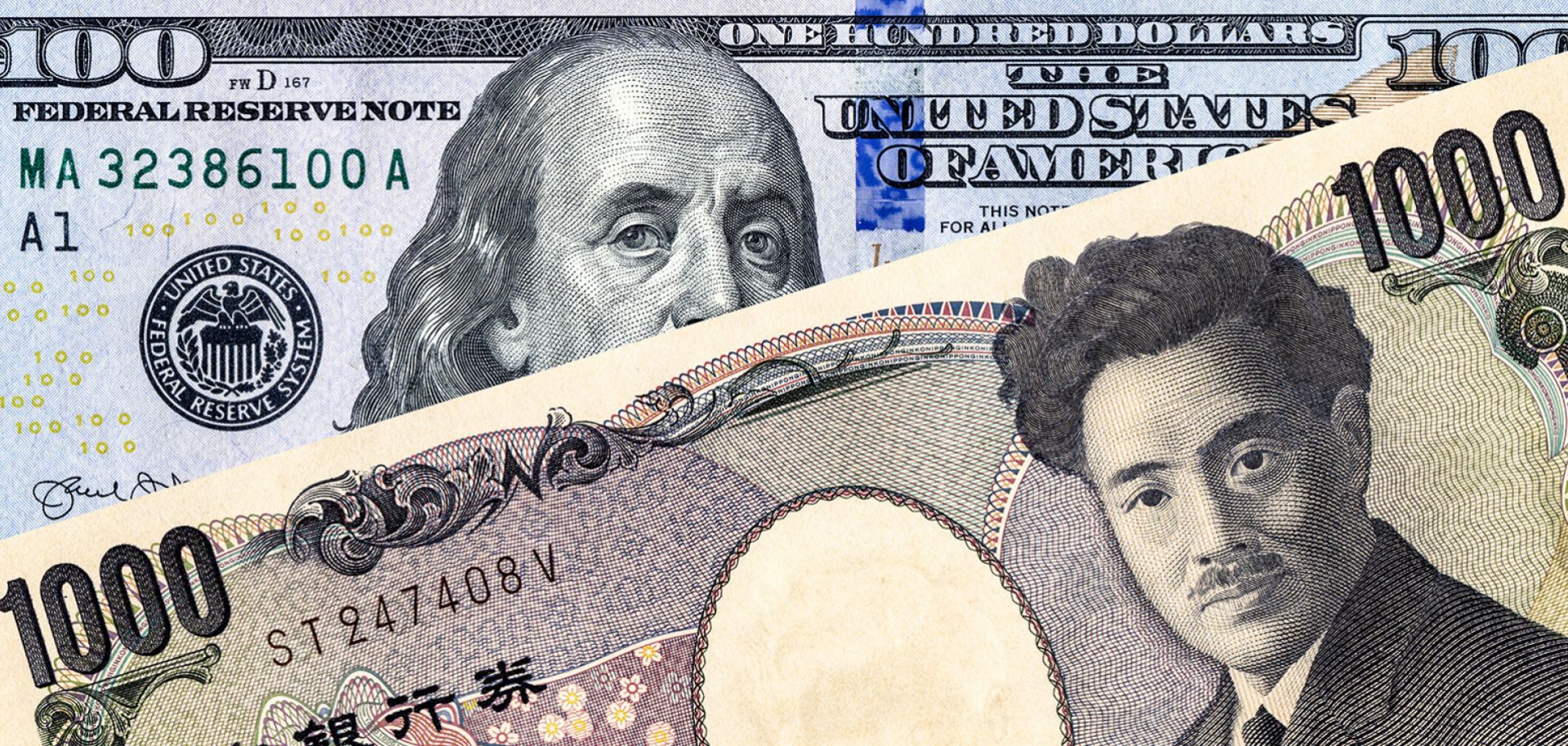
A photo illustration shows a banknote of the Japanese yen overlapping a banknote of the U.S. dollar.
Efforts by Japan's central bank to prop up the yen against the U.S. dollar will result in public backlash and weaker support for the Japanese government, threatening long-term policy continuity. On Sept. 22, the Bank of Japan (BOJ) intervened in the foreign exchange market by buying yen and selling dollars for the first time in 24 years. The yen-to-dollar rate subsequently slid after BOJ Gov. Haruhiko Kuroda remarked that the bank did not intend to adjust short-term interest rates from the current rate of -0.1%, and Finance Minister Shunichi Suzuki said this intervention was necessary to stabilize the market. Despite the intervention, the yen only briefly strengthened to 142 yen to one U.S. dollar before rising again to roughly 145 yen to the dollar on Sept. 26.
- Shortly after the announcement, the U.S. Treasury Department acknowledged the intervention but did not endorse the move, saying it "under[stood] Japan's action, which it states aims to reduce recent heightened volatility of the yen.'' This statement indicates that the U.S. Treasury does not view the BOJ's actions as attempted malicious currency manipulation.
- The yen's value has dropped by 21% compared with the dollar this year to its lowest point of 146 yen to one U.S. dollar.
The BOJ's recent intervention is not a long-term solution to the yen's declining value. The yen is depreciating vis-a-vis the U.S. dollar because the U.S. Federal Reserve is hiking interest rates in an effort to tame inflation. In response to the Fed's rate hikes, many people are investing their money in U.S. banks because of the guaranteed rate of return, and the correlating lack of investment in yen-denominated assets is exerting further downward pressure on the yen. This decline will force the BOJ to either continue selling dollars/dipping into its foreign exchange reserves or consider raising interest rates. The BOJ has traditionally refused to raise interest rates since they dropped below zero in 2016 (despite some public and political pressure to do so) because the bank is concerned that doing so could exacerbate deflation. However, raising interest rates is the only long-term tool the BOJ can use to address the yen's declining value in comparison with the U.S. dollar.
- U.S. Fed Chair Jerome Powell on Sept. 21 announced another 75-point hike that raised the key interest rate to 3.25%, and he signaled that there will be a further 125 basis point hike by the end of 2022.
- As of August 2022, Japan has roughly $1.3 trillion in foreign exchange reserves.
- Japanese inflation has hovered between -1.0% and 1.5% since 2015, and one of the BOJ's primary goals is to achieve sustained levels of healthy inflation.
Regardless of the BOJ's course of action, there will be political backlash against the Japanese government and legislatures, which could risk support for other contentious policies. Japanese Prime Minister Fumio Kishida and the governing Liberal Democratic Party (LDP) are already struggling with extremely low approval ratings, which will dip further due to the BOJ's efforts to stabilize the value of the yen. If the BOJ decides to raise interest rates for the first time in 10 years, either before the end of 2022 or at the start of 2023, it will dampen domestic consumption, which is the opposite of what Tokyo has been encouraging as a means of stimulating economic recovery. Additionally, if the bank fails to stabilize the yen's falling value, imports will remain expensive, and since Japan is an import-heavy nation, the Japanese people will feel the economic squeeze and create public backlash. This means the LDP will need to focus on policies to appease the general public and drive up approval ratings before it presses forward with more controversial policies.
- Support for the Japanese Cabinet dropped to 40.2% of those surveyed in a poll published on Sept. 18, and on Sept. 16, a poll recorded record-low support for Kishida of 32%. 69% of respondents disapproved of how the BOJ is currently handling soaring consumer prices, and only 19% voiced their support, while 65% wished for a stronger yen and disapproved of how the government was handling the depreciating currency.
- One of the LDP's more controversial policies is its effort to recognize Japan's Self-Defense Forces in the country's constitution, ahead of fully amending the document's war-renouncing Article 9 to allow Japan to have a standing army.
