
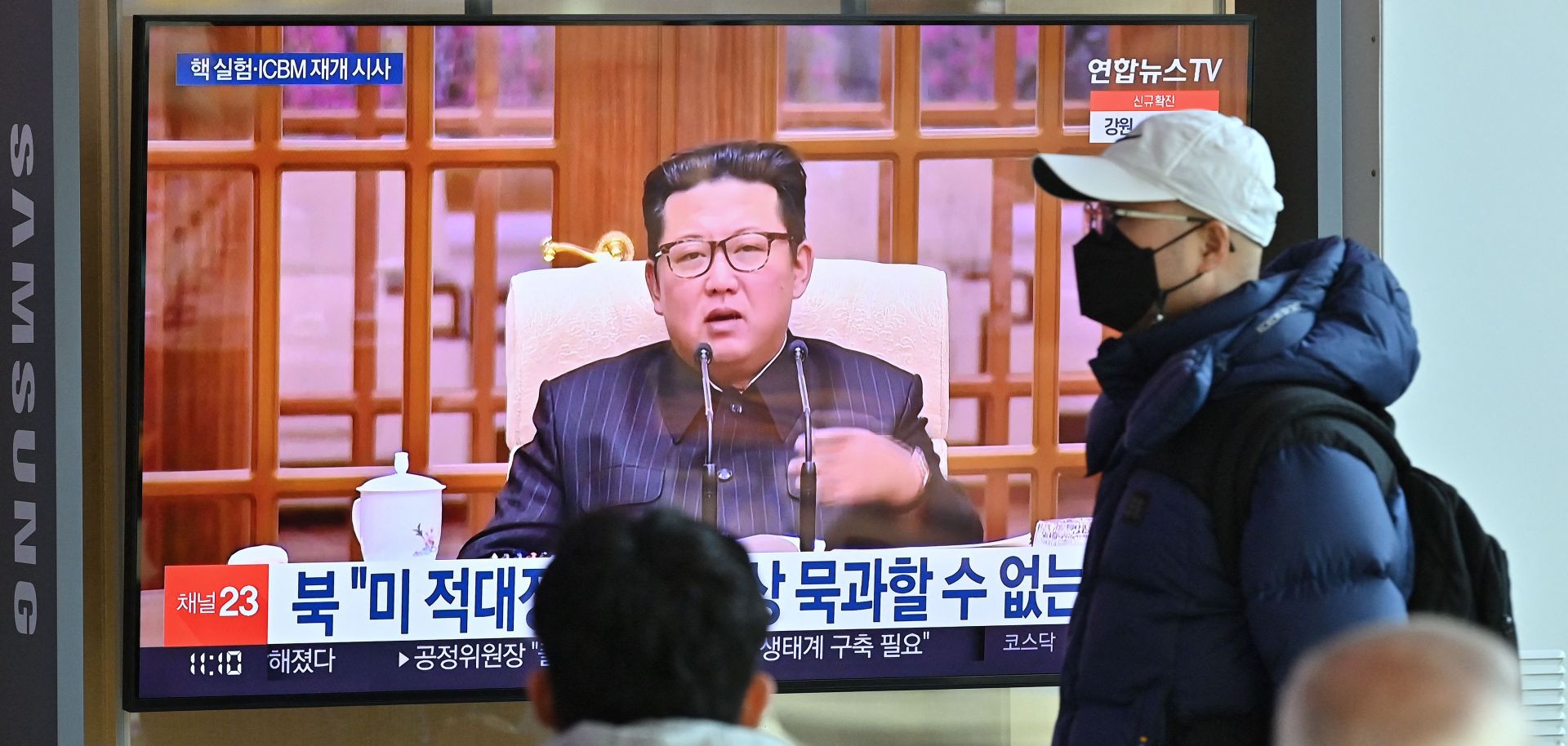
People watch a television screen showing a news broadcast with file footage of North Korean leader Kim Jong Un, at a railway station in Seoul, South Korea, on Jan. 20, 2022, after North Korea hinted it could resume nuclear and long-range weapons tests.
North Korea's upcoming nuclear test will confirm its reliance on nuclear deterrence to protect the governing regime, but is unlikely to fundamentally change the security dynamics in the region — so long as it's in line with previous tests. On Sept. 28, South Korea's intelligence agency informed the country's government that it expected North Korea to conduct a nuclear test at the Punggye-ri testing site between Oct. 16 and Nov. 7. North Korea has not tested a nuclear weapon since 2017. It has, however, conducted over 40 tests of other weapons since January 2022, including new hypersonic missiles, intercontinental ballistic missiles (ICBMs), cruise missiles, and ballistic missiles that fly in irregular trajectories aimed at evading missile defense systems capable of holding a nuclear warhead.
- North Korea conducted its first-ever nuclear test in 2006 and conducted a total of six nuclear tests until 2017, when Pyongyang began a self-imposed moratorium on ICBM and nuclear testing amid warming relations with South Korea and the United States under then-U.S. President Donald Trump. North Korea allegedly destroyed the Punggye-ri nuclear test site in 2018. But while Pyongyang invited foreign journalists to watch the detonation, it did not allow independent inspection of the facility.
- On March 24, North Korea broke the self-imposed moratorium on ICBM testing by launching the new Hwasong-17 ICBM, the largest missile it has tested to date. The rocket landed about 106 miles west of Aomori prefecture on the northern tip of the Japanese island of Honshu.
- On Oct. 6, North Korea conducted its first missile test over Japan in five years. After being launched from an area near North Korea's central border with China, the intermediate-range ballistic missile flew roughly 4,600 km (2,850 miles) at an altitude of 1,000 km (621 miles), reaching a top speed of Mach 17, before crashing into waters east of the northernmost Japanese island of Hokkaido.
North Korea's decision to resume testing reaffirms the regime's reliance on nuclear capabilities, driving its aggressive foreign policy toward South Korea, Japan and the West. North Korea's nuclear testing and development are ultimately driven by an internal imperative to deter a forcible regime change by presenting a robust nuclear strike capability. External factors reaffirm this imperative, such as the ongoing war in Ukraine. In 1994, Western powers convinced Ukraine to voluntarily give up its nuclear weapons by promising to protect the former Soviet state in the event of an invasion. But in response to Russia's ongoing offensive, the United States and Europe have yet to deploy troops to aid Kyiv, instead providing Ukrainian troops with funding and weapons. For North Korean leaders, the West's hesitation to directly intervene in Ukraine has further revealed the risk of relying on promises of protection from other nations, which even includes its patron China. To mitigate this risk, Pyongyang will use its reaffirmed nuclear capabilities to pursue a confident foreign policy where it does not seek any promises of regime stability from the West in exchange for denuclearization, nor any pledges of protection or security from neighboring China. This will see North Korea reject further calls for denuclearization from the international community and seek to forge new ties with non-aligned countries such as Egypt, as well as increase its economic and political relations with Russia.
- The threat of nuclear attacks against South Korea, Japan and their Western allies has been a central element of North Korea's foreign policy for decades. While Pyongyang is under significant pressure from the international community to abandon its nuclear program, the regime sees it as a vital tool to ensure its own survival.
- On Sept. 9, North Korea announced a new law that enshrines the right to conduct preemptive nuclear strikes if there is a threat of an imminent attack on either the country or its leaders, or if the nation's existence is threatened in war.
If North Korea conducts a high-yield nuclear test, it would represent a slight escalation in tensions, but it would not fundamentally alter the security status quo in the region. North Korea has already demonstrated it is a nuclear power with advanced, high-yield devices. Even if Pyongyang tests a nuclear device that is larger in yield than those it has tested in the past, it would not necessarily represent a new threat to North Korea's neighbors or the United States, and is therefore unlikely to substantially change Asian and Western policy responses to North Korea’s nuclear advances.
- North Korea's 2017 nuclear test was a supposed hydrogen bomb with a yield of 50-60 kilotons, but some estimates put it as high as 250 kilotons.
However, if North Korea conducts a miniaturized nuclear warhead test, it would significantly change the security dynamic in the region, demonstrating a new threat to the continental United States, which could prompt Washington to mull redeploying nuclear weapons to South Korea. If Pyongyang successfully conducts a miniaturized test, it would confirm previous U.S. and Japanese estimates of regime capabilities and suggests North Korea can place nuclear warheads on top of ICBMs that could then strike the mainland United States or other non-regional targets. Such a new threat would force fundamental changes in American nuclear and missile defense policy regarding North Korea, such as prompting the Biden administration to discuss redeploying nuclear weapons in South Korea. Alternatively, the United States could lift the ballistic missile constraints placed on the South Korean military. South Korea, however, remains highly unlikely to pursue developing its own nuclear weapons, even if North Korea demonstrates a capacity to miniaturize nuclear warheads, as their citizens are heavily against creating a domestic nuclear program and the country is part of the Non-Proliferation Treaty.
- In 2017, U.S. intelligence officials concluded that North Korea was likely capable of miniaturizing nuclear warheads. In 2019, Japan confirmed this assessment in its annual defense White Paper, which stated that North Korea had likely achieved the necessary capabilities to miniaturize nuclear weapons.
- The United States removed its nuclear weapons from South Korea in 1991.
Logistical difficulties and Chinese opposition will likely keep North Korea from conducting an above-ground nuclear test. For North Korea, conducting an above-ground nuclear test in the East Sea/Sea of Japan (either through a ballistic missile launch or some other fashion) would risk collateral damage to Korean, Japanese, and potentially Chinese fishing vessels in the region, in addition to any international flights in the area. Pyongyang would thus most likely conduct such a test in the Pacific Ocean, which would require flying the weapon unmolested to the chosen testing site or launching it over Japan. This, however, would still risk jeopardizing crucial support from China, as Beijing cannot publically support an escalatory act without exposing itself to likely harsh international condemnation. Above-ground nuclear tests can also have unintended impacts on the region, such as radiation blowing into populated areas and posing health risks to those who live there. Given this risk of ratcheting up regional tensions in unpredictable ways, as well as the risk of losing key Chinese support, North Korea thus remains extremely unlikely to conduct an above-ground nuclear test.
Regardless of the type of test, North Korea will remain a nuclear power and the West will not change its political stance on denuclearization, which means diplomatic relations will remain frozen, but regional security tensions will rise. The United States will continue its calls for denuclearization on the peninsula, offering economic and food aid, sanctions relief, and other programs in an attempt to sway the regime. But North Korea is unlikely to give up nuclear weapons after conducting another successful test. Indeed, Pyongyang has endured famine and other terrible conditions for decades, and its leaders remain willing to accept the human cost of poor economic management and harsh international sanctions in exchange for regime stability. The North's refusal to reopen dialogue with the South, despite multiple offers, further confirms that North Korean leadership is not interested in the current Western idea of peace on the peninsula (which would result in a militarily vulnerable North Korea). This will see South Korea and Japan engaging in their own non-nuclear arms race to bolster their defensive capabilities, which in turn will raise regional tensions and escalate the possibility of low-level military incidents.
- In response to the Oct. 6 North Korean test, South Korea launched four Army Tactical Missile Systems and a homegrown Hyunmoo-2 ballistic missile that failed after launch.
- Japan's ruling Liberal Democratic Party will use a more bellicose and nuclear North Korea to drum up public support for increasing the defense budget and formally recognizing the Japanese Self-Defense Force in the country's constitution.
- In May, newly inaugurated South Korean President Yoon Seok-yeol promised an ''audacious'' economic plan to raise the standard of living for all North Koreans if the regime commits to denuclearization.
