
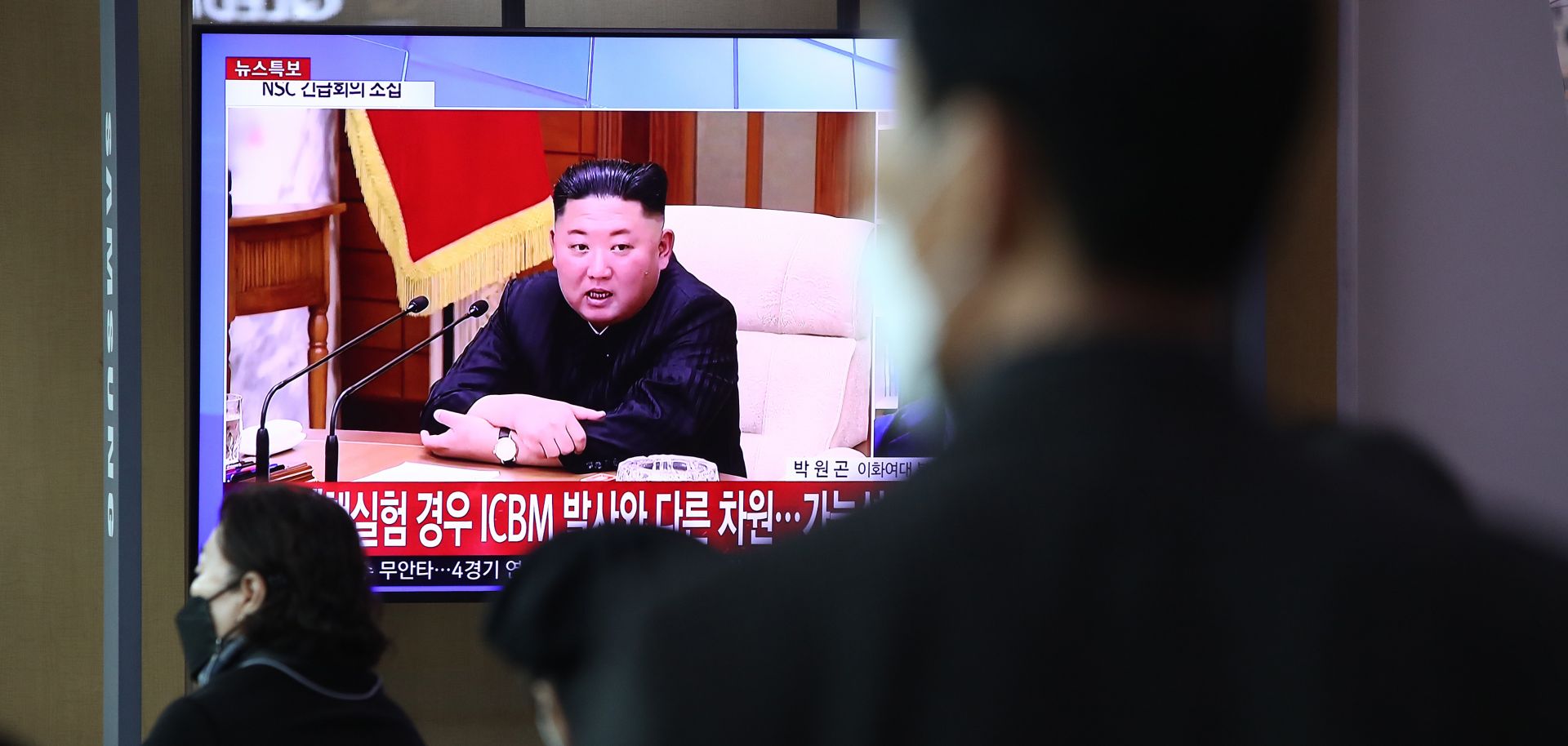
A TV at the Seoul Railway Station on March 24, 2022, in Seoul, South Korea, shows a file image of preparations for a North Korean missile launch.
North Korea's testing of an intercontinental ballistic missile marks a new step in the evolution of its strategic capabilities, likely triggering a reaction from Seoul that could lead to new South Korean tensions with China and improved South Korean ties with Japan. On March 24, North Korea broke a self-imposed moratorium on ICBM testing with a test of the Hwasong-17 ICBM. ICBMs and the associated missile technologies are possible launch vehicles for putting satellites into orbit, and can carry nuclear payloads. Pyongyang argues it has the right to peaceful space exploration and access, and that its launches are not aimed at provoking neighboring Japan.
- The March 24 ICBM test landed about 106 miles west of Aomori prefecture on the northern tip of the Japanese island of Honshu, well within the Japanese exclusive economic zone, which is the closest it has come to foreign soil in years. North Korea's 1998 satellite launch overflew Japan, but its 2012 satellite launch flew southwest toward the Philippines to avoid overflying any neighbor.
North Korea's missile testing cycle was influenced, but not caused by, the Russian invasion of Ukraine and the West's response. North Korea's missile testing runs on a three-year cycle, due to material and budget constraints, but Pyongyang took advantage of the coincidence that the Ukraine war was happening simultaneously to make a statement about its defensive capabilities to the West. Seeing the Western response to the Russian invasion of Ukraine, the North Korean leadership likely decided to forgo the next step in a satellite launch and test only an ICBM, signaling its response to rising anti-autocracy sentiment in the West and its allies.
- North Korea stated its tests on March 5 and March 16 were in preparation for a satellite launch, and the trajectories and photos released by Pyongyang support this; the next phase launch on March 24 failed almost immediately after takeoff.
- In response to the March 24 ICBM test, South Korean President Moon Jae-in ordered the South Korean army to conduct its own tests of weapons that could be used to target North Korean launch sites and platforms. This is a break from tradition for South Korea, which tends not to respond to missile tests with its own missile tests.
South Korea's response will likely involve acquiring and deploying anti-missile batteries, which could increase frictions with China while South Korean relations with Japan improve. The South Korean presidential election probably did not influence the northern test, but either way, the response from incoming South Korean President Yoon Seok-yeol will significantly affect Seoul's relations with China and Japan. Yoon has said he would like to increase Terminal High Altitude Area Defense (THAAD) deployments, and possibly restart Extended Deterrence Strategy and Consultation Group negotiations with Washington regarding the permanent strategic placement of high-powered U.S. military assets on the peninsula, likely cooling South Korean relations with North Korea. The deployment of THAAD has angered China, as its radar reaches into Chinese territory, and the Communist Party of China has denounced the system as actually aimed at China, not North Korea. Japan, on the other hand, will likely welcome a more robust American presence in the region. The new South Korean president's desire to warm relations with Japan combined with the continued North Korean missile launches may spark renewed intelligence sharing between the two countries to counteract the North Korean threat. The United States will condemn the launch and could sanction key individuals involved in the North Korean missile program, but is unlikely to take any concrete military action against North Korea to avoid triggering a North Korean ICBM and possible nuclear response.
- In 2017, Chinese consumers boycotted South Korean companies like Lotte after Lotte turned over land in South Korea for the deployment of THAAD. Further deployment of THAAD could see renewed Chinese boycotts of South Korean goods, further damaging bilateral relations.
- In 2019, Japan and South Korea began a trade war that saw the Japanese government removing South Korea from the "white list" index of trusted trade partners. In response, South Korea began boycotting Japanese goods and companies, resulting in ongoing economic damage for both nations.
