
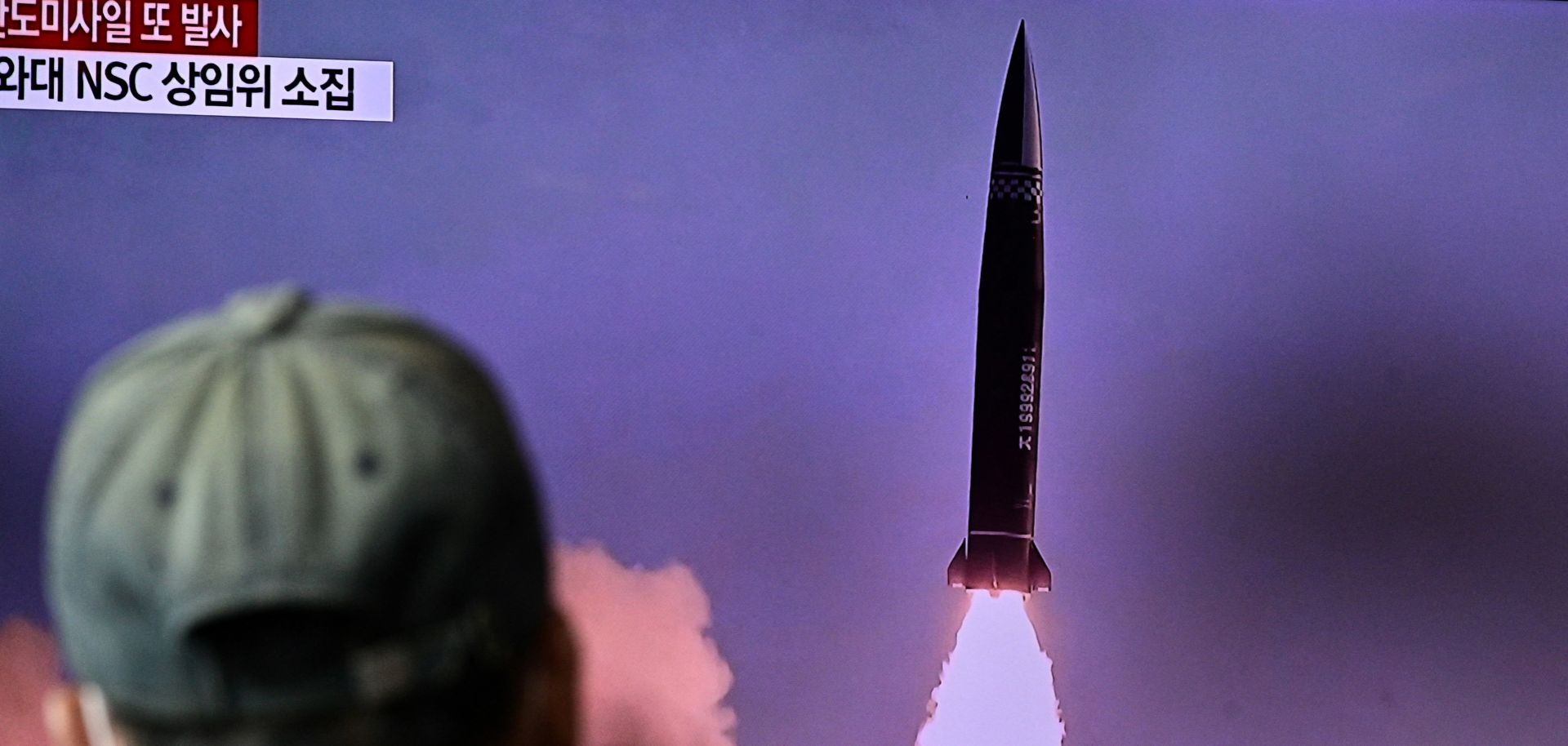
With the suspected launch of a submarine-launched ballistic missile, North Korea may have succeeded in threading the needle to increase its battlefield capabilities while still keeping open the possibility of talks with South Korea. North Korea appears to have successfully tested a submarine-launched ballistic missile (SLBM) off its east coast on Oct. 19, a month after South Korea launched its first SLBM. Initial assessments suggest the missile may have been launched from a North Korean submarine, as opposed to the submerged barge used in previous tests. If confirmed, this test would mark a major step in Pyongyang’s long journey to develop an SLBM capability, a key component of its national defense and specifically its nuclear deterrence strategy.
- In April 2021, South Korean and Japanese media cited intelligence sources as saying that the North had likely completed work on its new 3000-ton ballistic missile submarine, which is thought capable of carrying three ballistic missiles.
- The Western-designated Sinpo-C class submarine is a modified Soviet Romeo class submarine, an old diesel-electric model that North Korea has a long familiarity with. The modifications to hold the ballistic missiles are thought to have reduced the battery capacity of the submarine, limiting its submerged travel distance.
Coupled with its road-mobile ballistic missiles, the SLBM adds to the difficulty of the United States or South Korea being confident of destroying all of North Korea’s potentially nuclear-armed ballistic missiles in a first strike, thus making a pre-emptive strike less likely. Pyongyang has, in the past, carried out submarine scramble exercises in which many of its conventional submarines all leave, making it more difficult to track any particular one. North Korea may again deploy this tactic to increase the chances of the United States or its allies losing sight of the ballistic missile submarine. The SLBM would also demonstrate Pyongyang’s continued technological development despite Western sanctions, highlighting the limited effectiveness of a strategy of isolation to force changes in North Korean political behavior.
The test does not necessarily dampen South Korea’s current push to restart talks with the North, particularly as the administration of South Korean President Moon Jae-In nears its conclusion. While any North Korean ballistic missile test is banned under U.N. restrictions, Pyongyang has refrained from long-range missile tests in recent years, focusing instead on in-theater systems like its Iskander-like missiles, larger caliber multiple rocket launch systems, and SLBMs. From Pyongyang’s perspective, these weapon systems are not only less politically sensitive, but more battlefield-ready. South Korea sees this as a sign that North Korea may still be willing to re-enter negotiations, and Seoul has stepped up its dialogue with the United States and Japan to encourage renewed outreach to Pyongyang.
- Seoul recently proposed replacing the 1953 armistice that halted hostilities during the Korean War with a formal peace deal. The idea has gained some traction in Pyongyang, which has continued to decry the United States’ hostile intent toward North Korea.
- The United States has recently offered to re-enter talks with North Korea without pre-conditions, and while Washington will criticize the SLBM test, its response will remain muted unless Pyongyang restarts long-range missile or nuclear tests.
- North Korea recently reopened a western port for humanitarian supplies, suggesting that economic challenges remain severe. But this could also indicate that Pyongyang is preparing for more external engagement after more than a year of self-imposed isolation due to COVID-19.
