
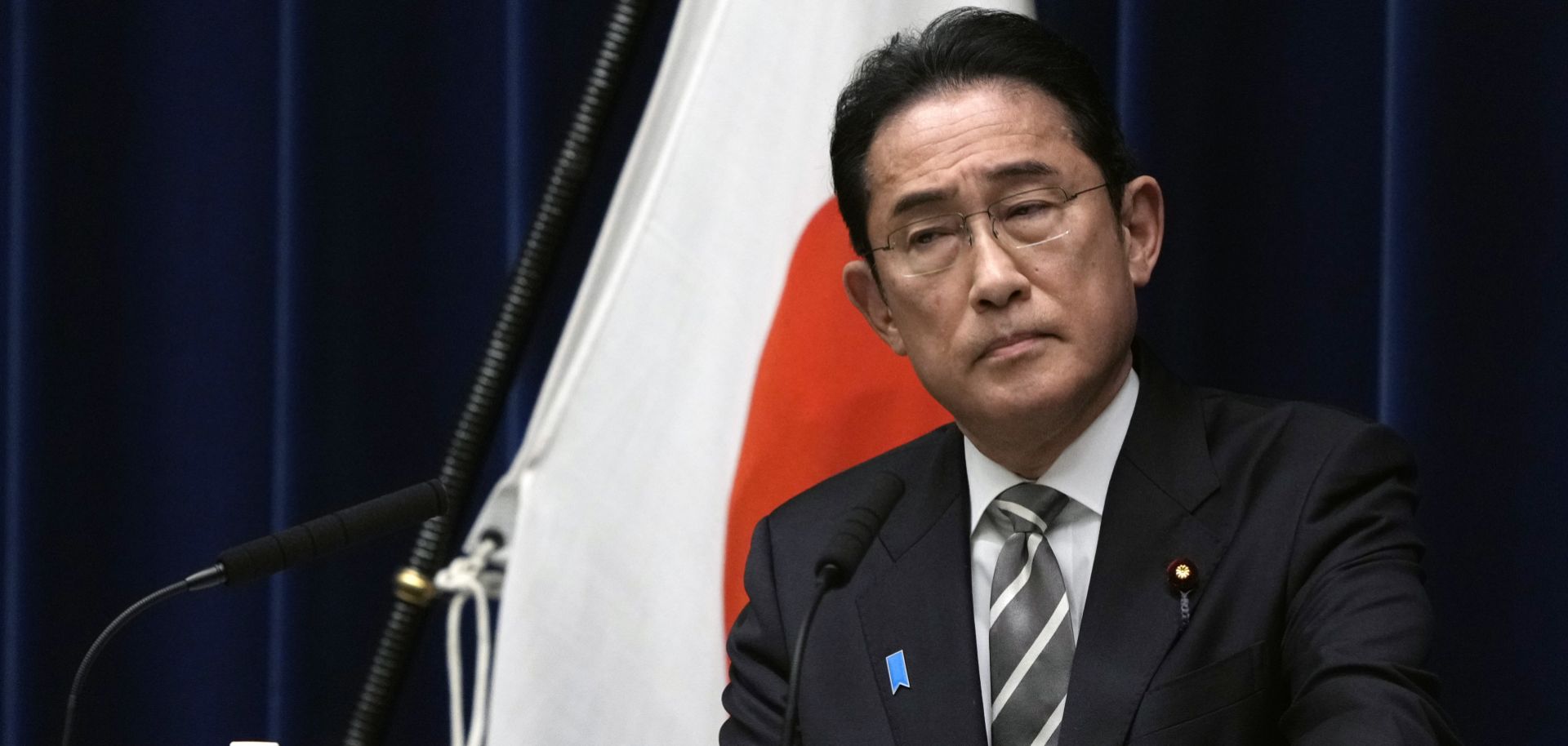
Scandals surrounding Prime Minister Fumio Kishida and Japan's ruling party will likely lead to Kishida's replacement in 2024, which could cause Tokyo to focus on domestic affairs, weakening Japan's efforts to expand its regional military ties in the face of strategic challenges from China. On Dec. 14, Japanese Prime Minister Fumio Kishida announced the resignations of top cabinet officials in connection to a slush fund scandal within the ruling Liberal Democratic Party (LDP). The officials include Chief Cabinet Minister Hirokazu Matsuno, Industry Minister Yasutoshi Nishimura, Agriculture Minister Ichiro Miyashita, and Internal Affairs Minister Junji Suzuki. Three LDP leaders also stepped down from their posts, including the chairman of the party's research council, Koichi Hagiuda, parliamentary affairs chief Tsuyoshi Takagi, and LDP secretary-general of the Upper House Hiroshige Seko. All seven of these officials were from the Abe faction in the LDP, formerly led by late Japanese Prime Minister Shinzo Abe, and news leaks earlier this week suggested Kishida had planned to fire them. The resignations have prompted some backlash from the Abe faction; a key LDP leader, Koichi Hagiuda, asked Kishida to reconsider ousting the officials, while some LDP lawmakers have called for Kishida's resignation. These intra-party disputes are the latest in a series of scandals that have marred Kishida's two years as prime minister. As a result, public support for the government has dropped precipitously in recent months, with a Dec. 8-11 NHK poll putting public approval for the Kishida cabinet at 23%. A November survey conducted by the Japanese news outlet The Asahi Shimbun, meanwhile, placed support for the LPD at 27%, its lowest support in a decade.
- The slush fund scandal involves allegations that top Abe faction officials colluded to skim funds off of party event ticket sales, with unreported funds totaling $3.5 million. In late November, Kishida tried to distance himself from the issue by suggesting that the Abe faction should speak for itself. Then on Dec. 7, Kishida resigned as head of the LDP's Kochikai faction, likely in a belated effort to show his impartiality toward factional affairs.
- According to reporting by The Asahi Shimbun, Kishida allegedly requested that former defense secretary Yasukazu Hamada replace Matsuno as chief cabinet secretary, but Hamada declined the offer. Yoshimasa Hayashi, who previously served as foreign minister under the Kishida administration before a cabinet reshuffle in September, is now slated to become Kishida's new right-hand man.
- Kishida has been dogged by several scandals since taking office in October 2021, including allegations about his political ties to the Unification Church, a controversial religious organization whose fiscal predations on its adherents are believed to have motivated the assassin who killed Shinzo Abe in July 2022. Kishida's efforts to digitize the MyNumber social insurance registration system have also been a flop, with widespread cases of mismatched registrations and wrongly allocated social benefits.
Dropping popular and party support for Kishida means he'll likely lose the LDP leadership election in September 2024, if scandals and intra-party disputes don't force him to resign before then. Kishida's Kochikai faction is the second smallest among the LDP's five primary factions, while the Abe faction is the largest. Kishida's ousting of the Abe faction could thus fatally wound LDP unity under his leadership, even if it helps mitigate the fallout from the slush fund scandal in the short term. In addition, Kishida's failure to secure his first pick to replace Matsuno and his recycling of recently reshuffled ministers suggests his backbench of political supporters is thinning out. Furthermore, the LDP is already starting to prepare for Japan's October 2025 general elections, with fears that the conservative opposition Japan Innovation Party could take away key parliamentary seats from the LDP's minor coalition partner Komeito. Because of this, the LDP needs to recover its public support, primarily by avoiding scandals and addressing the Japanese people's cost of living concerns, an issue that Kishida has so far failed to address. Kishida's faction struggles and the LDP's need to revive its electoral prospects suggest the party will select a different leader in September 2024 party leadership elections, which would force Kishida to step down as prime minister. But if Kishida can't contain the impact of numerous political scandals, he might not even make it until September, as the LDP may increasingly perceive that an unpopular Kishida will sully public support for any policy effort and further decrease the LDP's popularity among voters.
- The LDP has dominated Japanese politics for decades. Prime ministers from the LDP have ruled Japan continuously since the 1950s, with only small periods of opposition rule from 1993-1996 and 2009-2012. Japan's political system is thus more characterized by rivalries among different LDP factions than by rivalries among different parties.
- In a November poll for the ''most suitable'' LDP lawmaker to be prime minister, Japanese news outlet The Asahi Shimbun found that former Environment Minister Shinjiro Koizumi led with 16% support, followed by former Defense Minister Shiberu Ishiba (15%), and Digital Transformation Minister Taro Kono (13%). All three were ahead of Kishida.
- There is recent precedent for a Japanese prime minister resigning ahead of LDP leadership elections. Kishida's predecessor, former Prime Minister Yoshihide Suga, announced he would not seek reelection four weeks ahead of the LDP leadership election in September 2021. This announcement came after months of sliding polling numbers, with Suga's approval rating dropping to just 28% by August 2021. That same month, an LDP candidate endorsed by Suga also lost by a wide margin in the Yokohama mayoral election, further sealing Suga's fate ahead of the leadership vote.
- In November 2023, Kishida revealed a $113-billion support plan to provide inflation relief to households, but it received negative reviews by most Japanese in polls and was panned by lawmakers, even within the LDP, as an expensive gamble to boost the prime minister's public image.
Against this backdrop, faction management and domestic policy will take up more of the government's attention in 2024, impeding Tokyo's efforts to expand Japan's regional leadership in security matters. Should Kishida resign or the LDP replace him ahead of September 2024, Kishida's successor will have to focus heavily on repairing LDP factional rifts, particularly with the powerful Abe faction, and preparing for the 2025 elections with a focus on economic support policies. Japan's new prime minister may, in turn, have to scale back Kishida's pledge to double defense spending to 2% of GDP by 2027, and the accompanying personal and corporate tax hikes necessary to fund that bigger military budget. This shift would impede Tokyo's efforts to boost deterrence against Chinese aggression toward Taiwan and North Korea's expansion of its missile program. It could also weaken Tokyo's personalistic push under Kishida to improve ties with Seoul, eroding future gains in interoperability in the Japan-U.S.-South Korea relationship, such as their agreement to increase intel sharing on North Korean missile launches by the end of 2023. If Kishida remains in office, his time will also be increasingly devoted to domestic matters, like addressing cost-of-living concerns, as well as to putting out the political fires he has started. This may already be happening, as Kishida is believed to be considering delaying a trip to Brazil and Chile in January to deal with the slush fund scandal at home. On industrial policy, the LDP factions are fairly united on supporting strategic industries like semiconductors, supply chain resilience efforts with the West, and increasing energy security with nuclear power, so these matters are unlikely to change, either due to Kishida's recent staff changes or under a new prime minister.
