
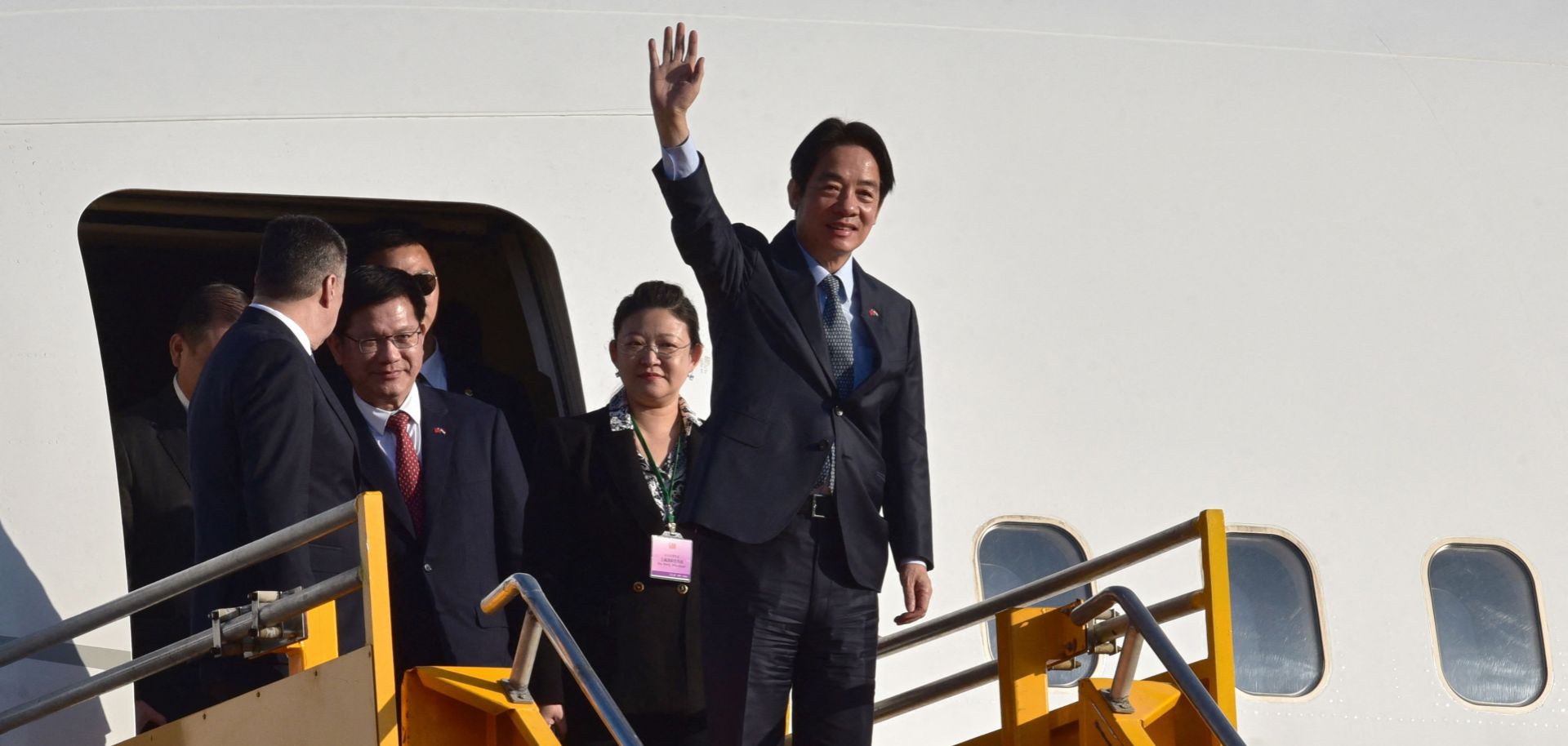
China's latest round of drills near Taiwan confirms Beijing's intent to use the military as its primary tool of influence over the island, which will accelerate supply chain decoupling by impeding China's trade and diplomatic relations with the West. On Aug. 19, the Chinese military conducted joint air and sea drills in the waters north, east and southwest of the main island of Taiwan, with at least 25 planes crossing the Taiwan Strait median line, according to the PLA Daily, the official newspaper of China's military. The PLA Daily report said the drills were in response to Taiwanese Vice President and leading presidential candidate William Lai's transit stops in the United States on Aug. 12-13 and again on Aug. 16-17 on either end of his trip to Paraguay. The paper also published a piece on Aug. 19 under the pseudonym Jun Sheng (which translates to ''voice of the army'') that decried Lai's visit as promoting Taiwan independence and said ''every time 'Taiwan independence' separatists flee to the United States, the vital interests of the people of Taiwan will be severely damaged.'' Unlike China's previous drills in August 2022 and April 2023, which both involved Taiwanese President Tsai Ing-wen meeting with U.S. congressional leaders, these latest drills were short (just one day), did not include a live-fire component, and were not given an official name by the military.
- A poll conducted by the Taiwan Public Opinion Foundation (TPOF) on Aug. 14-15 and released on Aug. 21 showed that Lai, of the ruling Democratic Progressive Party (DPP), led the presidential election race with 43.4% of public support, up 7% from the previous TPOF survey released on July 25. Lai was followed by third-party candidate Ko Wen-je at 26.6% (down 1.2%) and Beijing's favored candidate, Hou You-ih of the opposition Kuomintang party, who garnered just 13.6% in the latest poll (down 6.6%).
- In response to the Aug. 19 drills, the U.S. State Department urged China to ''cease its military, diplomatic, and economic pressure against Taiwan'' and engage in dialogue with Taipei instead.
China's drills will strengthen the position of the pro-U.S., anti-China DPP ahead of Taiwan's January 2024 election. The latest drills were quite light compared with China's previous military exercises near Taiwan. They also had little-to-no impact on shipping and air traffic in the busy waters around the island. This may be partly due to the unprovocative nature of Lai's visit to the United States, which was not nearly as high-profile as former U.S. House Speaker Nancy Pelosi's trip to Taiwan last summer and Tsai's meeting with Pelosi's successor, Kevin McCarthy, in April — both of which prompted much more extensive Chinese drills. The smaller scope of the Aug. 19 drills also reflects Beijing's desire to minimize the deleterious impact on public support in Taiwan for Hou, China's favored candidate in the island's upcoming presidential election. Recent polls show Hou's popularity is already dropping — a trend that Beijing's latest drills are unlikely to reverse. But Lai's current large lead over Hou will probably somewhat dissipate in the coming months, as the boost from China's past drills on the DPP's polling numbers also dissipated over time. In addition, Hou has pledged to visit the United States later this fall, which is unlikely to prompt heavy Chinese retaliation and could give him a boost in the polls if he's able to showcase his presidential bona fides by pulling off the trip without a hitch. But his Beijing-friendly KMT party could lose that additional support if Hou doesn't adequately assert Taiwan's sovereignty in response to China's drills.
China's actions confirm that Beijing plans to primarily wield military force against Taiwan under the DPP, which will continue to impede Beijing's ability to recover its cooperative trade and diplomatic ties with the West. The drills signal that Beijing intends to primarily wield military force for as long as the DPP remains in power in order to pressure Taipei to back down from any sovereignty-affirming moves, like independent interactions with foreign countries. This is partly because Beijing's economic coercion and political influence campaign during the 2016-2020 DPP administration failed to keep the DPP from being reelected in 2020. It's also partly due to Chinese President Xi Jinping's increasingly national security-oriented approach to foreign relations, which prioritizes quashing any threat to a broad range of national security issues (including sovereignty over Taiwan) over economic and diplomatic ties — even if it means exacerbating U.S. tensions and Hou's already weak polling numbers. Beijing's paradigm of needing to retaliate militarily to Taiwan's diplomatic moves (even common ones like visits by presidential candidates to the United States) is also directly contravening China's goal of achieving economic recovery, as the drills stoke fears about business continuity risks among investors and companies, already wary of the mounting security risks of operating in China. If DPP candidate Lai goes on to win Taiwan's January 2024 presidential election, Beijing will likely exacerbate this pattern of reaction, posing greater challenges to China's trade ties and diplomatic relations with the United States and Europe. These deteriorating relations will, in turn, accelerate supply chain decoupling trends as businesses perceive threats to their operations from China's military moves, like the disruptions to shipping lanes from China's Aug. 2022 drills.
- China and the United States are currently trying to secure a meeting later this year between President Xi and his U.S. counterpart Joe Biden to help reduce diplomatic tensions. But China's repeated drills are now that much more likely to be a sticking point in any eventual meeting, with Biden feeling the need to denounce them and Xi feeling the need to reiterate that the core of the U.S.-China relationship is Washington's respect for China's view on the Taiwan issue.
- While supply chain decoupling is complex and varies by country, trade between China and the United States is slowly ebbing. Between 2017 and 2022, the share of Chinese goods in U.S. imports by value dropped from 21.6% to 16.6%; the value of U.S. exports to China as a proportion of total U.S. exports also fell from 8.4% to 7.3% during that same time period.
