
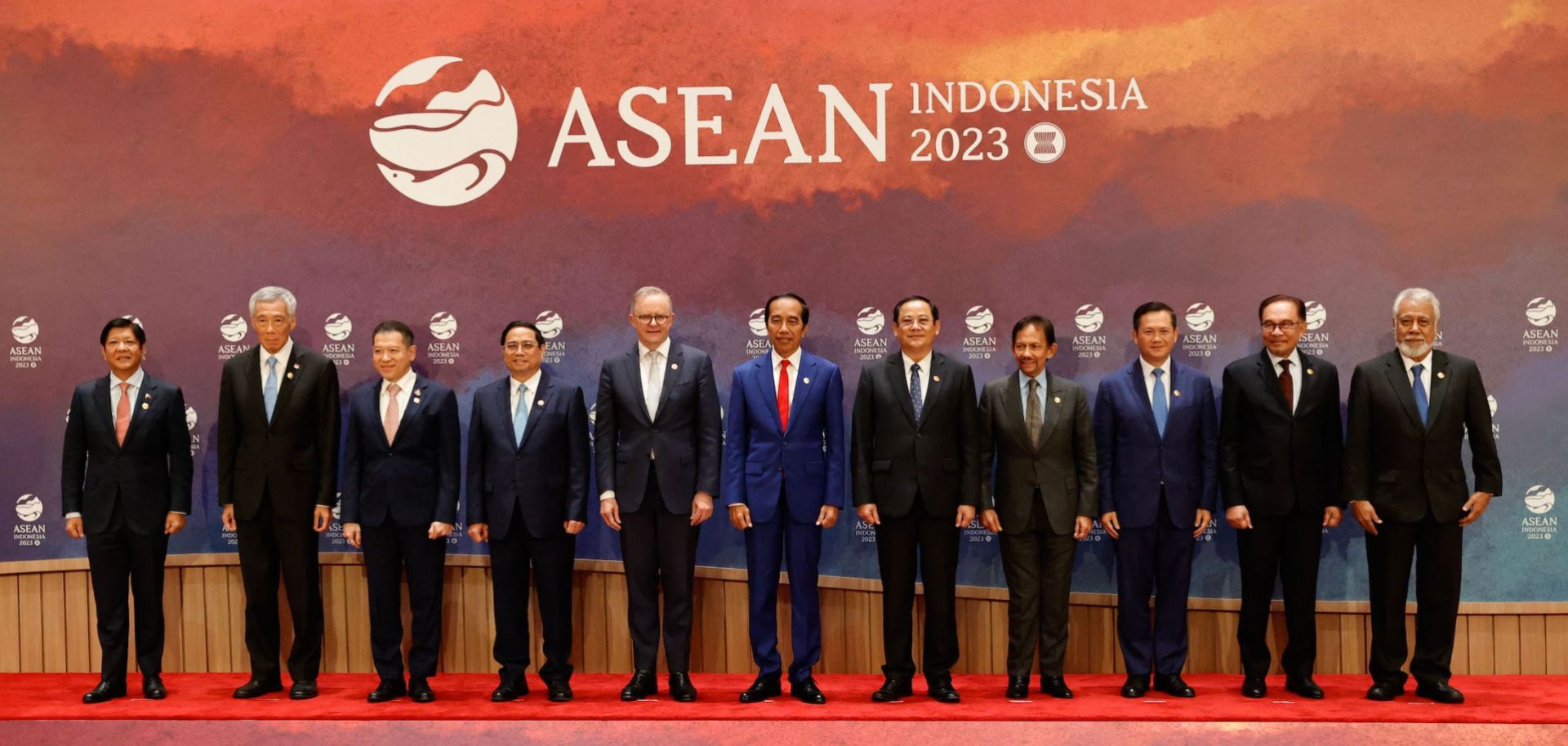
The Association of Southeast Asian Nations' (ASEAN) inactivity on core issues at its most recent summit will diminish ASEAN's importance and slowly compel its members to align with China or the United States. On Sept. 5-7, Indonesia hosted the 43rd ASEAN summit and related meetings, which brought together leaders of the bloc's 10 countries (except Myanmar, whose military leaders are suspended from meetings). Heads of state from India, Japan, South Korea, Australia and Canada and high-level officials from the United States, China and Russia also attended. Despite this prominent gathering of world leaders, the bloc made little progress in resolving its primary issues, including the ongoing civil war in Myanmar; instead of taking steps to enforce peace or Myanmar's adherence to the 2021 five-point consensus peace plan, ASEAN stripped Myanmar of its right to chair the bloc in 2026. Meanwhile, none of the meetings' joint statements mentioned territorial disputes in the South China Sea, which are of vital concern to the bloc's coastal members.
- ASEAN also instituted a "troika" mechanism to deal with Myanmar, meaning the bloc's 2023 chair (Indonesia) will partner with the 2024 chair (Laos) and the 2025 chair (Malaysia) on the issue rather than leave the responsibility to a single year's chair. Myanmar's junta has repeatedly failed to uphold its end of ASEAN's five-point consensus peace plan, to which it agreed in 2021. Most recently, the junta extended Myanmar's state of emergency on July 28, which further delayed elections.
- Several peripheral geopolitical issues clouded the summit, including North Korea's recent weapons tests and reports that it will sell weapons to Russia. Additionally, China issued a new map on Aug. 28 that reemphasizes its claim to most of the South China Sea, which ASEAN members Malaysia, the Philippines and Vietnam formally protested prior to the summit. Furthermore, recent clashes between Chinese and Philippine maritime forces, as well as Chinese and Vietnamese maritime forces, have raised regional tensions.
- ASEAN's negotiations with China over a South China Sea Code of Conduct, which would govern behavior in the contested waterway, also failed to make significant headway at the summit, despite three rounds of talks in 2023. The process has been stalled for decades.
Despite Indonesia's efforts to strengthen ASEAN, paralyzing passivity is forcing its members to leave regional consensus behind in favor of bilateral arrangements. As ASEAN's 2023 chair, Indonesia hoped to establish the bloc as the dominant regional forum and geopolitical pole in Southeast Asia by driving unified responses to the Myanmar and South China Sea issues at the summit. As Indonesia has the largest economy and population in Southeast Asia, is the region's only member of the Group of 20, and is the bloc's de facto leader, it had a better chance of succeeding than any other ASEAN member. However, other ASEAN members' ambivalence on decisive collective action prevented both of these goals from materializing. As a result, ASEAN is losing credibility as a forum to resolve regional geopolitical issues. Amid this passivity, ASEAN members are increasingly pursuing bilateral agreements with one another and external partners, rather than relying on the bloc to reach a consensus. For example, the Thai government circumvented ASEAN by initiating parallel talks with the Myanmar junta in June to bring it back into the regional fold, upsetting Indonesia as it encouraged Myanmar to forgo its prior commitments. On the security side, Vietnam is increasingly looking for partners outside ASEAN to protect its claims in the South China Sea, as it upgraded relations with South Korea in 2022 and will likely do so with the United States, Australia, Singapore and Indonesia in the coming months. The Philippines is similarly branching out and deepening security ties with the United States, Australia, Japan and South Korea. Indonesia, for its part, continues to deepen its military modernization relationship with the United States.
- There are signs that ASEAN is losing clout. For example, Indonesia moved the summit from November to September to coincide with the G-20 summit in India taking place the following week. Indonesia hoped the change in schedule would convince U.S. President Joe Biden and Chinese President Xi Jinping to participate, but both skipped the event.
- Additionally, Indonesia put together the first all-ASEAN joint military drills, which will take place on Sept. 18-25. However, not only will the drills be for non-combat missions, but Indonesia was pressured into moving them from the South China Sea to the mouth of the Malacca Strait. This demonstrates that even when actively trying to prop up ASEAN unity on maritime security issues, Indonesia is unable to shepherd consensus.
- Indonesia's role as ASEAN's thought leader is long-standing. It drove the issuance of ASEAN's community roadmap in 2003, its charter in 2007 and its Outlook on the Indo-Pacific in 2019, three pillars of the bloc's collective thinking. Indonesia also played a leading role in negotiating an end to the 2011 Thailand-Cambodia border dispute.
ASEAN will become even less effective in 2024 when Laos begins chairing the bloc, which will accelerate members' flight to stronger security partners like the United States and China. Laos is a much smaller economic and military power than Indonesia and is heavily dependent on China; it is also landlocked, rendering maritime concerns of little national interest. This means Laos will be less willing to put forward or back initiatives unfavorable to China, such as a legally binding South China Sea Code of Conduct, portending a continued stalemate on the issue in 2024. As a result, member states, particularly those with claims in the South China Sea, will continue seeking out bilateral security partnerships among themselves and with outside powers like China and the United States. Amid their strategic competition, Washington and Beijing will increasingly pressure ASEAN members to choose a side, upsetting most Southeast Asian nations' strategy of balancing between more powerful countries. As more ASEAN members resort to such bilateral agreements, divisions between regional countries will deepen, which could produce competing blocs that destabilize Southeast Asia.
- Indonesia warned that the ASEAN "community's strength is being challenged by one crisis after another" and intensifying geopolitical rivalries "could lead to open conflict that our region will be forced to face."
- ASEAN can achieve significant goals when its members act in unison. For example, after the Philippine navy unsuccessfully attempted to arrest Chinese fishers for seizing the Scarborough Shoal in 2012, ASEAN foreign ministers unveiled the bloc's Six-Point Principles on the South China Sea. This joint action led to reputational damage for China, which subsequently decreased the frequency of its seizures in the South China Sea.
