
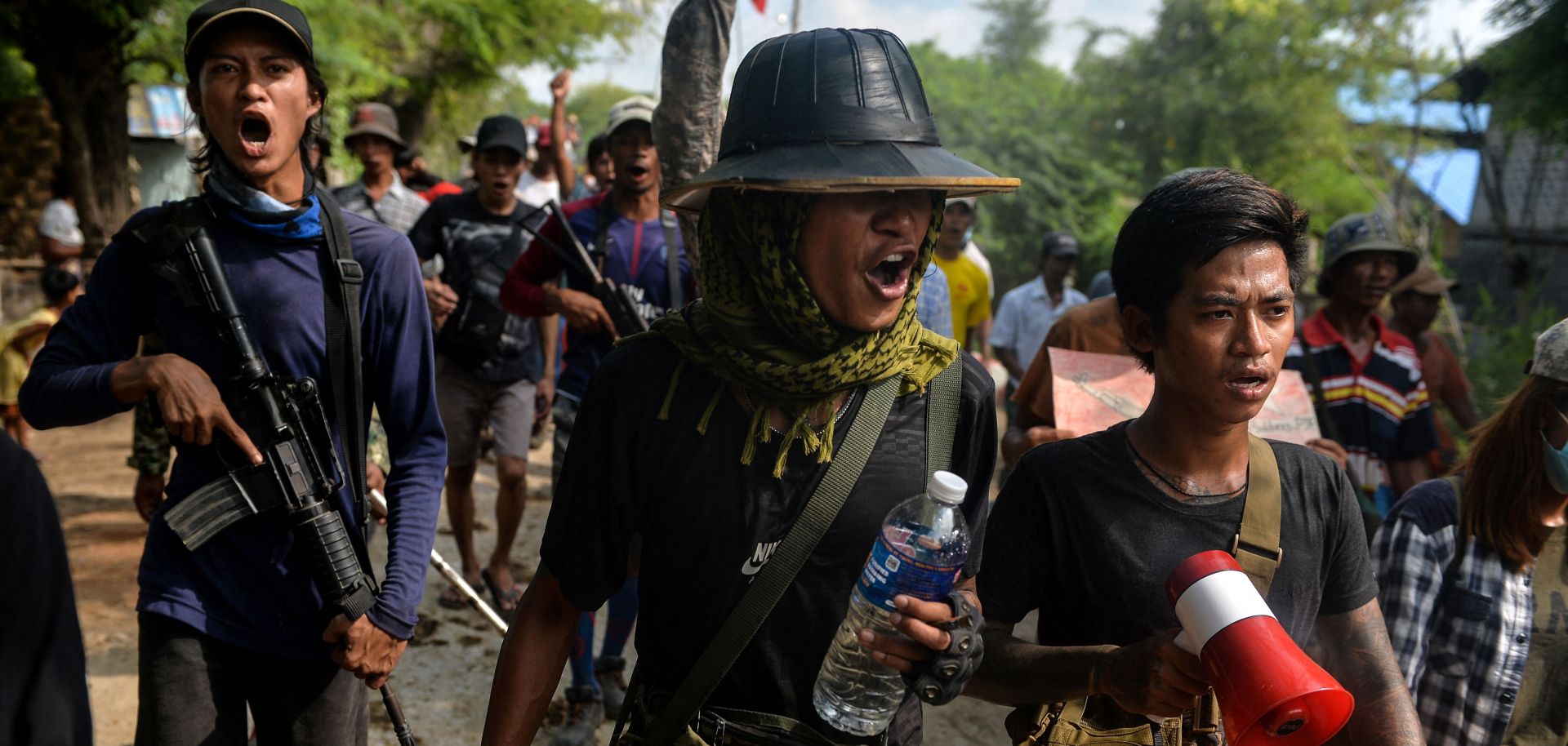
Anti-coup fighters escort protesters as they take part in a demonstration against the military coup in Sagaing, Myanmar, on Sept. 7, 2022.
Two years after seizing power, Myanmar's ruling junta faces a stalemate on the battlefield that is preventing it from transitioning to a legitimizing civilian government — portending a continuation of the country's civil war, economic malaise and international isolation. On Feb. 1, Myanmar's military government extended the state of emergency it imposed two years ago to overthrow the country's civilian government. The state of emergency expired on Jan. 31. Many expected the junta to use the occasion to establish a transitional council that would then pave the way for controlled elections in August that would likely lead to the ascension of a military-backed civilian government, which could have somewhat improved the war-torn country's foreign relationships and investment climate. But instead, Myanmar's National Defense and Security Council announced a third extension of the measure, this time for six months, citing the need to restore public order before elections can occur. Coup leader and military commander-in-chief Senior Gen. Min Aung Hlaing will thus remain in control of the country's government until at least Aug. 1 when, absent improvements on the ground, the military government will likely renew the measure for a fourth time.
- Under Myanmar's 2008 constitution (which the military wrote), elections cannot be held during an ongoing state of emergency. The junta enacted a law on Jan. 27 that severely restricts who can run in future elections. Myanmar's deposed ruling party, the National League for Democracy (NLD), denounced the election plans in a Jan. 30 statement.
The extension of the state of emergency comes on the two-year anniversary of the military coup that has since engulfed the country in chaos and civil war. Prior to the 2021 coup, tensions between the military and Myanmar's pro-democracy movement had been simmering for decades. Those tensions escalated exponentially following the 2011 establishment of a democratically elected government. In February 2021, Myanmar's military (or the Tatmadaw) overthrew the NLD-led government and established the governing State Administration Council (SAC), alleging election fraud — a claim that it has yet to produce evidence to support. Widespread peaceful civil disobedience then ensued, prompting the military to launch a crackdown on protest activity by employing wanton violence. After several months of the Tatmadaw's terror tactics, the NLD declared a ''people's defense war'' in September 2021. Since then, hundreds of loosely associated rebel groups — ostensibly under the leadership of the shadow National Unity Government — have taken up arms against the junta, staging the largest uprising the country has seen since gaining independence in 1948. These resistance forces — which include ethnic armed organizations and the People's Defense Force (PDF) guerrilla groups — now control large swaths of territory (mostly in rural areas), creating a patchwork of battle spaces that has left few areas of Myanmar secure.
- In April 2021, before full-blown hostilities ensued, Myanmar's military leaders signed the Association of Southeast Asian Nations (ASEAN)-brokered Five-Point Consensus plan to end the violence. But the junta has since ignored its stated commitment, insisting rebel forces are terrorists who lack legitimate grievances.
- Scores of former NLD lawmakers remain imprisoned, among them former State Counsellor Aung San Suu Kyi, along with nearly 14,000 additional political prisoners. The United Nations estimates that more than 3,000 civilians have been killed and 1.2 million internally displaced since the February 2021 coup.
Western countries instituted fresh sanctions on the second anniversary of the coup, the most substantial yet and an indicator of the junta's growing isolation from the West. On Jan. 31, the United States, United Kingdom, Canada and Australia unveiled fresh sanctions targeting three entities and six individuals deemed to generate revenue or enable arms procurement for the Tatmadaw. The new measures target the Union Election Commission (the body responsible for planning Myanmar's next election), mining companies, military officials and — perhaps most notably — the state-owned Myanma Oil and Gas Enterprise (MOGE). The MOGE's inclusion marks a significant escalation in the West's sanctions campaign, as Washington and its allies had previously been hesitant to sanction Myanmar's vital energy sector for fear of exacerbating the already dire economic situation among the civilian population. The targeting of the country's oil and gas industry — which serves as the junta's primary source of exports and revenue (generating about $1.5 billion annually) — will further erode the military government's dwindling foreign reserves. The decision to escalate sanctions, along with increasingly vocal criticism from the United Nations, indicate the Myanmar situation has taken a more prominent place in the minds of Western policymakers after two years of criticism for their perceived inaction.
- Previously, only the European Union had placed sanctions on Myanmar's oil and gas industry. The United States, in particular, had been wary of enacting sanctions that could disrupt Myanmar's energy trade with U.S. treaty ally Thailand.
- On Jan. 27, U.N. Human Rights Chief Volker Turk claimed that Myanmar had ''profoundly regressed [by] nearly every feasible measurement.'' This followed a Dec. 21 U.N. Security Council Resolution, its first on the Myanmar situation, calling for an end to violence and the release of political prisoners in line with the Five-Point Consensus. Russia, China and India abstained from the vote.
- Myanmar's central bank suspended all foreign loan payments in July 2022, highlighting the desperate foreign currency reserve situation.
However, absent more thorough secondary sanctions (which the West may be hesitant to impose on partners such as Singapore and Thailand), regional complacency and support via other avenues will continue to keep the junta afloat. Singapore's sprawling financial system has so far enabled Myanmar's military government to effectively evade arms embargoes and sanctions by operating as a nexus between the junta and third parties. Thailand also relies on energy imports from Myanmar to the tune of around 15% of its gas supply. Indonesia, which occupies the rotating ASEAN chairmanship in 2023 — has been the junta's most vocal critic in the region. But ASEAN as a whole has thus far failed to reel in the junta's excessive violence, even after it agreed to the Five-Point Consensus. Both China and Russia, for their part, have also continued to tacitly support the junta over the past two years by supplying the regime with weapons, military equipment and support in the international arena. China, in particular, places high geostrategic value on Myanmar; the China-Myanmar Economic Corridor (CMEC) accommodates oil and gas supply into China — while circumventing the vulnerable geographic choke point of the Malacca Strait — and offers the prospect to shift manufacturing to southwestern provinces as part of its middle-income transition strategy.
- A Jan. 16 report from the Special Advisory Council for Myanmar, an independent organization of former U.N. officials, claims firms from 13 countries, including the United States, enable Myanmar's domestic arms industry to maneuver around sanctions, with Singapore's financial sector playing a prominent role.
- Since the February 2021 coup, the most serious consequence ASEAN has imposed on Myanmar is barring SAC representatives from formal events. To intervene more broadly could be seen as violating the grouping's core tenet of not interfering in member states' internal affairs, a standard few in ASEAN would willingly see eroded. Indonesia assumed the ASEAN chairmanship on Feb. 3 and has already pledged to prioritize resolving the Myanmar situation via the Five-Point Consensus. It is also most advantageously positioned to do so among ASEAN members, owing to its critical appraisal of the junta and outsized relative regional power. But absent a fundamentally different approach that imposes tangible costs on Myanmar's military government, 2023 will likely come and go without consequential ASEAN action.
- Russia is Myanmar's top arms provider, accounting for 25% of weapons imports as of 2021.
- In April 2022, then-Chinese Foreign Minister Wang Yi declared China would continue to support Myanmar ''no matter how the situation changes'' after furnishing the Tatmadaw with a submarine in August 2021.
Myanmar's civil war, meanwhile, is unlikely to end in the short-to-medium term due to the strong perception on each side that victory is attainable, along with the widespread antipathy toward the junta among the population. The junta's intention to eventually hold elections has sparked widespread international condemnation owing to the high likelihood of manipulated results. But an eventual transition to a civilian government would help the junta achieve a degree of needed legitimacy and work to begin restoring investor confidence. Such a government — even if brazenly installed by the military — could help rehabilitate Myanmar in ASEAN. However, armed resistance to the Tatmadaw and the SAC has historically been uniquely fierce, largely due to novel cooperation between ethnic minority resistance groups and a large portion of the Bamar ethnic majority. This has left large swaths of the country now beyond the junta's control — rendering even a sham election logistically infeasible for now, thereby leaving the junta unable to make progress on legitimizing its power grab or reinvigorating investor interest in the country.
- The junta likely exercises effective control over less than half of Myanmar's territory.
- In neighboring Thailand, 2014 coup leader and current Prime Minister Prayut Chan-ocha resigned from the military to become a civilian head of state as military leadership passed the baton to a military-backed civilian government via dubious elections in 2019 — a model the Myanmar junta's higher-ups could emulate.
- Feb. 1 saw widespread ''silent strikes'' and empty streets throughout Myanmar's largest cities where the SAC remains largely in control, indicating sustained popular discontent among non-combatants and potential voters.
The fighting will also become deadlier and pose a greater threat to regional security as the military and resistance forces use more sophisticated weaponry and increasingly rely on the drug trade for income. Over the past two years, the post-coup conflict in Myanmar has devolved into an asymmetric war of attrition — and one where both sides are deploying deadlier weapons. The Tatmadaw's tactical shift toward precision airstrikes, heavy artillery and heliborne operations has intensified. Resistance forces, too, have begun rigging civilian drones for military purposes to conduct increasingly destructive attacks. In 2022, rebel groups reportedly conducted 642 drone strikes — a number likely to increase over the next year as the war rages on. Adding to regional security concerns is the junta and rebel groups' growing reliance on the illicit drug trade to generate revenue due to the economic fallout from the ongoing conflict. A Jan. 26 report released by the U.N. Office on Drugs and Crime found that opium cultivation in Myanmar increased by 33% in 2022. The country has also seen a significant increase in methamphetamine production. The outflow of narcotics from Myanmar has already caused drug prices to plummet in black markets across Southeast Asia by oversaturating supply. Smuggling has also driven increasingly frequent violent incidents along the Thai-Myanmar border, leading to multiple fatal shootouts in recent months.
- The narcotics economy now outpaces the formal economy in several localities in Myanmar as the country's war-torn economy drives the junta, rebel groups and farmers to increasingly rely on the drug trade for income. The drug trade further empowers criminal organizations and fuels money laundering networks, creating add-on regional security and socioeconomic risks that will likely worsen the longer the country remains engulfed in conflict.
The volatility created by the ongoing conflict, combined with Western sanctions, will continue to severely inhibit Myanmar's business environment and economic growth. Myanmar's economy is projected to have expanded slightly in 2022 after contracting 18% the previous year in the wake of the coup and subsequent war. While business operations in the country on average remain well below full capacity, more firms also reported that their operation capacities had improved during the fourth quarter of 2022, according to a recent survey conducted by the World Bank. That same survey found that firms reporting conflict as their most prominent challenge also decreased at the end of the last year, while firms reporting no operational challenges increased. But while these are positive signs, there is little chance the country's greater economic conditions will improve to pre-coup levels in the short term due to sanctions, foreign currency shortages and the continued depreciation of the kyat (Myanmar's local currency). But while Myanmar's economy is rebounding from its low point in 2021, per capita GDP remains 13% lower than it was in 2019. Businesses that wish to enter or stay in the market face acute reputational and sanctions risks as most economic sectors are tied to the Tatmadaw, and Western companies are increasingly ending operations in the country. However, East and Southeast Asian firms remain interested in pursuing business opportunities as ASEAN inaction enables Myanmar to maintain access to the bloc's open trade framework.
- The kyat's value against the U.S. dollar has dropped by more than 60% since Myanmar's military seized power on Feb. 1, 2021.
- In July 2022, Thai state-owned oil and gas conglomerate PTT Exploration and Production Pcl took over operations of Myanmar's Yadana gas field following U.S.-based Chevron and France-based TotalEnergies' exits from the country, for which they cited the junta's human rights violations.
