
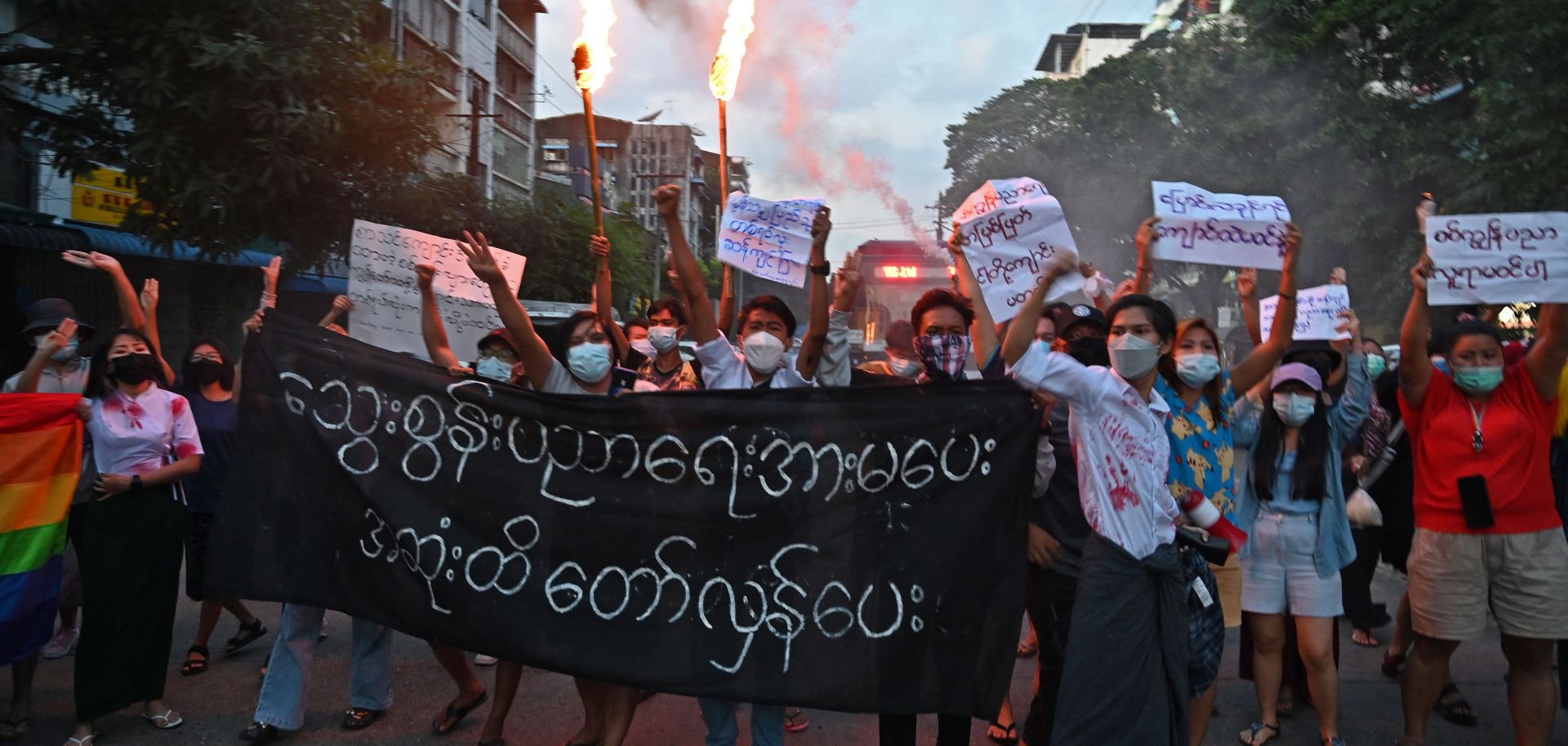
Protesters take part in a demonstration against the military coup in Yangon, Myanmar, on Nov. 10, 2021.
One year after the Feb. 1 military coup, Myanmar remains in the grips of a stalemated and increasingly deadly civil conflict that will continue to rattle its economy throughout 2022. Western companies will steer clear of the country amid the ongoing turmoil, though the wavering leadership of the Association of Southeast Asian Nations (ASEAN) may tempt East Asian businesses to resume activities. Violence looks set to escalate in border regions and key interior cities in Myanmar as public support persists for the resistance’s National Unity Government, along with the loosely affiliated People’s Defense Force (PDF) guerrilla groups and various ethnic armed organizations (EAOs). Moreover, it seems likely that 2022 will unfold similarly to 2021, with more human rights abuses and outflows of Myanmar refugees into broader Asia. The junta seems unable to both quell resistance groups and revive legitimate general elections, the results of which originally spurred the military to overthrow the civilian government run by the National League for Democracy (NLD). Outside of Myanmar, the United States and its Western allies seem content to repeatedly sanction the junta as China limits cross-border flows from the country for fear of COVID-19 infections. ASEAN, meanwhile, has sought to shore up its international legitimacy by helping resolve Myanmar’s conflict, but has so far made little progress to that end.
- The United States, through occasional cooperation with the United Kingdom and Canada, has levied at least five rounds of sanctions against the junta, as well as affiliated organizations and persons, with the latest round coming on Feb. 1 against three junta-appointed officials.
- China continues to give the junta tacit support through continued energy trade and minor provision of COVID-19 supplies. But Beijing remains most concerned with stemming the flow of COVID-19 into its southwestern Yunnan province, as shown by China’s recent request to Myanmar’s EAOs on the border to cease fighting — which would reduce cross-border refugee flows — during the Beijing Olympics from Feb. 4 to March 13.
- ASEAN’s five-point consensus (FPC) — which calls for a cease to violence in Myanmar, constructive and inclusive dialogue, and external (ASEAN) consultation — has gained little traction since the program was proposed on April 24. In response to this lack of progress, ASEAN uninvited junta leader Senior General Min Aung Hlaing from the Oct. 26-28 ASEAN annual summit and attempted to do the same for the Jan. 18-19 ASEAN foreign ministers meeting, now postponed to mid-February. Meanwhile, Cambodian Prime Minister Hun Sen (who is this year’s ASEAN chair) became the first foreign head of state to meet with Min Aung Hlaing post-coup on Jan. 7 and has been pushing to include the military leader in ASEAN meetings.
The conflict between the junta and the various resistance groups looks set to escalate in 2022 as fighting persists in villages and key cities across Myanmar, and as the military’s attacks against civilians become increasingly brutal. Since the Feb. 1 coup, the junta is estimated to have killed over 1,500 civilians, detained almost 12,000, and displaced more than 340,000, with at least 30,000 of those fleeing to India’s Mizoram state as of Dec. 1. Meanwhile, recent protests show public support for the resistance movement remains strong, with silent protests on Dec. 10 and Feb. 1 drawing widespread support from businesses and civilians in key cities like Mandalay, Yangon and even the political capital of Naypyidaw. The severity of the junta’s atrocities against civilians has also been increasing, which indicates Myanmar’s military leaders are growing frustrated with persistent guerrilla groups — portending ongoing economic and political turmoil throughout 2022. On the anniversary of last year’s coup, the junta declared it would replace the country’s current “first past the post” electoral system with a new proportional representation system ahead of new elections scheduled for 2023. But most people in Myanmar oppose this alternative electoral system (which is meant to increase the junta’s electoral chances). And many citizens also still believe the junta genuinely lost the Nov. 2020 elections that led to the coup, despite the military’s allegations of fraud. Continued charges against former Myanmar leaders will also continue to galvanize Myanmar’s resistance.
- On Sep. 7, the National Unity Government declared an all-out “people’s defense war” against the junta, calling on PDF guerrilla groups, borderland EAOs and citizens alike to revolt. On Nov. 2, the junta then declared a three-month war to squash the PDF guerrilla forces across Myanmar and ordered that “all the people from their hideouts in villages'' be arrested.
- In addition to burning down villages, the junta has wielded airstrikes, artillery barrages, and helicopter machine gun attacks in its latest campaign to ferret out resistance fighters from among the populace. On Dec. 22, ten civilians and resistance fighters were killed by junta airstrikes in the Sagaing and Magwe regions. Two days later, the junta burned alive at least 35 villagers, including potentially two foreign aid workers, in Kayah state’s Hpruso township.
- On Dec. 6, former NLD leader and State Counselor Aung San Suu Kyi was sentenced to four years in prison for allegedly “inciting violence” after she publicly condemned a video showing junta soldiers driving into a group of protesters. Many more such prison sentences are likely in the near future, given the bevy of junta charges against her and other detained members of Myanmar’s ousted civilian government.
- On Feb. 1, a bomb was detonated during a pro-military demonstration in Tachileik (one of many activities the junta organized to counter nationwide protests on the one-year coup anniversary). As of Feb. 2, no resistance groups had claimed responsibility for the attack, which killed one junta soldier.
Myanmar’s economic situation also remains dire as Western companies continue to distance themselves from the country while East Asian firms hesitantly probe for opportunities to reopen trade. Amid Western trade reductions, the junta’s poor management of COVID-19, and the breakdown of infrastructure and supply chains caused by the civil conflict, Myanmar appears poised for more economic instability in 2022. Still, if ASEAN abandons the FPC or allows the junta to reap the benefits of ASEAN membership without implementing the deal, opportunities may arise for companies from East and Southeast Asia to resume business in Myanmar. With Cambodia’s Hun Sen pushing for the general’s rehabilitation into ASEAN and other ASEAN members adamant about the FPC, it is possible that 2022 could pass without Myanmar’s adherence to the FPC, or with only partial adherence, such as half-hearted efforts at peace discussions. But with its legitimacy at stake, the international group is unlikely to abandon the FPC altogether.
- On Jan. 26, the World Bank projected that Myanmar’s economy would grow by 1% from Oct. 2021 to Oct. 2022 following the country’s 18% GDP contraction in 2021. This projection, however, assumes Myanmar’s civil conflict doesn’t worsen and that COVID-19 outbreaks in the country are brought under control — two scenarios that are both unlikely given the escalating attacks on cities and junta atrocities against villagers since December, as well as Myanmar’s 34% fully vaccination rate (the lowest in ASEAN) amid the omicron-fueled COVID-19 surge currently gripping Southeast Asia.
- A Dec. 14 Human Rights Watch report stated the humanitarian issues in Myanmar would escalate rapidly in 2022 amid disruptions to infrastructure, including telecommunications, as well as the junta’s blocking of key roads for transport of humanitarian aid and outright attacks on aid workers.
- At least 22 foreign companies have left Myanmar since the Feb. 1 coup. Some of the more recent departures include the Jan. 21 exit of France-based TotalEnergies and U.S.-based Chevron from local energy projects, as well as the Jan. 16 move by Norway’s Telenor to sell its 51% stake in Digital Money Myanmar, a financial services provider.
- In November, executives from South Korea’s Samsung and LG Electronics Inc., along with the Korea Chamber of Commerce and Industry, met with civil servants of the Myanmar junta to discuss business ties. That same month, special envoys from Japan, China, and Thailand also met with Min Aung Hlaing, possibly to discuss Myanmar’s progress on the FPC.
