
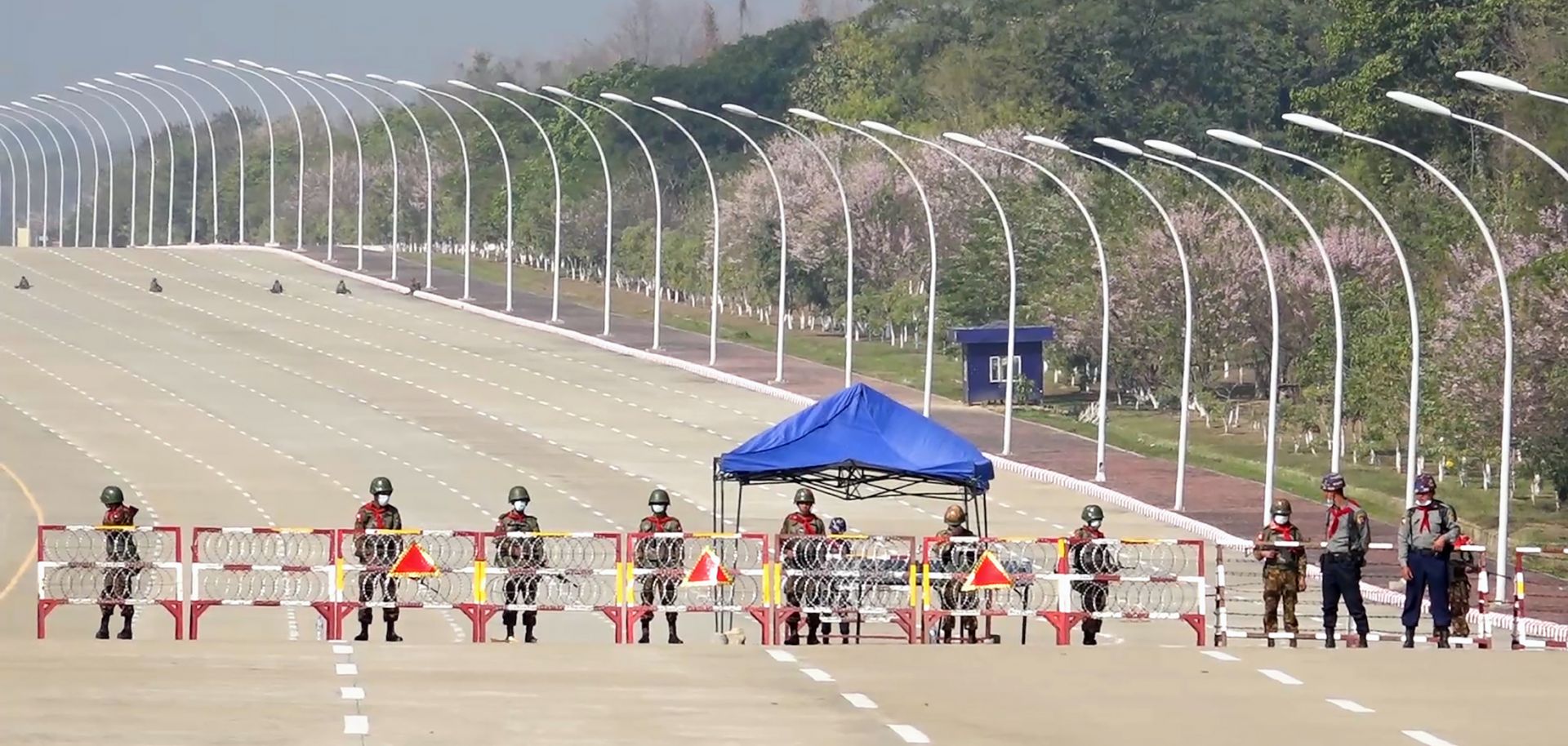
Soldiers stand guard on a blockaded road to Myanmar's parliament in Naypyidaw on Feb. 1, 2021, after the military detained the country's de facto leader and president in a coup.
Myanmar's military will use its recent coup to reverse the erosion of its political power and influence, with the pace of return to civilian control determining the reaction of global powers intent on limiting China's opportunities to strengthen its position in a regionally important country. On Feb. 1, Myanmar’s military, the Tatmadaw, announced a state of emergency under the constitution that will allow the commander-in-chief of the defense services to take on all executive, judicial and legislative powers. This followed the early morning detention of State Counsellor Aung San Suu Kyi, President U Win Myint and key National League for Democracy (NLD) officials nationwide. The military also suspended communications, bank access, flights and road travel in many areas.
- The takeover followed military allegations of “10 million” voting irregularities in November 2020 elections, which the Union Election Commission (UEC) ruled were free and fair on Jan. 28, allowing the Feb. 1 first sitting of the new parliament to proceed. Since Jan. 26, the military had been hinting at the prospect of a coup and reports emerged of unusual moves by security forces in key areas, including Yangon and Naypyidaw.
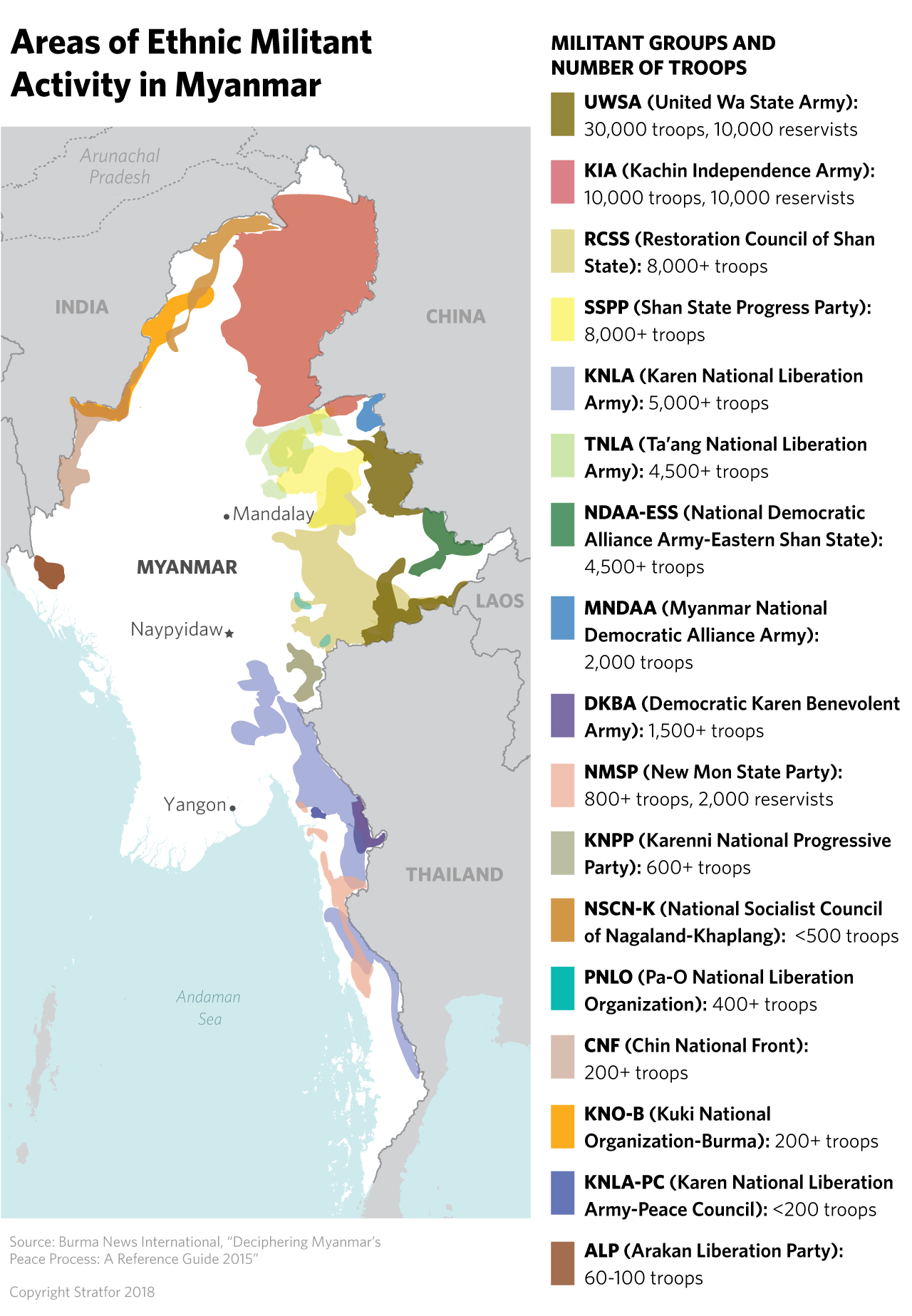
- On Feb. 1, the Tatmadaw said it will retain power for up to one year to focus on addressing election issues, curbing COVID-19 as well as restoring “eternal peace” in conflicts between ethnic militants and the government, saying that when these tasks have been completed it will hold a multiparty general election.
- The military carefully designed Myanmar’s constitution to enable it to take control as needed and limit civilian rule. Section 417-418 of the constitution contains a clause that essentially legalizes a coup by allowing the president to declare a state of emergency to prevent the “disintegration of the union.”
Myanmar’s military will leverage the coup to roll back a decade of electoral gains by civilian parties and limit their future power. Given the military’s already strong constitutional role, it may choose to do so without major disruptions, although its intervention will have long-term consequences for civilian power. A minimally disruptive course would likely see the military begin preparations for a fresh set of elections, while putting in place controls that limit protest activity and the NLD’s political prospects. This option is attractive in that it could avoid heavy international pressure by forging a clear path back to normalcy, while still chastening the NLD. The ongoing COVID-19 pandemic would also allow the military to justify delays in the polls as needed. A more costly course of action, however, would see the military abolish the constitution altogether to impose a new system that would allow a greater direct military hand in parliament, as in Thailand. A major public protest movement could provoke the military into a heavy-handed crackdown that could, in turn, push it toward this longer-term takeover scenario.
- Myanmar's military retains a constitutionally guaranteed 25% of parliament. But in recent years, its civilian proxy party, the Union Solidarity and Development Party (USDP), has lost significant ground to the NLD, which now has 82% of national and regional/state-level seats following back-to-back landslide victories in the 2015 and 2020 elections.
- On Feb. 1, the NLD released a pre-recorded video of Suu Kyi calling on the public to reject the coup and resist, raising the prospect of pro-democracy protests. Fear of the military and COVID-19 might deter turnout, eroding the NLD’s future credibility to threaten the military.
The reaction of key international players will hinge on how the military exercises control over the government, as well as the pace of restoration of civilian governance. If the Tatmadaw opts for a shorter, more clearly delineated timeline to reconstitute civilian control, the West will be more likely to prioritize outreach to military leaders to influence their timeline rather than trying to leverage overt pressure such as sanctions to restore an elected government. A severe crackdown or extreme systemic changes would be more likely to lead to isolation by the West and a stronger hand for China.
The United States will likely seek to retain ties with Myanmar’s government if the Tatmadaw opts for a shorter, more clearly delineated path back to civilian control. A severe crackdown or extreme systemic changes, however, could force Washington and other Western governments to isolate the country, opening the door for increased Chinese influence. U.S.-China competition will shape Washington’s response to Myanmar’s coup. President Joe Biden’s new administration may respond strongly to differentiate U.S. pro-democracy foreign policy against China's lack of such principles to appeal to citizens in countries around the world. Alternatively, Washington may adopt a pragmatic approach to keep China from building further inroads in Myanmar by maintaining its own economic and potential security ties with the country. Domestic pressure from U.S. human rights groups may be partly muted by Suu Kyi's complicity in the controversial crackdown on Myanmar’s Muslim Rohingya population, making the latter option more viable. Should it pursue a measured approach that prioritizes maintaining links with Myanmar, the U.S. government will likely ensure that any sanctions it imposes target only the military, just as U.S. sanctions over Myanmar’s Rohingya crisis did.
- The United States issued two strongly-worded statements in response to the coup on Feb. 1, saying reversals in Myanmar's democratization would bring a review of the repeal of sweeping sanctions over the past decade, threatening their reimposition.
- During the 2014 military coup in Thailand, the junta avoided draconian crackdowns. This enabled the United States to opt for relatively minimal economic sanctions without jeopardizing the majority of its assistance to the country.
China, meanwhile, will benefit from the complications that Myanmar's coup presents for the United States. Beijing has a long track record of adapting in Myanmar and gaining ground when Western influence wanes. China has managed to maintain good relations with both the NLD and military, as well as key ethnic minority parties and ethnic militant groups, giving it inroads regardless of the outcome of the current crisis. Beijing will quietly intervene where needed to avoid chaos. But its primary concern will be the continuity of its infrastructure projects, business interests and border security — all of which can be preserved by the military.
India will find itself caught between its own strategic focus on Myanmar, whose keystone position between China and the Indian subcontinent has only grown in importance amid New Delhi’s own mounting competition with Beijing. India has long struggled to exert influence in Myanmar given its inability to deliver major investment and trade on par with China. A strong U.S. response to the coup would see India caught these considerations and the need to support Washington’s regional agenda given the U.S. emphasis on India as a key partner against China.
