
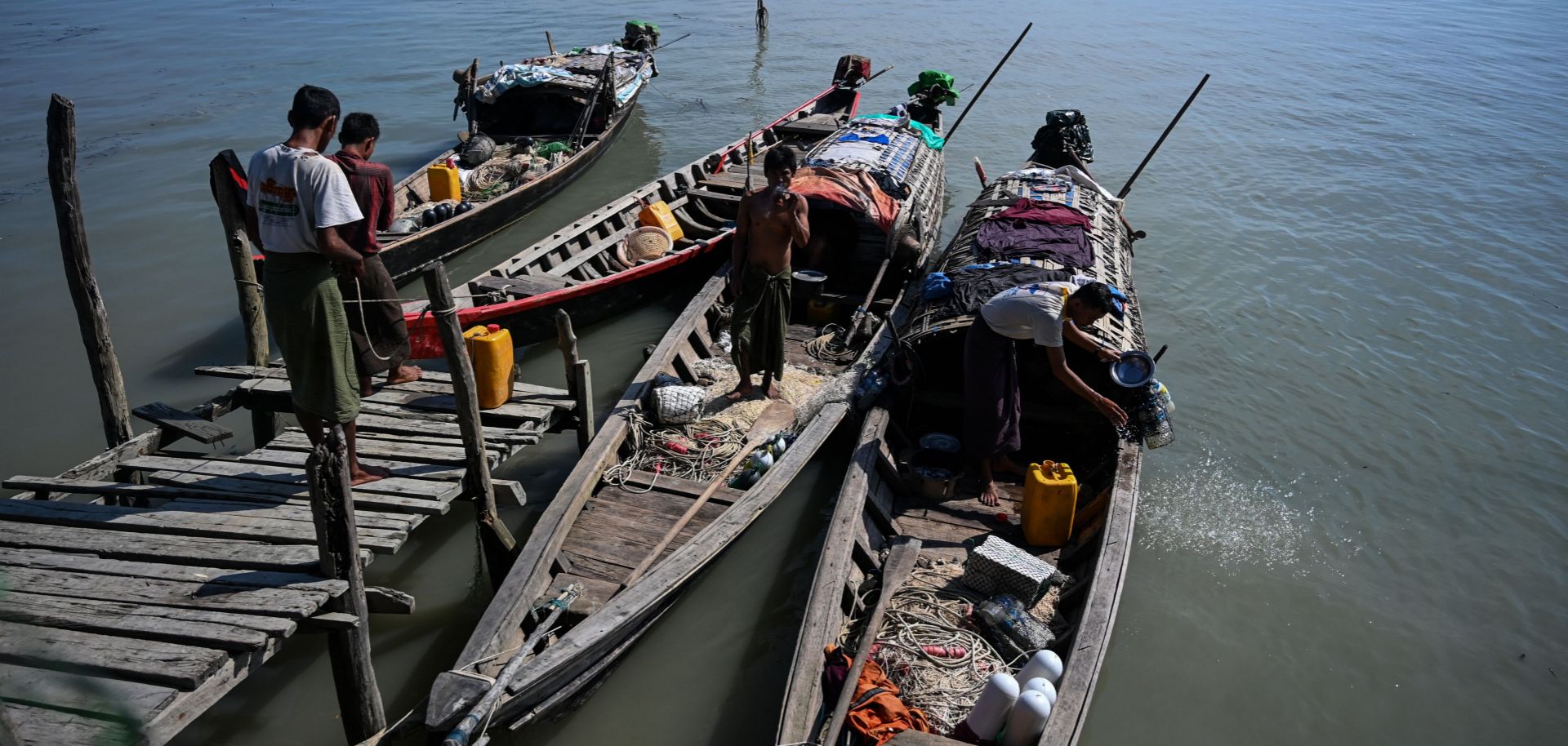
This photo taken on Oct. 2, 2019, shows fishermen boarding their boats at a small jetty on Made Island off Kyaukphyu in Myanmar's Rakhine state. Myanmar is somewhat wary about Chinese investments in places like Kyaukphyu, but there's little it can do to stem the tide.
For China, there's no time like the present to foster closer links with a key country on its frontier. Amid China's push for better transport connections, tighter border control and deeper energy security to the south, President Xi Jinping will begin a two-day visit to Myanmar on Jan. 17, during which time he is expected to sign investment deals for the planned Kyaukphyu Special Economic Zone along the countries' shared border and oil and gas pipelines. Moreover, Xi may also push to revive the $3.6 billion Myitsone dam project in the northern Kachin state.
Ultimately, as Beijing fends off challenges from Washington in its backyard, it will seek assurance from Naypyidaw that Myanmar will adhere to its commitment to China's Belt and Road Initiative and energy security as it heads to a general election later this year. Negotiations regarding the Kyaukphyu and Myitosone megaprojects have sparked significant concerns about China's looming presence — and its strategic intentions — in Myanmar, but the country may find its options to push back significantly curtailed. Indeed, with Myanmar facing Western isolation over its treatment of the Rohingya Muslim minority and struggling to forge national unity, China's assistance is more essential than ever if Naypyidaw is to fulfill some of its domestic priorities — namely, advancing a peace process with ethnic armies along the northern border, managing the Rohingya crisis and developing its weak economy. Such a situation, naturally, is bound to put China in prime position in the looming great power rivalry in Southeast Asia.
China Returns
In the five years since Myanmar's first democratic election in 2015, the world has soured on its leader, Nobel Peace Prize winner Aung San Suu Kyi, and her civilian government. To be clear, the country has made some strides on the economy, posting an average growth rate of 6.5 percent over the past five years thanks to a robust manufacturing sector, particularly its garment industry, and its success in attracting infrastructure investment from Singapore, China and Japan. Even so, Myanmar's performance has failed to match the early expectations for the country, particularly in light of its population of 20 million relatively young and inexpensive workers and abundant natural resources. Strikingly, the country's foreign investment inflow has continued to decline from a peak of roughly $9 billion in 2015 to just $5 billion in 2018 and 2019 — even at a time when total inflows to Southeast Asia have hit a record high thanks to shifts in manufacturing away from China amid the latter's trade war with the United States.
Most critically, the Suu Kyi government's inaction over the military crackdown on the Rohingya, as well as ongoing conflicts with ethnic insurgencies in the north, have seriously tainted the Nobel laureate's image. Ultimately, such unease — along with grave concerns about the country's difficult regulatory, financial and infrastructure environment — have continued to drive away Western governments and investors.
Enter Beijing. From 2015 until 2019, China accounted for an average of 22 percent of Myanmar's approved investments — putting it second to only Singapore — and nearly a third of the country's total trade. That level still trails China's share during the previous military regime, which allowed Beijing to greatly expand its interests and construct energy links, but it is a step up from the term of former President Thein Sein, who courted the West during his 2011-2016 term by halting some Chinese-led investment projects and ramping up offensives against China-linked ethnic insurgencies. And now that the United States and many European countries are giving Myanmar a wide berth, Naypyidaw has few options to find a counterbalance to the looming influence of its northern neighbor.
Growing Resistance?
Significantly, over the past five years, China has directed many of its Myanmar investments to large transportation and other infrastructure projects that will link China to the Indian Ocean as part of the China-Myanmar Economic Corridor, a segment of the Belt and Road Initiative. For China, Myanmar's location and direct access to the Indian Ocean is key to its strategy to diversify its sea routes and supply chains away from its crowded eastern and southern coasts — a goal that has become all the more important for Beijing as its relations with Washington have soured. China's projects include the 431-kilometer Muse-Mandalay railway project, the deep-water Kyaukphyu port on the Bay of Bengal, ongoing discussions about a 2,161-kilometer water transport route along the Irrawaddy River, as well as several large development zones. Of course, China is not the only one pursuing transportation and large development projects in Myanmar, as India, Japan and Thailand have also set their sights on the country, but the sheer size and scope of China's initiatives dwarf those of any other players in the country.
Naturally, China's activities in Myanmar are not without resistance. Some in the country have especially expressed worries that China could use its debt-financing approach to grab control of strategic assets like the Kyaukphyu port. Among the 38 projects that Beijing has proposed, Naypyidaw has approved only nine so far, while the Suu Kyi government has reduced the size of the Kyaukphyu port by nearly 80 percent and scored Myanmar entities a greater stake in the project thanks to U.S. assistance. Elsewhere, the Myitosone dam is likely to ignite significant protests among the Kachin peoples if Naypyidaw reopens the project after military authorities suspended it in 2011 amid local demonstrations. Without question, the long-term risks to Myanmar will increase the more China's presence in the country increases.
At the same time, China's close links to many of Myanmar's ethnic groups (both because many such communities also live in China and because Beijing historically cultivated ties with such groups to pressure past Myanmar governments) and its ability to mediate in the Rohingya crisis make it the key player to aid Naypyidaw's peace process and nation-building efforts. Such prominence, naturally, will help Beijing secure its economic interests and give it the political weight to shape Naypyidaw's behavior whenever necessary.
Securing Interests Where It Can
As the United States casts its eye toward the broader Indo-Pacific region, Myanmar's strategic value to China will only increase as Beijing's desires for energy security, extended corridor connectivity and border security intensify amid the various challenges to its power on its periphery. For now, Myanmar's disengagement with the West has put China on the front foot to extend its influence in a country that could be key in the great power rivalry in Southeast Asia.
China, however, won't necessarily have it all its own way in Myanmar. The country will head to the polls later this year for an election that could create uncertainty about Beijing's intentions. Until now, Beijing has safeguarded its interests by engaging with the country's different political stakeholders, which is one of the reasons why Xi will meet with several prominent politicians, including opposition figures and, critically, the head of the all-powerful military — China's erstwhile ally until relations soured under Thein Sein. Still, there is no guarantee such overtures will continue to bring success, given that Myanmar's fractured political scene means there will always be someone to raise questions about China's numerous projects in the country. Whatever the case, as Myanmar tries to rebuild some bridges with the international community, Beijing will be there to adjust its approach to make sure its southern neighbor remains on its side.
