
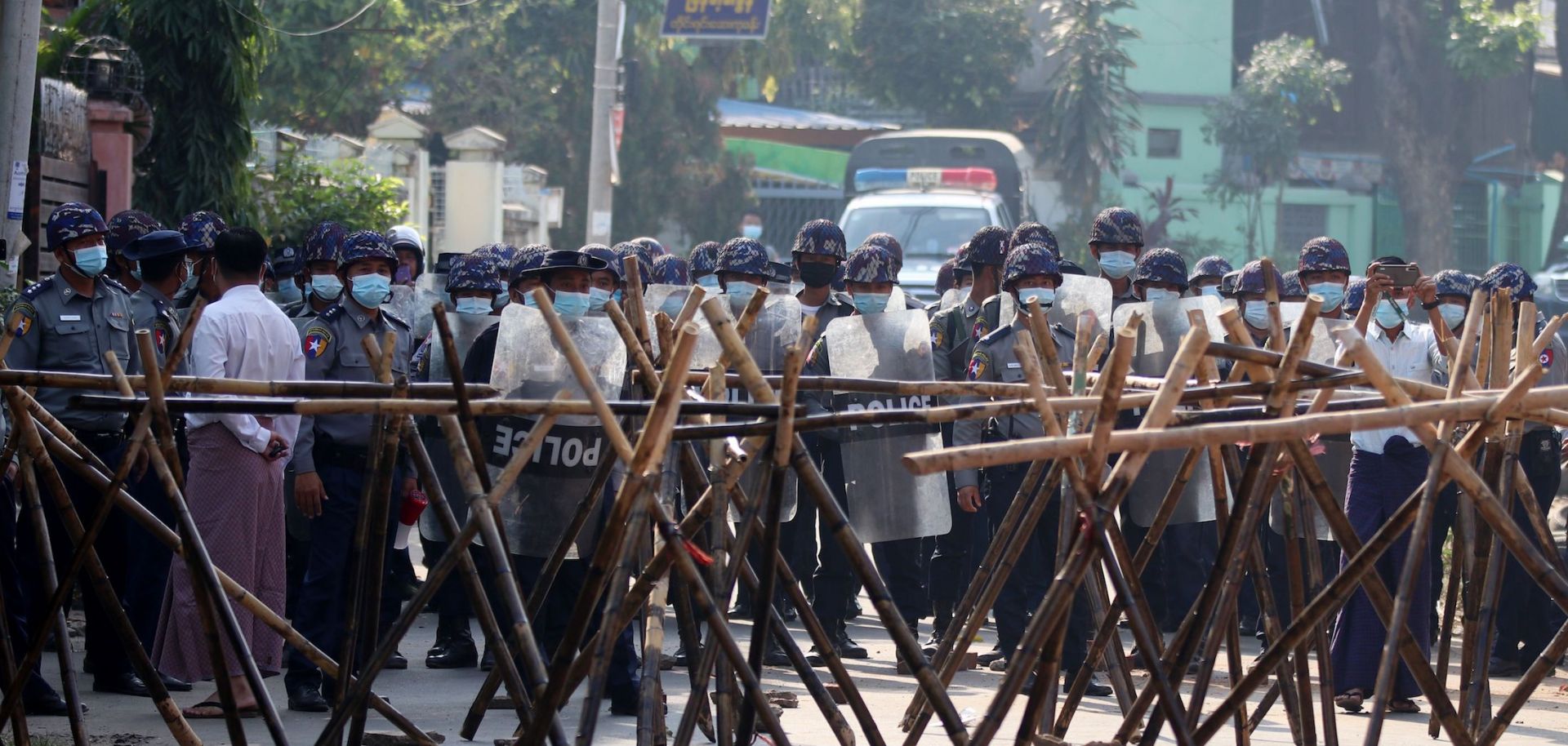
Riot police approach protesters' barricades in an attempt to disperse a March 4, 2021, demonstration in Naypyidaw, Myanmar, against the military coup.
Without the prospect of international cooperation, the United States is proceeding cautiously with pressure on Myanmar's military government in spite of a week of deadly crackdowns on anti-coup protesters. For now, it is stopping short even from imposing sectoral or deeper country-level trade restrictions, to say nothing of more aggressive financial sanctions, in order to keep Chinese influence in Myanmar from growing. On March 4, the U.S. Department of Commerce Bureau of Industry and Security (BIS) made two announcements regarding Myanmar:
- The BIS added Myanmar military-linked conglomerates Myanmar Economic Holdings Limited (MEHL) and Myanmar Economic Commission (MEC) to the Entity List, a trade blacklist, in addition to the country's Ministry of Defense and Ministry of Home Affairs. This addition will restrict the export and reexport of items and technology subject to the U.S. Export Administration Regulations, which cover a range of trade items, including telecommunications equipment, computers and aerospace equipment.
- The Commerce Department also moved Myanmar to Country Group D:1 of its trade license categories, subjecting any license application to a review if it involved exports or reexports to Myanmar of military-use goods subject to U.S. Export Administration Regulations, reverting to measures lifted in 2016 by the Obama administration.
Leaks also emerged March 4 that the United States blocked an attempt on Feb. 4 by the Myanmar junta to withdraw $1 billion in Myanmar government funds from the Federal Reserve Bank of New York's Central Bank and International Account Services, freezing these accounts automatically given the 2020 addition of Myanmar to the Financial Action Task Force's money laundering gray list.
China and Russia will continue to block any U.N. Security Council measures imposing meaningful sanctions on the Myanmar government, limiting the response by countries besides the United States. Any coordination at the international level outside of institutions would have to involve some level of coordination between the United States and the European Union in addition to consultation with South Korea, Japan and likely the Association of Southeast Asian Nations. Various possible measures are on the table, but Western countries and U.S. partners in Asia will hesitate to pursue such measures, particularly in the near term.
- On Feb. 28, U.N. Special Rapporteur to Myanmar Thomas Andrews called for the United Nations to push for a global arms embargo, sanctions on military-owned conglomerates and to invoke Chapter VII of the U.N. charter, which allows options that also include steeper sanctions and the intervention of the International Criminal Court.
- Andrews said March 5 that U.N. member states should sanction state-owned Myanmar Oil and Gas (MOGE), which holds minority stakes in the country's four large offshore natural gas fields (Yetagun, Yadana, Zawtika, Shwe) operated by Malaysia's Petronas, France's Total, Thai PTTEP and South Korea's Posco.
- Any U.S. (or broader) sanctions on MOGE would dramatically impact Myanmar government revenue. This particularly true if they hinder financial transactions with the state-owned enterprise, which sells into several markets, including Thailand and China, while also piping Middle Eastern oil into the Chinese interior. This is unlikely to materialize, however, until the United States has exhausted other options to further target the Myanmar military directly and broader trade.
- A Justice for Myanmar investigation alleged that U.S., Israeli and European firms had sold a range of dual-use digital tools to the Myanmar police and intelligence agency, including some that can be used to collect digital data, procure passwords, track signals, monitor social media and clone phones. This raises the possibility of a broader push against the sale of such dual-use technology.
The United States will continue to proceed cautiously in its pressure on the junta, calculating carefully before rolling out the sorts of expansive measures that would truly jeopardize foreign investment in Myanmar, which would include restricting U.S. dollar transactions. Such measures would risk pushing U.S. partners and Western companies completely out of the Myanmar economy, leaving China as nearly the sole player, as was the case before the 2010 transition to partial civilian rule. Further U.S. sanctions will likely come slowly and match the military's actions on the ground.
- These new unilateral U.S. measures fall short of barring transactions with or investment in these two military conglomerates, which have extensive reach throughout every sector of the economy and partnerships with foreign companies, particularly in consumer goods and mineral extraction.
- A 2019 U.N. Office of the High Commissioner for Human Rights report identified 14 foreign companies likely in joint ventures with MEHL, MEC or subsidiaries in addition to 44 others that likely have other commercial or contractual ties. Direct joint ventures included South Korean, Japanese, French-Swiss, Vietnamese and Singaporean companies in addition to numerous Chinese partnerships. The latter, larger group added Indian, Malaysian, Belgian, Thai and Taiwanese entities.
- While China is currently the dominant player in Myanmar's trade with 31.7% of the total, U.S. ally Japan plays a key role at 7.9% of Myanmar's exports, with the United States accounting for 4.6% and South Korea for 2.9%. Thailand is Myanmar's second-largest export destination at 17.9%, while a number of EU member states constitute a substantial portion as well, particularly Germany, Spain and the Netherlands.
