
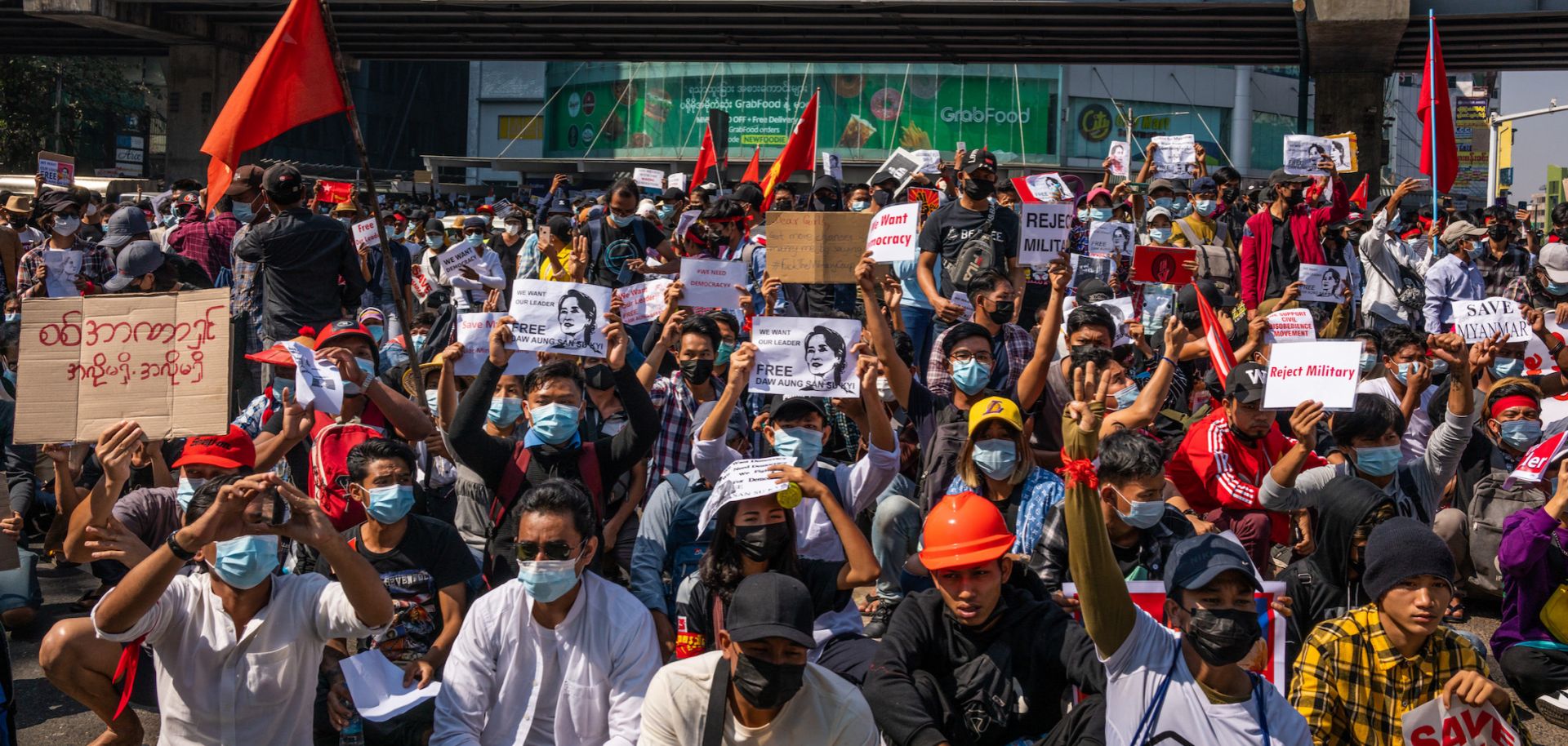
Anti-coup protesters wave red National League For Democracy (NLD) flags and raise three-finger salutes on Feb. 9, 2021, in Yangon, Myanmar.
Sustained anti-coup protests in Myanmar will compel the military to respond, raising the risk of a violent crackdown that would threaten the junta’s ability to legitimize its rule with international partners. After several days of low-level public defiance against the Feb. 1 military takeover, protests have escalated significantly across Myanmar beginning Feb. 6. On Feb. 7, tens of thousands of people reportedly took to the streets in Yangon. Demonstrations also broke out in the isolated capital of Naypyidaw that same day. As of Feb. 9, protests remain ongoing with no signs of easing back, and have now spread to most major cities and a number of smaller localities.
- Protesters are demanding a return to civilian rule and the release of National League for Democracy (NLD) detainees, including ousted State Counsellor Aung San Suu Kyi.
- Civilians from key sectors of the Myanmar economy and government have participated in the protests, including civil servants from several ministries, frontline medical workers, teachers, manufacturing sector workers and even workers from a China-backed copper mine.
Without the release of detainees or a concrete timeline for elections, Myanmar’s military will struggle to legitimize its takeover in the eyes of the public and, in turn, quell the unrest. Although authorities have responded in select cases with crowd-control measures and communications restrictions, they have not yet resorted to the violence deployed in the 8888 Uprising in 1988, the Saffron Revolution in 2007 or the copper mine protests in 2014.
- Police have used rubber bullets and water cannons to disperse protesters in Myawaddy on the Thai border and the capital city of Naypyidaw. The military also deployed uniformed soldiers in Yangon on Feb. 9 for the first time since anti-coup protests began.
- The military has declared martial law in many areas of the country, imposing an 8 p.m. curfew and banning gatherings of over four people in 10 states and regions, including Yangon. But despite these restrictions, protests have continued undeterred.
- On Feb. 6, the military imposed a nationwide internet blackout that lasted only one day. The junta has also ordered mobile networks and internet service providers in Myanmar to block Twitter, Instagram and Facebook in a bid to reduce the spread of protests.
- On Feb. 8, junta head Senior General Min Aung Hlaing made his first address since the coup, reiterating claims about fraud in the November elections and promising this military government would be different from others. He also repeated his pledge to hold fresh elections.
Myanmar’s military leaders will weigh the costs of a heavy-handed approach to the protests against the risk of either triggering U.S. sanctions or losing China’s support at the U.N. Security Council. The military will also consider the continued business response as non-Chinese foreign firms pull out of Myanmar amid the unrest.
- A heavy-handed military crackdown could compel the United States and other countries to quickly impose unilateral sanctions that expand beyond those targeted at specific entities or individuals, disrupting Myanmar’s economy.
- China has called for a “peaceful resolution” as it works to prevent a unified international response to the unrest in Myanmar. Beijing did, however, recently allow the U.N. Security Council to issue a rare statement on Myanmar’s internal political situation, which called for the release of detainees and expressed the need to support the country’s transition to democracy.
- New Zealand became the first country to suspend high-level military and political contact with Myanmar on Feb. 9 in response to the coup. New Zealand also imposed a travel ban on Myanmar military leaders and will reshape its aid program to prevent benefits to projects that benefit the military government.
- On Feb. 9, major Singapore investor Lim Kaling pulled out of a longstanding joint venture with the military-linked Myanma Economic Holdings Public Co. Ltd. (MEHL) in the country's near-monopoly Virginia Tobacco. This followed Japanese brewer Kirin’s Feb. 5 termination of its Myanmar Brewery deal with MEHL.
