
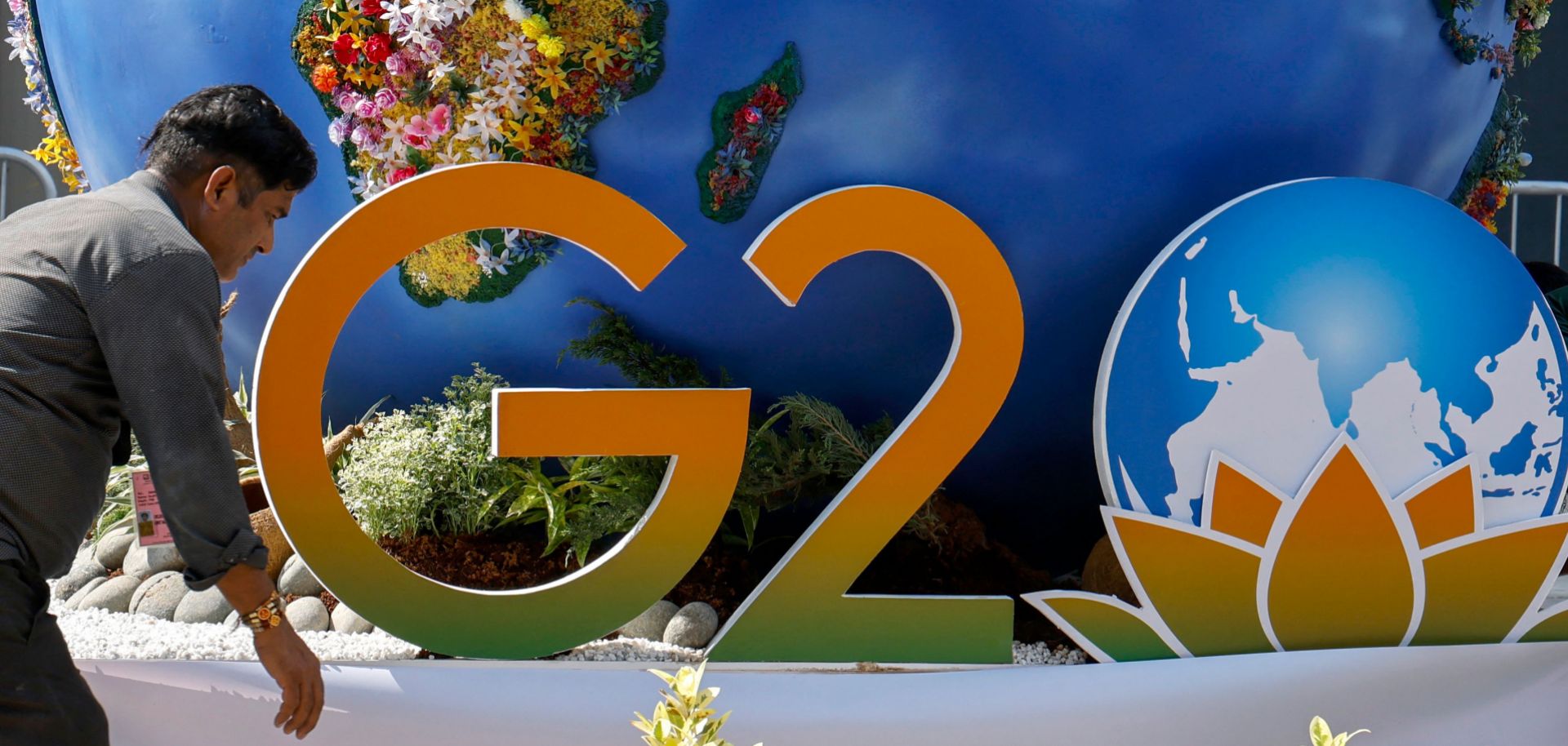
As the annual G20 summit takes place in New Dehli, India, from Sept. 9 to 11, geopolitical processes, a shifting world order and a disoriented G20 call into question the viability of the initiative's future. The G20 can trace its origins to two major crises. The 1997 Asian Financial Crisis compelled the G7 developed countries to recognize the growing importance of developing economies and led to the formation of the G20 as a meeting ground for finance ministers and central bankers. A decade later, the global financial crisis of 2007-2009 reshaped the G20 into a summit of national leaders, expanding its role and remit. In both cases, the interconnectedness of the global financial architecture and the rapid spread of economic challenges from one region to another provided the momentum for collaboration and collective action. However, the global economic disruptions triggered by the COVID-19 pandemic have not driven a similar reinvigoration of the G20. Although the group is considering expanding to include the African Union (AU) as a permanent member, the G20 is feeling the strains of a shifting global order.
Perhaps the most significant aspect of the G20 format was that it represented a recognition by the developed (in particular Euro-Atlantic) world that the global concentration of economic heft was diffusing and shifting. Global trade was shifting to the Pacific from the Atlantic, long the center of the global economic and financial architecture. The end of the Cold War, less than a decade before the Asian financial crisis, reinforced the belief in the West that the global financial architecture founded in the aftermath of World War II was not only victorious but universal. The Asian financial crisis didn't shake this belief but rather reinforced it, despite Western-inspired or directed reforms in part triggering the crisis and Western investor activities accelerating it. However, the developed West did take note that the growing diffusion of economic activity meant that distant crises could ripple back into Western systems. The G20 was one small step to mitigate that risk.
Despite serving as a forum for communication and cooperation among central banks and finance ministers, the G20 largely failed to anticipate or stave off the global financial crisis. What came out of that crisis (one that started in the developed West, not the developing East) was the establishment of a leaders summit as part of the G20 mechanism. The global financial crisis of 2007-2009 reinforced perceptions of the interconnectedness of the global economy and reawakened ideas of nationalism and protectionism, reviving talk of "geopolitics" as a driving force in a world that had been characterized as "flat." The leaders' summit reflected a reluctant re-acceptance of the political nature of economics and the role of international relations in international trade. It also showcased the rise of China and Beijing's alternative to the Western liberal order. As the G20 shifted its structure to include national leaders, China was showcasing its initial resilience to the crisis, thus challenging Western assertions of the necessary link between democratic freedoms, separation of government and business, and economic success. In short, China's economic success appeared to belie the universalist assertions of the Western liberal order.
As China shifted from its more passive "bide your time" model of global political relations to a more assertive proponent of the China model, the Western members of the G20 doubled down on the traditional Western liberal model — at least in rhetoric. At home, however, protectionist measures and national interests were finding increasing acceptance, not only as last-resorts in times of crisis but as policies to keep around well after a shock had passed. Whereas the G20 had been a case of the developing world recognizing the importance of the developed world and all parties seeing the risks inherent in a closed global economic system, the G20 did not really adapt to take into account the growing discomfort in the developing world with the extremes of Western liberalism, and the greater willingness of the developing world to challenge these norms. The G20 included developing nations, but it did so on G7 terms. Though the G20 recognized the developing world, it did not necessarily adjust its thinking to accept other ideas from the developing world.
The divisions in the G20 due to competing philosophies — China's economic success and the universalist assertions of the Western liberal order — are complicated even further by an inflating agenda, particularly since the inception of the leaders' summits. When it was founded, the G20 had a fairly narrow remit, but as time went on, it became a forum for numerous issues ranging from health to climate to local wars. The leadership summit becomes a convenient and enticing place to put political issues on the agenda and bring national or regional interests to leaders of more than three-quarters of the global economy. But in doing so, it becomes just another forum with a bloated agenda, in which common accord is growing more and more difficult to come by. The intended expansion of the G20 to include the African Union — understandable perhaps in the sense of expanding representation from Africa — may only add to the dilution of the G20's initial purpose, particularly as the AU has no central financial authority as compared to the European Union.
Yet it is not merely structural issues that impact the efficacy of the G20 — it is a shift in the global balance of power over the past quarter century and much of the organization's existence. The Asian financial crisis was an early sign of the interlinkages of the post-Cold War global economy. Still, it also should have been a reminder that geopolitical forces had not been erased by the West's "victory" over the Soviet Union. Instead, they became more pronounced as the semi-stability of the Cold War confrontation was shattered, and national and sub-national identities and competition broke out along the old seams between East and West. The shift in global trade and economic heft from the Atlantic to the Pacific was already underway when the G20 was founded, but that shift accelerated after the Asian financial crisis. The rise of China and the further diffusion of economic activity to the global south, as noted above, brought on a new wave of political, social and economic challenges to Western liberal universalism. Russia recovered but resorted to 19th century modes of action, invading its neighbors to stem any further slide of its peripheral states to the West. In short, the world changed and evolved, the brief moment of U.S. "unipolarism" faded, and national self-interest re-emerged. The world may have already passed the limits of extreme globalization; in the return to a more historically normal multi-polar world order, national interests are subsuming the incentives for global collaboration.
The G20 is not alone in feeling these stresses. Many of the institutions established after World War II are increasingly challenged by bloat, mission creep and the resurgence of nationalism and protectionism. These are slowly being supplemented or replaced by smaller, more focused or larger but more flexible arrangements, whether in opt-in trade arrangements like IPEF (Indo-Pacific Economic Framework for Prosperity) or restricted security collaboration like AUKUS, the trilateral security pact between Australia, the United Kingdom and the United States. And it is not only Western-inspired institutions that are starting to fray: expansions of the Shanghai Cooperation Organization or the BRICS both risk weakening entities that already had either radically evolved or poorly articulated purposes. Traditional geographic groupings, like ASEAN (Association of Southeast Asian Nations), the European Union, or Mercosur, also face internal frictions that challenge their ability to effectively coordinate and adapt to the shifting global balance of power. As countries and multilateral organizations adjust to multipolarity (or fail to do so), ideology may remain a strong talking point, but national self-interest will play a bigger role, making large-scale cooperation difficult.
The upcoming G20 summit in India highlights many of these growing problems for the organization. Chinese President Xi Jinping isn't attending, perhaps reflecting the strains between Beijing and New Delhi, between Beijing and Washington or reflecting the economic challenges China now faces (ones that will inevitably have global implications and thus would seem to be critical for a G20 discussion). The Russian President can't attend without threat of arrest, and the G20 is split internally on maintaining economic ties with Russia since the re-invasion of Ukraine, while the media is focused on what name New Delhi calls its country on the dinner invitations (India or Bharat). The AU is up for membership, and other countries are proposing joining the G20 (perhaps mirroring the rise in applications to join the BRICS), likely further diluting focus and the ability to reach consensus. If the lack of a G-20 collective response to the COVID-19 pandemic's economic impact is any indication, the organization may well be reaching its limits of effectiveness. Rather than being known for its international impact, it may be seen as little more than another international forum most valuable for its side-line meeting opportunities.
