
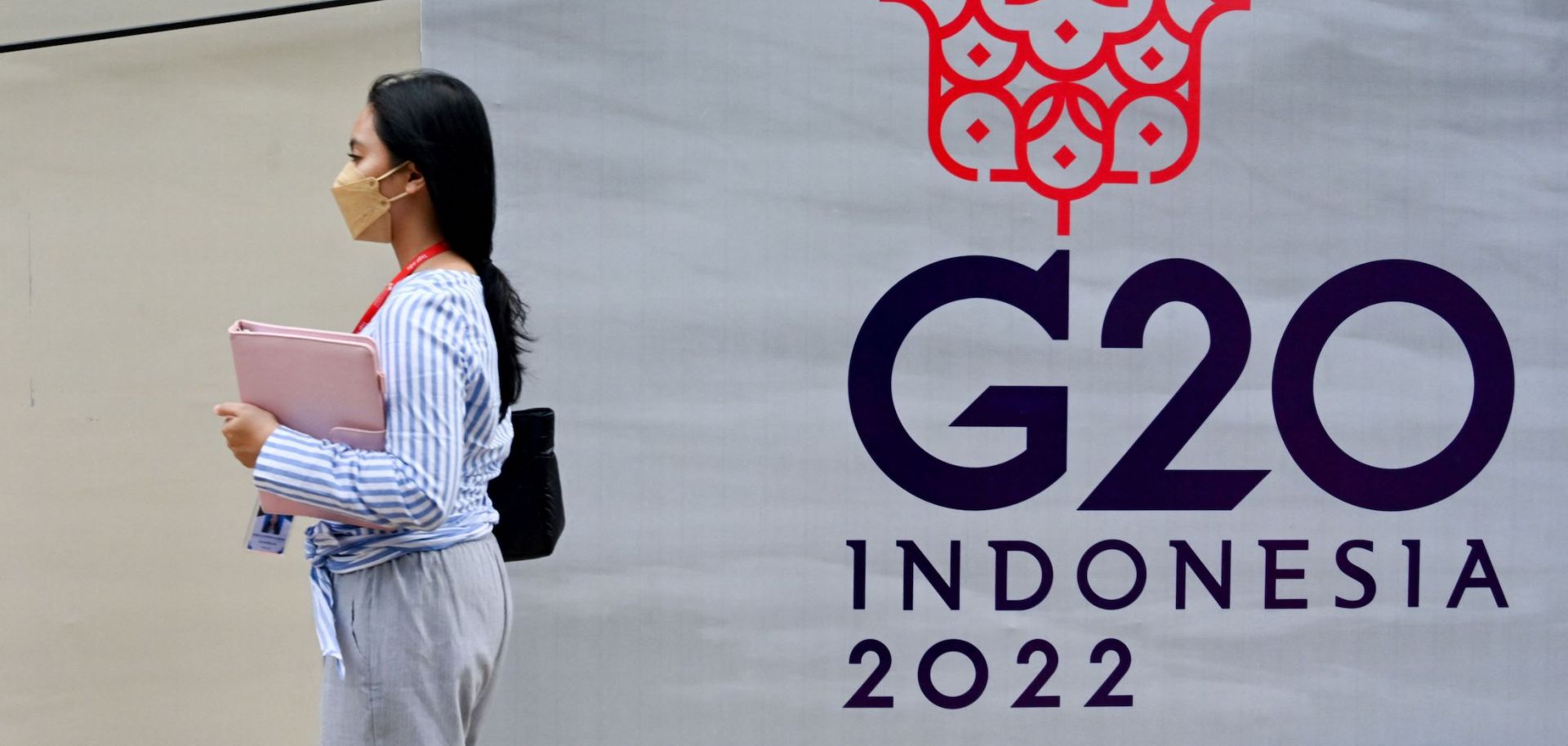
A woman in Jakarta, Indonesia, walks past a logo for the upcoming G-20 Summit in Bali on Nov. 8, 2022.
Indonesia will use its role as the host of the next Group of 20 (G-20) summit to position itself as a credible mediator in international conflicts, though deep-rooted geopolitical tensions will limit Jakarta's aspirations and result in only modest concessions for developing nations. Indonesia will host its first-ever G-20 summit in Bali on Nov. 5-16, marking a key milestone in the Southeast Asian country's push to take a more visible role in global political affairs. Under the theme of ''Recover Together, Recover Stronger,'' the agenda for the summit is primarily focused on economic affairs (including rising commodity costs) in the wake of multiple global crises, as well as health, technology and environmental issues. Leaders from rival Western and Eastern powers, however, will look to drive these conversations toward more immediate political issues, like the war in Ukraine and the growing rift between China and the United States. As the host of the 2022 G-20 summit, President Joko ''Jokowi'' Widodo's main challenge will thus be keeping discussions on-topic and cordial. If he can successfully bring leaders from feuding countries together for meetings and prevent escalatory disagreements, Jokowi will further the idea of his country being a potential mediator in international affairs — even if it is a minor role.
- Indonesia assumed the G-20 rotating presidency in December 2021. The country also assumed the chairmanship of the Association of South East. Asian Nations (ASEAN) in October.
Indonesia is hoping to come away from its G-20 summit with at least a minor leadership role in influencing global events, if not take a more substantial leadership role in influencing the development of the wider Southeast Asian region. Indonesia is the largest economy in Southeast Asia, as well as an important energy exporter and raw resource provider — making it a key figure in the global marketplace. But despite its economic influence, the island nation has been largely shut out from global political affairs. Jokowi's government has recently sought to change this by ramping up its high-level diplomatic meetings with world leaders, and by taking a more active role in mediating high-profile international issues (like the Ukraine crisis). Through hosting the upcoming G-20 summit and directing conversations between world leaders, the Indonesian president is hoping to further this diplomatic push and cement his country's place at the leadership table among other influential and powerful nations.
- Over the summer, Jokowi visited Kyiv on June 29, where he met with Ukrainian counterpart Volodymyr Zelensky, before traveling to Moscow the next day to meet with Russian President Vladimir Putin. During his June 30 conversation with Putin, Jokowi offered to deliver a message from Zelensky. While the details have not been made public, it was widely believed the message was related to the July 22 grain export deal Russia and Ukraine reached less than a month later.
- On July 26, Jokowi visited Beijing for a rare in-person meeting with Chinese President Xi Jinping, who is notoriously COVID-cautious. Xi hadn't met with a foreign leader in China since the Beijing Winter Olympics in February.
President Jokowi will work to prevent political discussions from derailing the economic focus of the summit. Both Putin and Zelensky are expected to attend the summit remotely via video conference, which will decrease the likelihood of diplomatic tiffs disrupting events (e.g. U.S. President Joe Biden and other Western leaders boycotting meetings where Putin is present). This will help Jokowi prevent discussions from straying too much from the three official pillars of the summit (and Indonesia's G-20 presidency): global health architecture, sustainable energy transition, and digital transformation.
- Jokowi resisted U.S. pressure to disinvite Russia from the G-20 summit, saying that all member states were welcome to attend.
- On June 29, Ukrainian President Zelensky tentatively accepted Jokowi's invitation to the summit, but stressed his attendance would depend on developments in his country's ongoing war against Russia and whether Putin would also be in attendance.
- During meetings on the sidelines of the summit, Biden will still try to convince leaders of the G-20 countries that have so far taken a neutral diplomatic stance on the Ukraine war (like Turkey and South Africa) to join the West's sanctions campaign against Russia or take part in a price cap on Russian oil. Such informal talks, however, are unlikely to derail the official group meetings or discussions held during the upcoming summit.
Indonesia will likely be able to secure additional U.S. and Chinese investments for infrastructure and healthcare initiatives, but getting Beijing and Washington to cooperate on greater global issues will prove difficult. After nearly three years of battling COVID-19, Indonesia and other developing nations are in dire need of financial investments to bolster their pandemic response and severely strained healthcare systems. While richer countries (barring COVID-wary China) have largely ''returned to normal,'' many poorer nations are still struggling to contain the virus due to challenges in accessing and distributing vaccines. This will drive Jokowi to seek more guarantees from the largest and wealthiest countries to overhaul and modernize healthcare infrastructure in the developing world. The United States, China and European countries are unlikely to pour as many resources into the global fight against COVID-19 as they did in 2021, when there were more concerns about the emergence of new, potentially vaccine-resistant variants in the world. But while Jokowi will likely secure some infrastructure and region-specific investments from these wealthier nations during the summit, U.S.-China tensions mean that any new commitments from Washington and Beijing will come as separate competitive offers. This will effectively force Indonesia to weigh the pros and cons of each investment action. The United States and China's increasingly bitter rivalry will also leave little room for cooperation between the world's two largest economies on major international issues, like setting digital security standards.
- Large Chinese infrastructure investments are usually state-led, entailing closer political ties with Beijing. U.S. investments, by contrast, often have fewer political strings attached since they're typically spearheaded by the private sector (but this also makes U.S. investments less streamlined and directed compared with those from Beijing).
- Only 68% of Indonesia is fully vaccinated against COVID-19, despite the country receiving large quantities of donated vaccines. This is due to poor healthcare infrastructure and the fact that many Indonesian citizens live in remote, difficult-to-access areas that are spread out across the country's archipelago.
If Indonesia succeeds at keeping the summit's agenda on track, it will strengthen its position as a growing player in the global political system. To prevent friction between China and the United States from derailing the summit, Jokowi may give speakers leeway to discuss their own plans for achieving economic and developmental goals, while requesting that leaders refrain from calling out other nations by name. This statecraft practice will enable Jokowi to present Indonesia as a viable non-aligned party capable of mediating significant international disputes. If Jokowi fails in his leadership push at the G-20 summit, Indonesia will be forced to continue its ''follower'' role in global politics for the foreseeable future. But if he is successful, the Indonesian president will be able to further prove his country's worth as a viable intermediary that can help facilitate negotiations between Russia and Ukraine, as well as opposing parties in other international disputes.
