
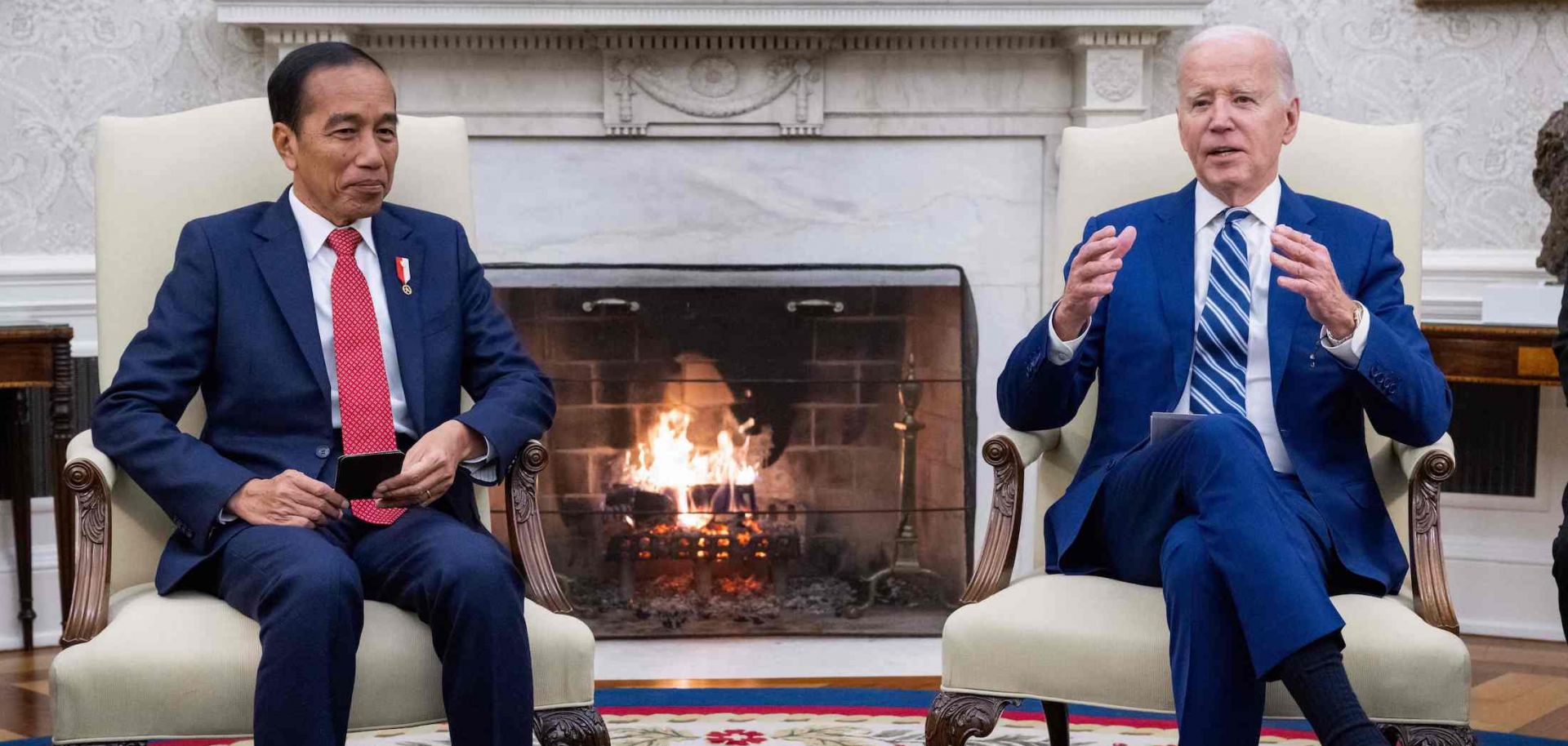
Upgraded ties between the United States and Indonesia will open the door to more robust critical mineral trade and deepen defense cooperation, but U.S. concerns about the quality of Indonesian nickel and the country's commitments to environmental, social and governance standards, as well as Jakarta's desire to balance between Washington and Beijing, will impose an upper limit on collaboration. On Nov. 14, U.S. President Joe Biden and Indonesian President Joko ''Jokowi'' Widodo met at the White House where they upgraded ties to a ''comprehensive strategic partnership,'' Indonesia's top-tier diplomatic relationship. The elevated ties will focus on climate, energy, digital connectivity and defense, per the two countries' Joint Statement. The two sides also agreed to begin discussions to ''develop a critical minerals action plan'' primarily geared toward using Indonesian nickel and cobalt for green energy use and will soon issue a memorandum of understanding between the U.S. State Department and Indonesia's Ministry of Energy and Mineral Resources on the matter. On the defense side, Indonesia and the United States agreed to hold biannual formal meetings between senior defense officials under the auspices of a newly signed Defense Cooperation Arrangement; Biden and Jokowi also signed a Work Plan on Maritime Security Cooperation.
- Jokowi was in Washington ahead of the Asia-Pacific Economic Cooperation summit in San Francisco, which runs from Nov. 15-17.
- During the visit, Indonesia's state-owned energy conglomerate Pertamina and U.S. oil majors Chevron and Exxon Mobil signed a $2 billion carbon capture and storage agreement, highlighting growing business ties between the two countries.
- Indonesia also has ''comprehensive strategic partnerships'' with China, Australia, India, Russia and South Korea. Indonesia upgraded its ties with Japan to a ''strategic partnership,'' or second-tier status, in September.
The move to elevate relations is in line with both countries' foreign policy priorities and economic strategies as each looks to diversify defense and trade partners. The agreement is the latest in a series the United States has inked to upgrade its ties with countries in the Indo-Pacific, including Papua New Guinea and Vietnam, in Washington's quest to counter Chinese influence and contain it militarily. Washington is also looking to de-risk supply chains from China by diversifying trade partners, particularly in critical minerals needed for green technology. Additionally, the United States is seeking to curb Chinese influence in Indonesia and China's dominance in some of the country's economic sectors, like nickel, by entering as a competitor in the market. For Indonesia, the visit to Washington marks the latest stop in Jokowi's quest to secure more supply chain partners to invest downstream in Indonesia's natural resources ahead of the end of his presidency in November 2024. In one of his signature policy moves, Jokowi banned exports of raw nickel and bauxite in January 2020 and June 2023, respectively, forcing investors to invest in smelting and refining in-country. Indonesia will also ban exports of other raw natural resources, starting with copper in May 2024, and raw cobalt, tin, palm oil and coal could be banned next, as Jokowi — as well as his eventual successor — keep pushing resource nationalism policies that aim to move Indonesia up the value chain by selling refined products rather than raw ore.
- Indonesia holds the world's largest reserves of nickel, a mineral critical to producing electric vehicles, green energy and various space and military equipment. The island nation also has the world's third-largest reserves of cobalt, a key component in lithium-ion batteries.
Elevating ties will eventually help streamline critical mineral supply chains that will facilitate trade in refined nickel and cobalt, but the absence of a free trade agreement and U.S. concerns about Indonesian nickel quality, as well as Indonesia's labor and environmental standards, will likely result in lengthy negotiations that curb the potential for cooperation. Indonesia and the United States will first commit to developing an action plan that will eventually increase investment in both countries' critical minerals sectors and create jobs to that effect, but this will face challenges. For example, Jokowi's government has been looking to sign a limited free trade agreement with the United States in order for Indonesian EVs to be eligible for consumer subsidies under the Biden administration's 2022 Inflation Reduction Act (IRA), similar to the U.S.-Japan Critical Minerals agreement signed in March. But this has not transpired. The two sides could revisit a trade pact in the future, but some U.S. business interests and lawmakers will oppose this on the grounds that it would not grant U.S. exporters any market access and, since much of Indonesia's critical minerals are mined and refined by Chinese companies (a result of billions of dollars in investment the past two years), the pact would not facilitate profits for the companies. Additionally, critics have warned that inking a trade deal with Indonesia would take away opportunities for U.S. critical mineral mining operations. Indonesia is also known for substandard labor rights and worker safety, as well as severe environmental degradation caused by the Indonesian nickel industry, such as deforestation and polluted groundwater. Though Indonesia will likely endeavor to reform some of the most basic areas of concern (such as occupational safety), these challenges will nonetheless be off-putting to some U.S. manufacturers and lawmakers, whose support would be needed to sign a free trade deal. The quality of Indonesian nickel is a concern as well and, from Washington's perspective, ties into the issue of Chinese investment. Most of Indonesia's nickel is graded Class 2, a low-purity type used for stainless steel, rather than Class 1 nickel, which is higher in purity and more in demand for producing EV batteries. Indonesia says it is committed to reforming its nickel industry to more readily meet rising demand for Class 1 nickel, but this process has stalled, likely because deemphasizing Class 2 nickel would cause outsized harm to China's stainless steel sector, which relies on Indonesian nickel, and Indonesia's profitable nickel industry would suffer amid lengthy reforms. Moreover, much of Indonesia's critical mineral mining and refining take place on outlying islands where there is little government oversight, thus presenting a safety risk. To be sure, U.S. economic and strategic imperatives to counter China and access critical raw materials will likely make the White House and Congress willing to compromise on some of these issues – especially if Jakarta passes some industrial sector reforms. But U.S.-Indonesia trade negotiations could prove lengthy, with some issues possibly irreconcilable, representing a constraint on immediate collaboration.
- On Oct. 25, a bipartisan group of nine U.S. Senators issued a letter opposing establishing a limited free trade agreement with Indonesia. The letter cited environmental and labor concerns, as well as fears that such a deal would deny business to U.S. mining companies in favor of foreign entities.
- The IRA provides up to $7,500 in consumer subsidies if the purchased EV has at least 50% of its battery components produced in North America and if 40% of the critical minerals (such as nickel and bauxite) were extracted, processed and/or recycled in the United States or in a country with which the United States has a free trade agreement.
- The United States foresees Indonesian critical minerals as being essential for green energy potential, which is 3,600 gigawatts according to Jokowi, in addition to EVs.
- The two countries do have an existing trade mechanism, the U.S.-Indonesia Trade and Investment Framework Agreement, but it falls short of a free trade agreement. The critical minerals action plan will be negotiated in the context of that agreement.
Despite deepened U.S.-Indonesian military ties aimed to curb Chinese influence, Jakarta will continue to hedge between the two powers, limiting the scope of increased U.S. military cooperation with Indonesia. In the coming years, Washington will continue pursuing deepened relations with Indonesia, which is the world's third-largest democracy and tenth-largest economy. As the United States endeavors to curb Chinese influence in the region and contain it militarily, Indonesia's geopolitical importance is also only set to grow — especially when considering the country's strategic geography, which contains or is adjacent to numerous critical chokepoints, such as the Malacca and Lombok straits. The United States and Indonesia already collaborate closely in maritime security and defense, and the defense aspect of upgraded ties via the new Defense Cooperation Arrangement will increase trust and communications between the two militaries by formalizing deeper cooperation on specific tactical issues such as counter-terrorism, cybersecurity, nuclear threats and outer space, while encouraging systems interoperability. Meanwhile, the Work Plan on Maritime Security Cooperation will enhance Indonesia's ability to counter illegal, unregulated and unreported (IUU) fishing, which has long been an issue in Indonesia's vast maritime space, with China being the primary culprit of IUU fishing. However, Jakarta will still seek to remain neutral in the escalating U.S.-China great power competition in an effort to preserve both its diplomatic flexibility and deep economic ties with China. While President Jokowi will leave office at the end of 2024, the three frontrunners vying for his position have all vowed to maintain Indonesia's long-standing non-alignment foreign policy, indicating that the emphasis on hedging between the United States and China will continue. So while U.S.-Indonesia defense cooperation will continue to deepen in targeted areas that boost specific capabilities, Indonesia will not lean fully into the U.S. geopolitical camp that seeks to contain China. This means Jakarta will not allow U.S. forces to base in the country, nor will it pursue antagonistic policy toward Beijing, despite the two Asian countries' territorial dispute over the Natuna Islands. This contrasts with the Philippines — another Southeast Asian country deepening military ties with the United States — in that Manila has agreed to host a sizable U.S. military presence and has pursued an assertive policy in defending its territorial claims against China's.
- All three of Indonesia's presidential contenders have indicated a commitment to foreign policy continuity after Jokowi leaves office in November 2024. Frontrunner Subianto Prabowo publicly reiterated this commitment on Nov. 14 as Jokowi was meeting with Biden.
- During their recent meeting, Jokowi also pressed Biden on the Israel-Hamas war in Gaza — a political necessity for the leader of the world's most populous Muslim country. But the upgrade in ties demonstrates that Washington's broad support for Israel will not be a serious constraint on U.S.-Indonesia relations.
